This content introduces key concepts in health and gerontology, including definitions of health, illness, and disease, the determinants of health, and strategies for health promotion and disease prevention. It also touches upon the role of gerontological nursing in facilitating healthy aging.
As the global population undergoes a "gerontological explosion," the healthcare landscape is shifting. With the proportion of people aged 65 and older steadily increasing due to low fertility rates and higher life expectancy, understanding the nuances of health and aging is more critical than ever. For nursing professionals, who represent the largest group of human health resources in the Canadian healthcare system, the goal is not merely to treat illness but to facilitate healthy aging and maximize well-being.
Defining Health, Illness, and Disease
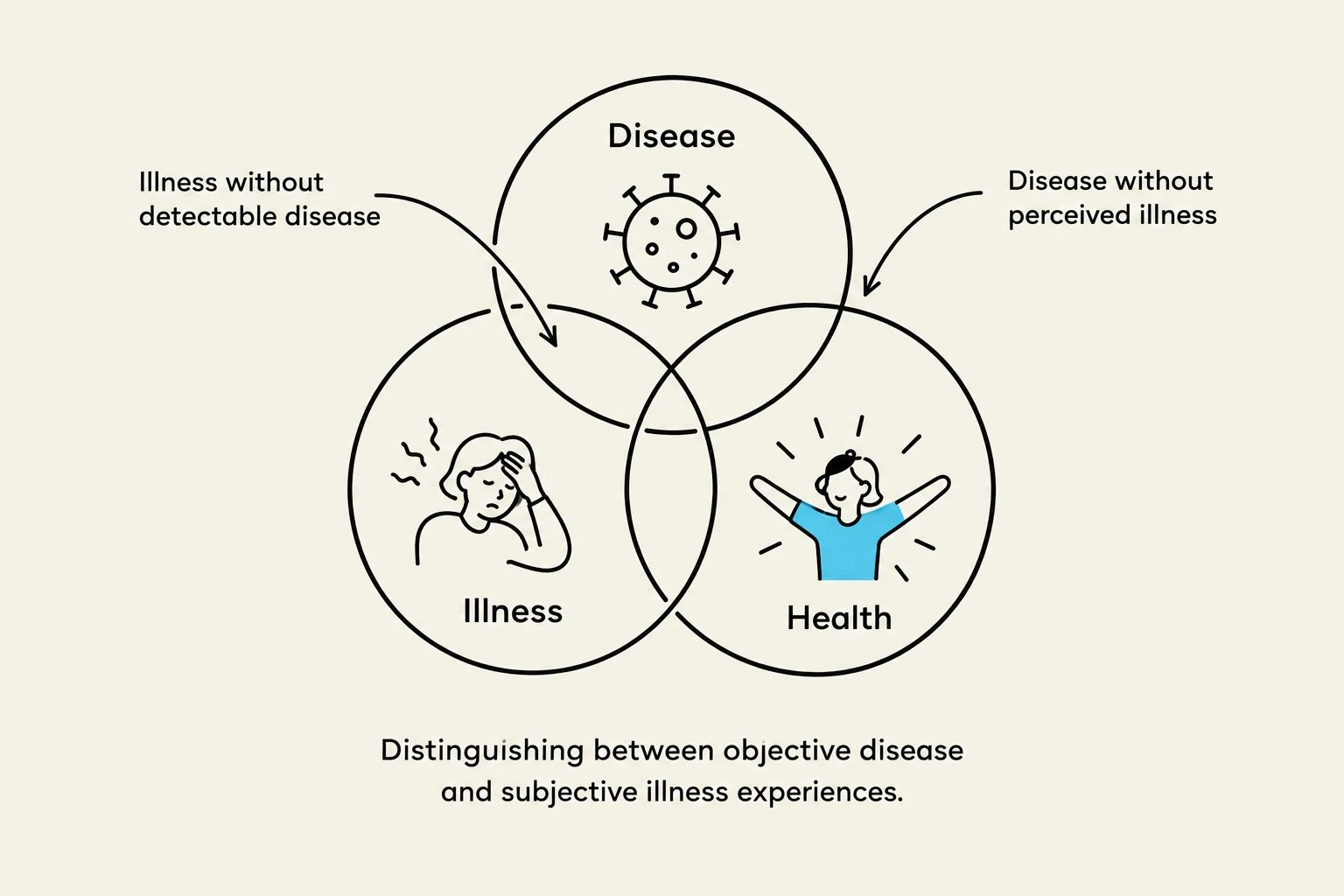
This diagram illustrates the distinction between objective disease and subjective illness experiences, showing three overlapping circles for Disease, Illness, and Health.
To provide effective care, one must first understand what it means to be "healthy." Modern definitions have moved away from a purely medical model toward a more holistic perspective.
Health is defined as a state of complete physical, mental, and social well-being, rather than merely the absence of disease or infirmity. It is viewed as a positive concept—a resource for everyday living that enables individuals to realize their aspirations, satisfy their needs, and cope with their environment.
It is essential to distinguish between three often-confused terms:
Health: A positive state of well-being and resourcefulness.
Illness: A subjective, personal experience of the loss of health.
Disease: An objective, pathological state of ill health that can be detected through medical science.
Study Tip: Think of the difference as subjective vs. objective. A patient may feel "ill" (subjective experience) even if medical tests cannot find a specific "disease" (objective pathology).
The Determinants of Health (DOH)
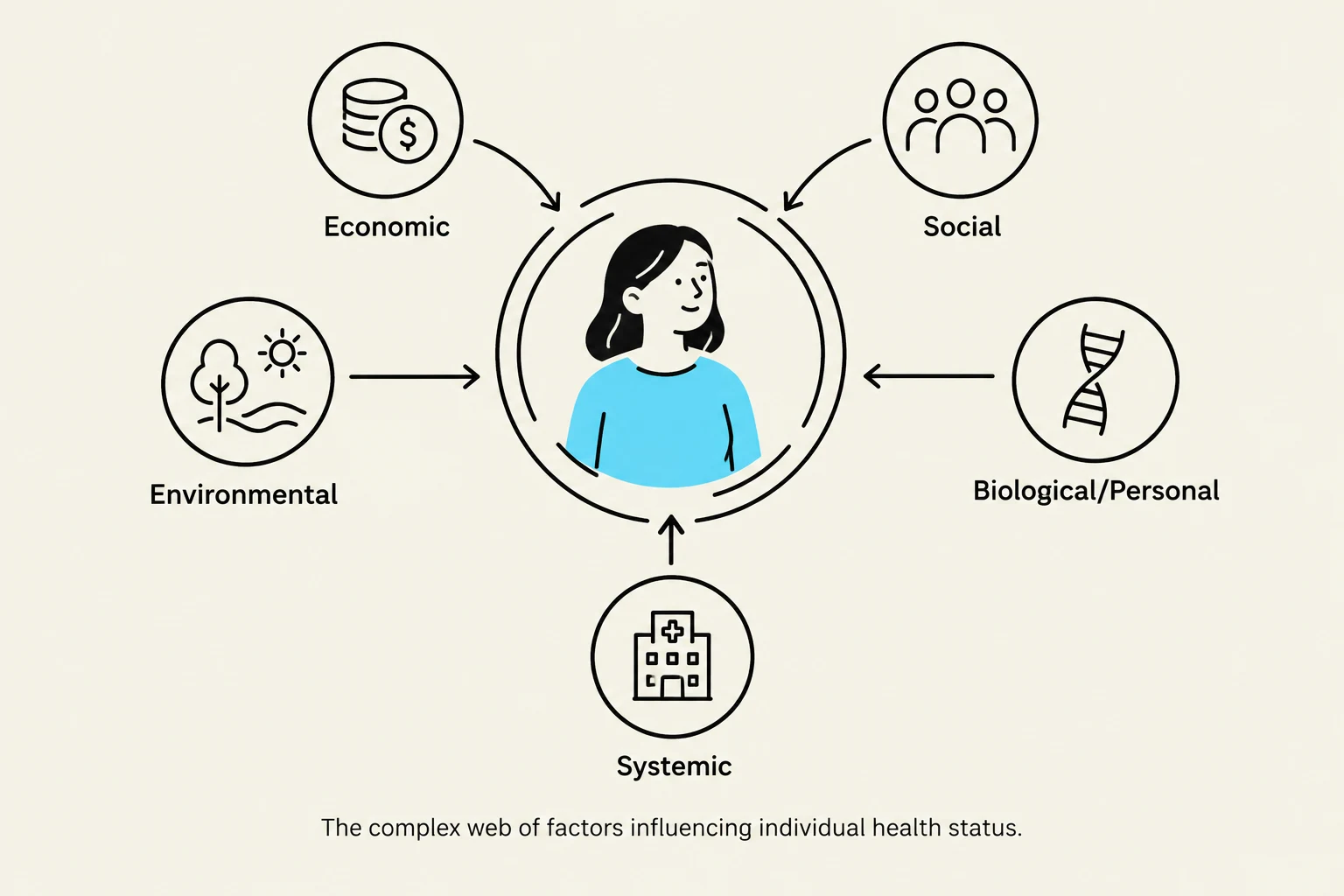
A diagram illustrating the multifaceted influences on an individual's health, including economic, environmental, social, biological/personal, and systemic factors.
Health does not exist in a vacuum. It is shaped by a complex web of factors known as the Determinants of Health (DOH). In Ontario, 17 recognized factors influence the health status of the population. These include:
Economic factors: Income and income distribution, employment, and job security.
Social factors: Social support networks, social inclusion/exclusion, and education, literacy, and skills.
Environmental factors: Physical environments and housing.
Biological and personal factors: Gender identity, Indigenous status, disability, and personal health practices/resiliency.
Systemic factors: Access to health services, food security, and globalization.
The Population Health Promotion Model suggests that an individual's health status is the result of the interaction between their personal health practices and their social and physical environments. Therefore, achieving health for all requires addressing these determinants through social justice and health equity.
Strategies for Health Influence: Promotion vs. Prevention
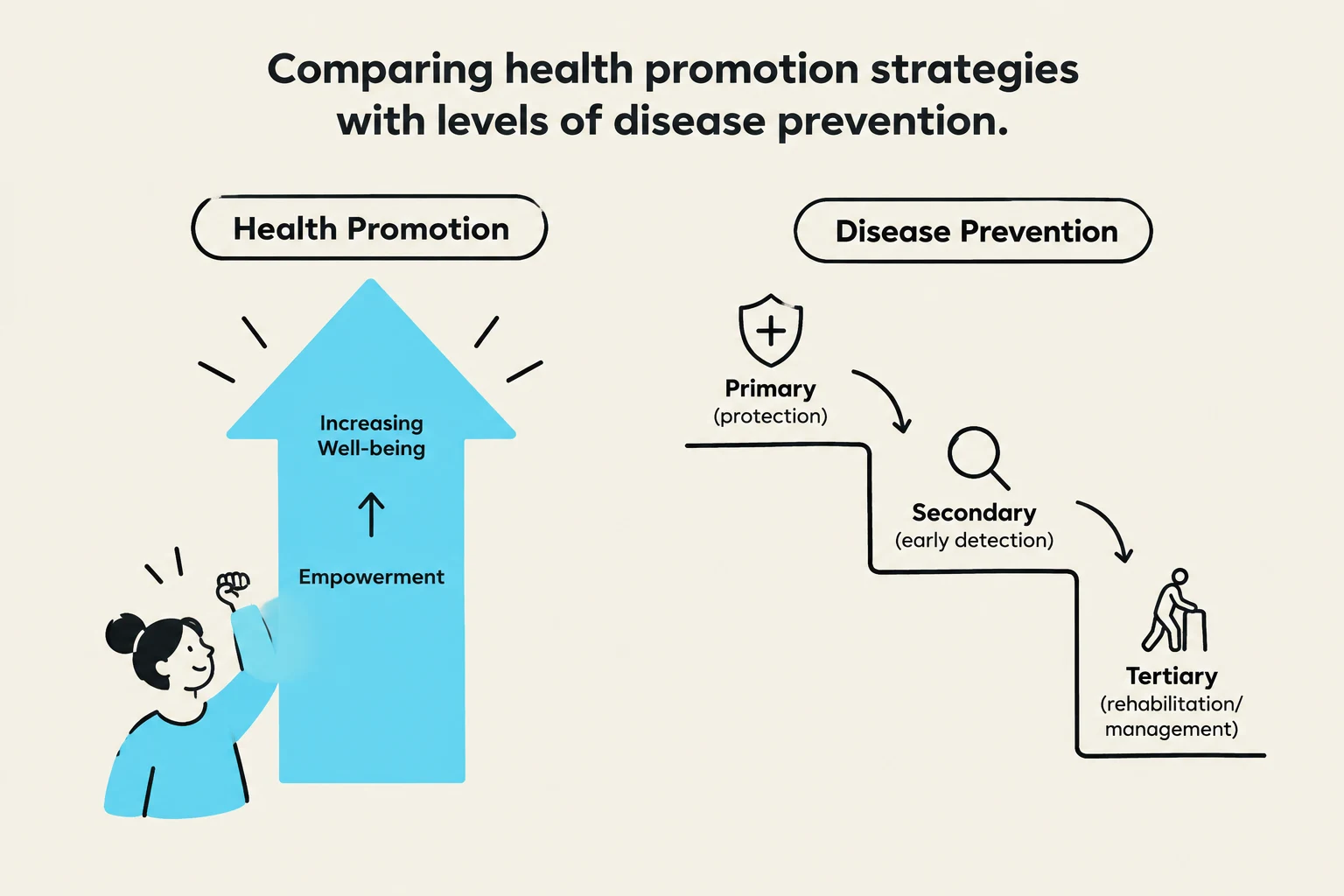
This diagram compares health promotion strategies with levels of disease prevention, illustrating how health promotion aims to increase well-being and empowerment, while disease prevention is categorized into primary (protection), secondary (early detection), and tertiary (rehabilitation/management) levels.
To improve health outcomes, healthcare providers utilize two distinct but complementary strategies: Health Promotion and Disease Prevention.
Health Promotion
Health promotion focuses on increasing a person's level of well-being and self-actualization. It is about empowering individuals and communities to gain control over their health. The Ottawa Charter provides five essential strategies for this:
Building healthy public policy.
Creating supportive environments.
Strengthening community action.
Developing personal skills.
Reorienting health services.
Disease Prevention
While promotion focuses on "moving up," prevention focuses on "avoiding". Prevention is categorized into three distinct levels:
Level
Focus
Example
Primary
Protection against disease before symptoms appear.
Immunizations, smoking cessation programs.
Secondary
Activities focused on early detection of disease.
Cancer screenings, blood pressure checks.
Tertiary
Interventions during the convalescence stage to prevent progression.
Rehabilitation after a stroke, chronic disease management.
Upstream vs. Downstream Approaches
A vital concept in public health is the direction of intervention.
Downstream Approach: This focuses on treating the symptoms or the disease after it has already occurred (e.g., treating a patient for a respiratory infection).
Upstream Approach: This focuses on addressing the root causes of health issues (e.g., improving air quality or housing conditions to prevent respiratory issues in the first place).
Effective health management strives to move "upstream" to tackle the determinants of health before they manifest as clinical diseases.
The Role of Gerontological Nursing
As Canada's population ages—with nearly one in five Canadians now aged 65 or older—the role of the nurse becomes increasingly specialized.
Gerontological nursing is not just about managing the decline associated with age; it is about facilitating healthy aging. This involves:
Assessment: Helping older persons explore the underlying situations (social, physical, or emotional) that may interfere with their wellness.
Collaboration: Working with the older person to develop and implement personalized plans.
Interprofessionalism: Engaging in intersectoral collaboration to improve access to services and promote health.
By incorporating the principles of Primary Health Care—such as accessibility, public participation, and intersectoral collaboration—nurses can help older adults achieve the highest possible level of wellness.
Summary for Practice: Remember that wellness is a balance between internal and external environments, including emotional, spiritual, social, and physical processes. Your role is to support that balance across the entire lifespan of the older adult.
Keep reading for free.
Create an account to finish this reading and make it part of your study routine.