This article explains fundamental genetic vocabulary, including genes, alleles, genotype, phenotype, and zygosity (homozygous and heterozygous states), with worked examples.
Understanding genetics begins with mastering a specific language. While we often talk about "traits" or "genes" in everyday conversation, biological science requires precision to describe how information is stored, passed from parents to offspring, and expressed in a living organism. This article breaks down the fundamental vocabulary of classical inheritance, moving from the microscopic level of alleles to the observable level of phenotypes.
The Building Blocks: Genes and Alleles
At the heart of genetics is the gene, a specific sequence of DNA that provides the instructions for building a protein or performing a function within a cell. However, genes do not always produce the exact same result in every individual. This variation is due to alleles.
An allele is a specific version or variant of a gene. Think of a gene as a category (e.g., "Eye Color") and an allele as a specific option within that category (e.g., "Blue" or "Brown"). Every organism inherits two alleles for each gene—one from each biological parent.
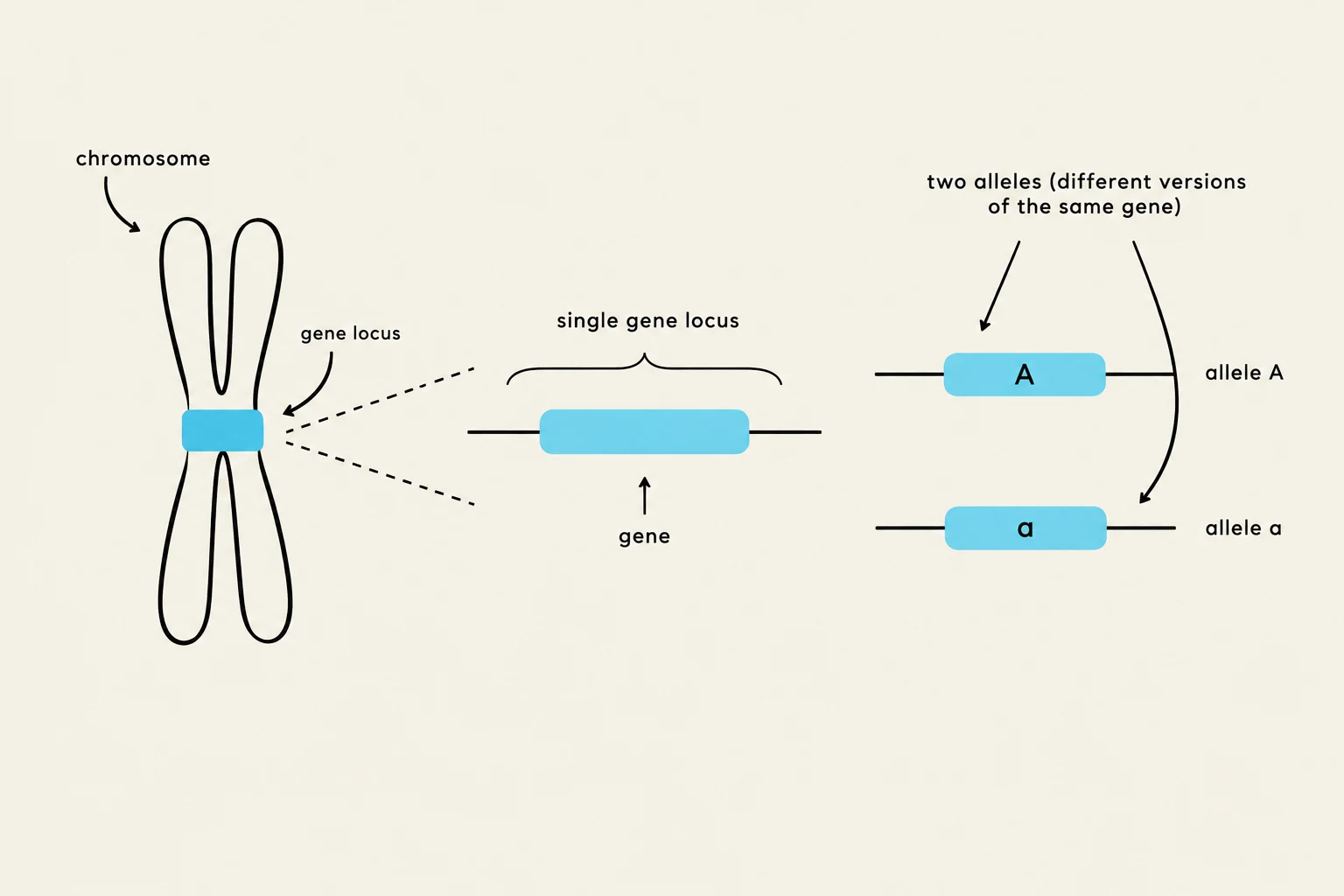
This diagram illustrates the concept of alleles, which are different versions of the same gene, located at a specific gene locus on a chromosome.
Exam Tip: When working through genetics problems, always identify which allele is dominant and which is recessive. Dominant alleles are typically represented by uppercase letters (e.g., A), while recessive alleles are represented by lowercase letters (e.g., a).
Genotype vs. Phenotype: The Blueprint and the Building
One of the most critical distinctions in biology is the difference between what an organism carries in its DNA and what it actually looks like.
The Genotype
The genotype is the complete genetic makeup of an individual. It is the specific combination of alleles an organism possesses for a particular gene. Because we inherit one allele from each parent, the genotype is always a pair of alleles.
The Phenotype
The phenotype is the observable physical or biochemical characteristic of an organism. This is the "expression" of the genotype. The phenotype can be influenced by the genotype, but it can also be affected by environmental factors (such as nutrition or sunlight).
For example, if a pea plant has the alleles for purple flowers, its genotype is the specific letter combination, while its actual purple color is the phenotype.
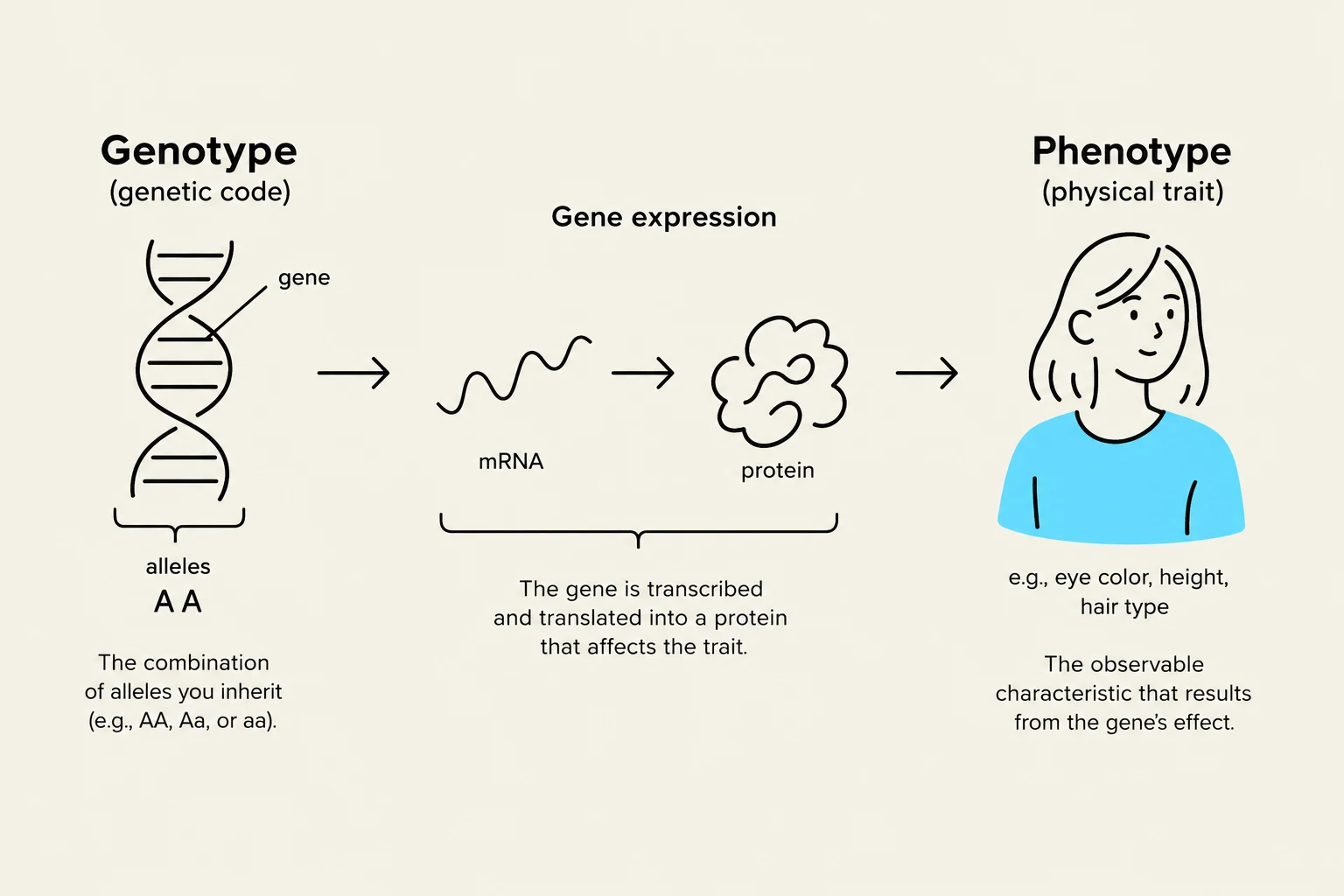
This diagram illustrates the process of gene expression, showing how genotype (genetic code) leads to phenotype (physical traits) through the transcription and translation of genes into proteins.
Term
Definition
Example
Genotype
The internal genetic code
BB, Bb, or bb
Phenotype
The outward physical trait
Brown eyes or Blue eyes
Zygosity: Homozygous and Heterozygous States
Because organisms carry two alleles for every gene, we categorize those pairs into two distinct states: homozygous and heterozygous. This categorization describes the relationship between the two alleles at a specific locus.
Homozygous
An organism is homozygous for a trait if it possesses two identical alleles for that gene.
Homozygous Dominant: Both alleles are the dominant version (e.g., AA).
Homozygous Recessive: Both alleles are the recessive version (e.g., aa).
Heterozygous
An organism is heterozygous if it possesses two different alleles for a gene (e.g., Aa). In a simple Mendelian inheritance pattern, the heterozygous individual will typically display the phenotype associated with the dominant allele, effectively "masking" the recessive one.
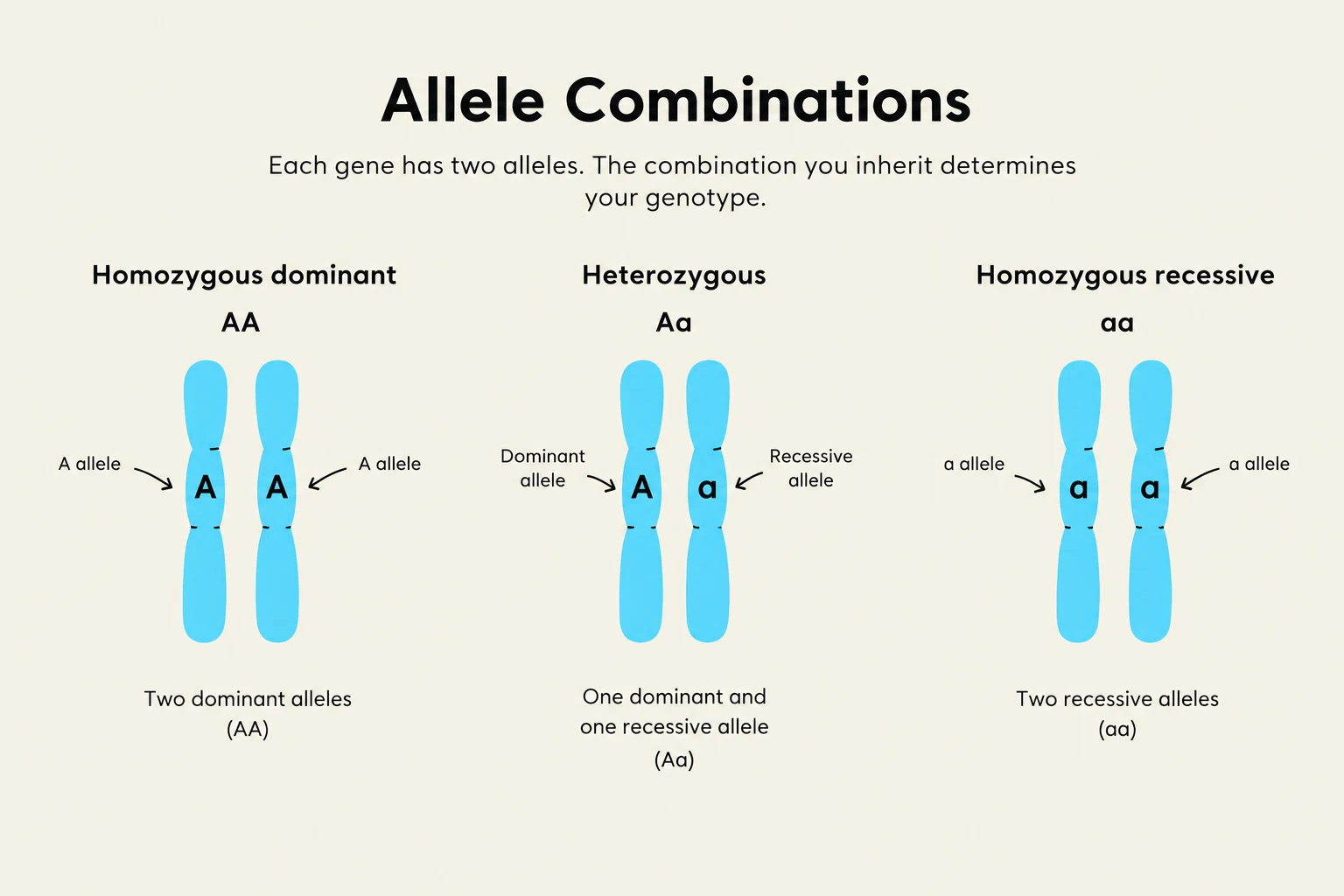
This diagram illustrates allele combinations and their relation to genotype, showing homozygous dominant (AA), heterozygous (Aa), and homozygous recessive (aa) scenarios.
Worked Example: Putting It All Together
To ensure you can apply these terms, let's look at a classic inheritance scenario involving flower color in a hypothetical plant species.
The Scenario:
The allele for Red flowers (R) is dominant.
The allele for white flowers (r) is recessive.
Problem 1: Identify the Genotype and Phenotype
If a plant has the alleles Rr:
What is its genotype? The genotype is Rr.
Is it homozygous or heterozygous? Because the alleles are different, it is heterozygous.
What is its phenotype? Because R is dominant, the plant will have Red flowers.
Problem 2: Predicting Outcomes
If we cross two heterozygous plants (Rr×Rr), we can use a Punnett square to find the potential offspring. The mathematical probability of the genotypes can be expressed as:
P(RR)P(Rr)P(rr)=41=42=21=41
In this cross, $75%$ of the offspring will show the Red phenotype (the RR and Rr individuals), while $25%$ will show the white phenotype (the rr individuals).
Summary Checklist:
Allele: A version of a gene.
Genotype: The allele combination (the letters).
Phenotype: The physical trait (the look).
Homozygous: Two of the same alleles (AA or aa).
Heterozygous: Two different alleles (Aa).
Keep reading for free.
Create an account to finish this reading and make it part of your study routine.