This content covers the fundamental properties of gases, including pressure, volume, temperature, and the number of moles. It explains the Kinetic Molecular Theory, fundamental gas laws (Boyle's, Charles', Avogadro's), the Ideal Gas Law, and gas dynamics such as effusion and diffusion. It also touches upon the chemistr
Gases are unique states of matter characterized by their ability to be compressed, a property that distinguishes them from liquids and solids. This compressibility is due to the vast amount of empty space between molecules; in a typical room, approximately 99.992% of the volume is empty space. Understanding gases requires exploring the relationships between pressure, volume, temperature, and the amount of substance, as well as the microscopic behaviors that drive these macroscopic observations.
Comparison of molecular spacing in solids, liquids, and gases.
Physical Properties of Gases
To describe a gas, we must quantify four primary variables: pressure, volume, temperature, and the number of moles.
Pressure (P)
Pressure is defined as force exerted per unit area (P=force/area). Because gases exert pressure through constant molecular collisions, measuring it is vital for understanding their behavior. Common units include:
Pascals (Pa): Where 1 Pa=1 N/m2.
Bar:1 bar=100,000 Pa.
Atmospheres (atm):1 atm=101,325 Pa.
mmHg or Torr:1 atm=760 mmHg=760 Torr.
Temperature (T)
In the context of gas laws, temperature is a measure of the average translational kinetic energy of the gas molecules. The relationship is expressed as:
KE=21mv2
Exam Tip: Always convert temperature to Kelvin (K) before performing any gas law calculations. Absolute zero (0 K or −273.15∘C) is the theoretical point where gas volume would reach zero.
Kinetic Molecular Theory (KMT)
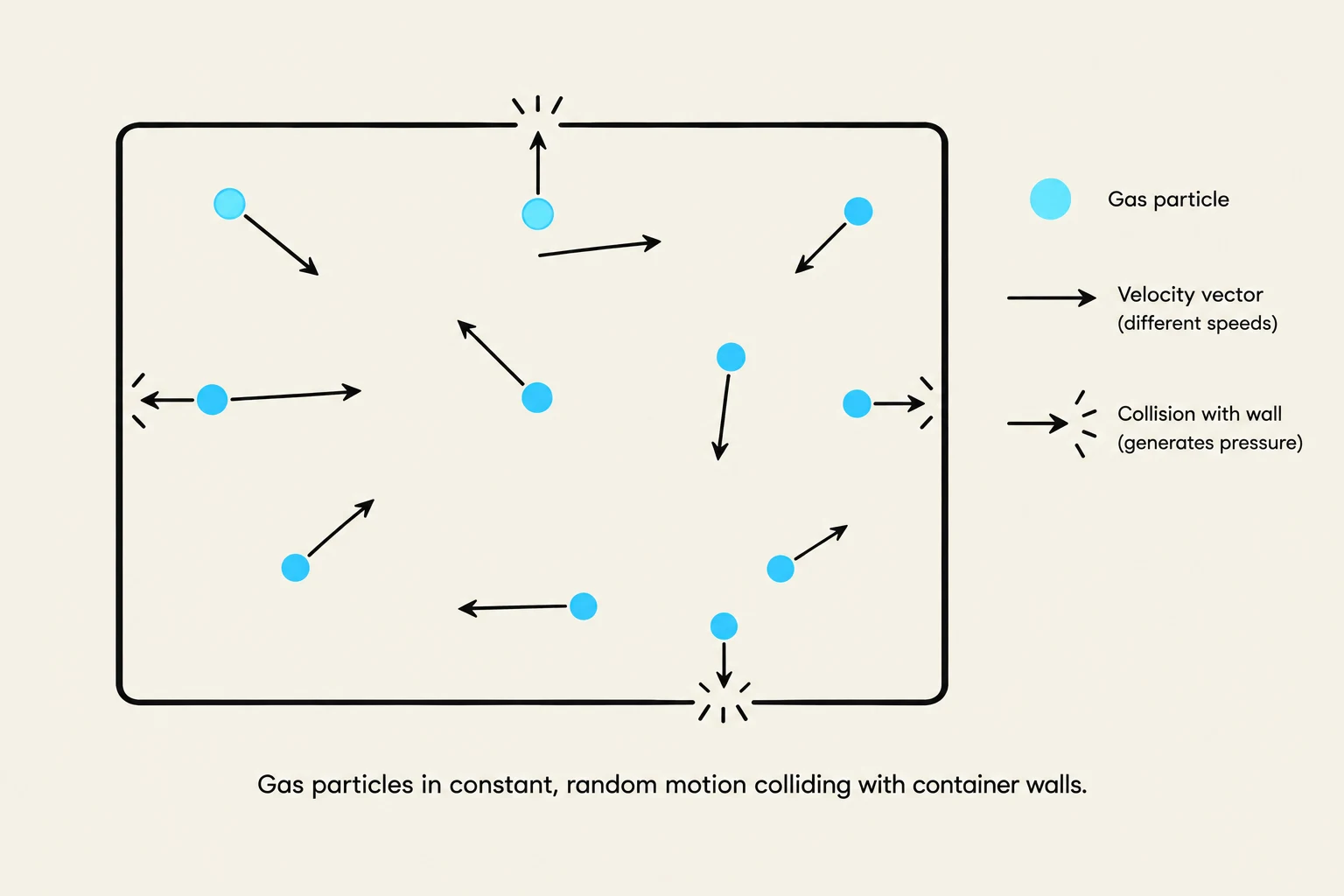
Gas particles in constant, random motion colliding with container walls.
The Kinetic Molecular Theory provides a microscopic model to explain why gases behave the way they do. The theory assumes:
Gas particles are in constant, random motion.
Particles have negligible volume (they are treated as point masses).
There are no attractive or repulsive interactions between particles.
Collisions between particles and container walls are perfectly elastic.
The average kinetic energy of the particles is directly proportional to the absolute temperature.
While KMT describes "ideal" gases, real gases deviate from these assumptions, particularly at high pressures (where molecular volume becomes significant) or low temperatures (where intermolecular forces cause liquefaction).
Fundamental Gas Laws
The interactions between P, V, n, and T are described by several empirical laws:
Boyle’s Law: At constant n and T, volume is inversely proportional to pressure (V∝P1 or $PV = k$).
Charles’ Law: At constant n and P, volume is directly proportional to temperature (V∝T or TV=k′).
Avogadro’s Law: At constant T and P, volume is directly proportional to the number of moles (V∝n or $V = k''n$).
The Ideal Gas Law
By combining these individual relationships, we derive the Ideal Gas Law, which serves as the foundation for gas stoichiometry:
$PV = nRT$
In this equation, R is the Ideal Gas Constant. Its value depends on the units used:
R=0.08314 L bar mol−1 K−1
R=8.314 J mol−1 K−1
Gas Dynamics: Speed, Diffusion, and Effusion
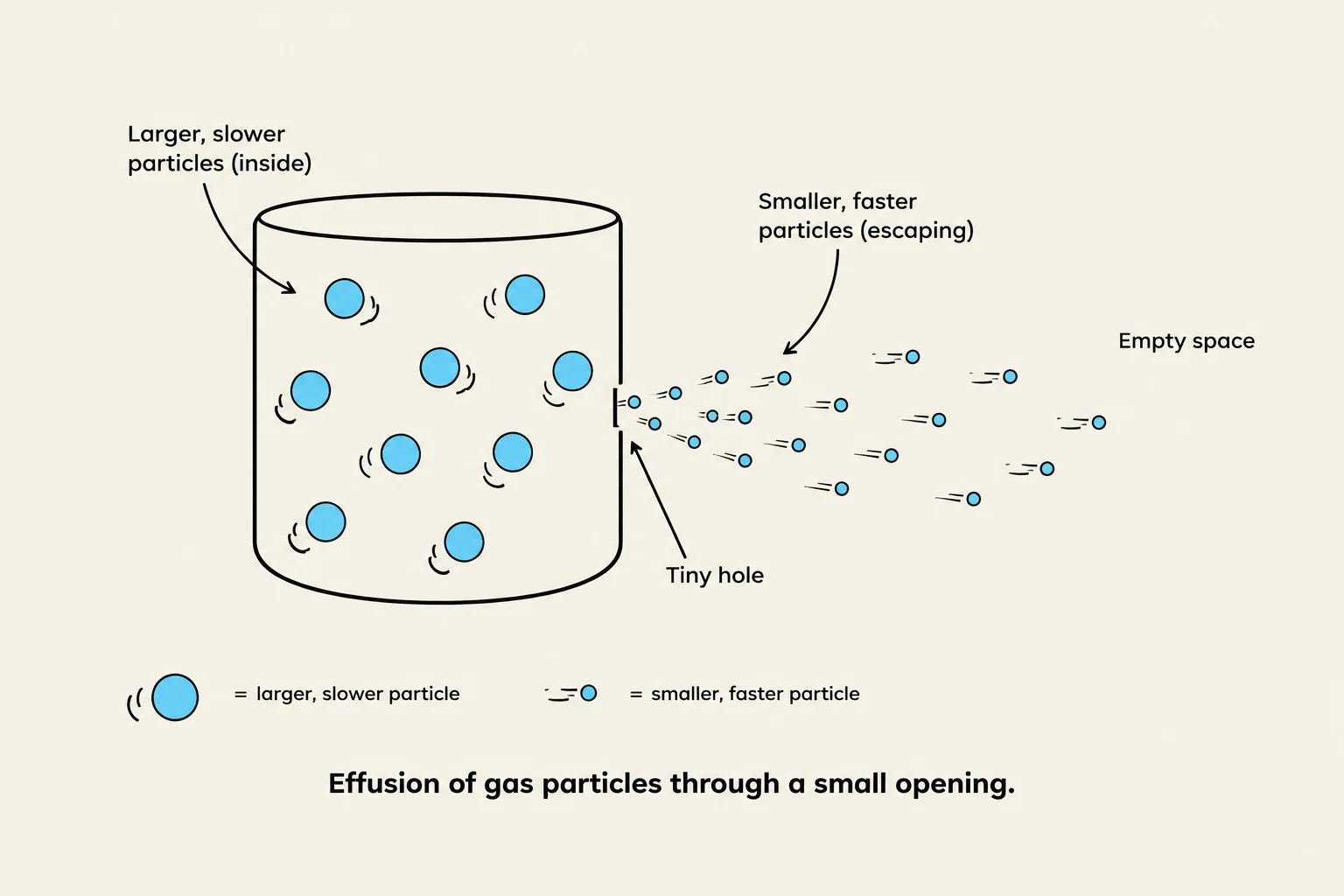
Effusion of gas particles through a small opening.
Because gas molecules move at high velocities, we can study how they move through space and escape containers.
Molecular Speed and Mean Free Path
The speed of a gas molecule depends on its temperature and molar mass (M). A simplified relationship for speed (v) is:
v=M3RT
This explains why lighter gases, like Hydrogen (H2), move much faster than heavier gases like Oxygen (O2).
The Mean Free Path (l) is the average distance a molecule travels before colliding with another. This distance decreases as pressure increases or as the "size" of the molecule increases.
Effusion and Diffusion
Effusion is the process where gas particles escape through a tiny opening into a vacuum. Graham's Law states that the rate of effusion is inversely proportional to the square root of the molar mass:
rate2rate1=M1M2
Diffusion is the gradual dispersion of one substance through another (e.g., a gas spreading through a room).
Chemistry of the Atmosphere
The atmosphere is a complex mixture of gases, primarily Nitrogen (N2,78.1%) and Oxygen (O2,21.0%). The chemical behavior of these gases has significant environmental implications.
The Ozone Layer
Ozone (O3) is created in the stratosphere through the Chapman Cycle, where oxygen molecules are photolyzed by UV light to create free oxygen atoms that then react with O2. However, Chlorofluorocarbons (CFCs) can destroy this layer. When CFCs reach the stratosphere, light breaks them down to release Chlorine atoms, which act as catalysts in a cycle that destroys ozone.
Atmospheric Warming and Smog
Greenhouse Effect: Gases like CO2 absorb infrared light, contributing to atmospheric warming. This occurs because the molecular vibrations (stretching and bending) allow the molecule to absorb specific wavelengths of energy.
Smog: Urban smog is a mixture of oxidants, hydrocarbons, and nitrogen oxides ($NO_x$). It is often exacerbated by sunlight and temperature inversions, where a layer of warm air traps pollutants near the ground.
Acid Rain: This is caused by the oxidation of sulfur dioxide (SO2) into sulfur trioxide (SO3), which then reacts with water to form sulfuric acid (H2SO4).