Introduction to Forensic Archaeology and Human Osteology
This content introduces forensic archaeology, its scope in criminal investigations, mass disaster recovery, and humanitarian operations. It also covers basic human osteology, detailing the axial and appendicular skeletons and the forensic archaeological process.
Archaeology is often associated with the study of ancient civilizations and distant pasts. However, a specialized sub-discipline applies these same rigorous scientific principles to much more recent events—those occurring within living memory. This field is known as forensic archaeology. It involves the application of archaeological methods to recover evidence for criminal, civil, humanitarian, and mass disaster investigations.
Defining the Forensic Archaeologist
A forensic archaeologist is a trained professional who possesses a unique intersection of skills. Unlike a traditional field archaeologist who might focus on cultural heritage or prehistoric settlements, a forensic archaeologist must be proficient in:
Archaeology: For systematic excavation and stratigraphic analysis.
Osteology: The study of bones, which is essential when dealing with human remains.
Crime Scene Investigation (CSI) techniques: To ensure that evidence is recovered in a manner that is legally admissible.
Exam Tip: Remember that the primary difference between forensic and field archaeology often lies in the "time scale." Forensic archaeology typically deals with events from the last 70 years—recent enough for legal prosecution.
Scope of Investigation
The work of a forensic archaeologist is not limited to excavating bones; it is a broad field that covers several distinct types of casework.
Human Remains and Criminal Investigations
The most common request for a forensic archaeologist involves human remains investigations. These are often criminal cases involving homicide victims, where the police request assistance through a Scientific Support Manager (SSM) or a Police Search Advisor (PolSA).
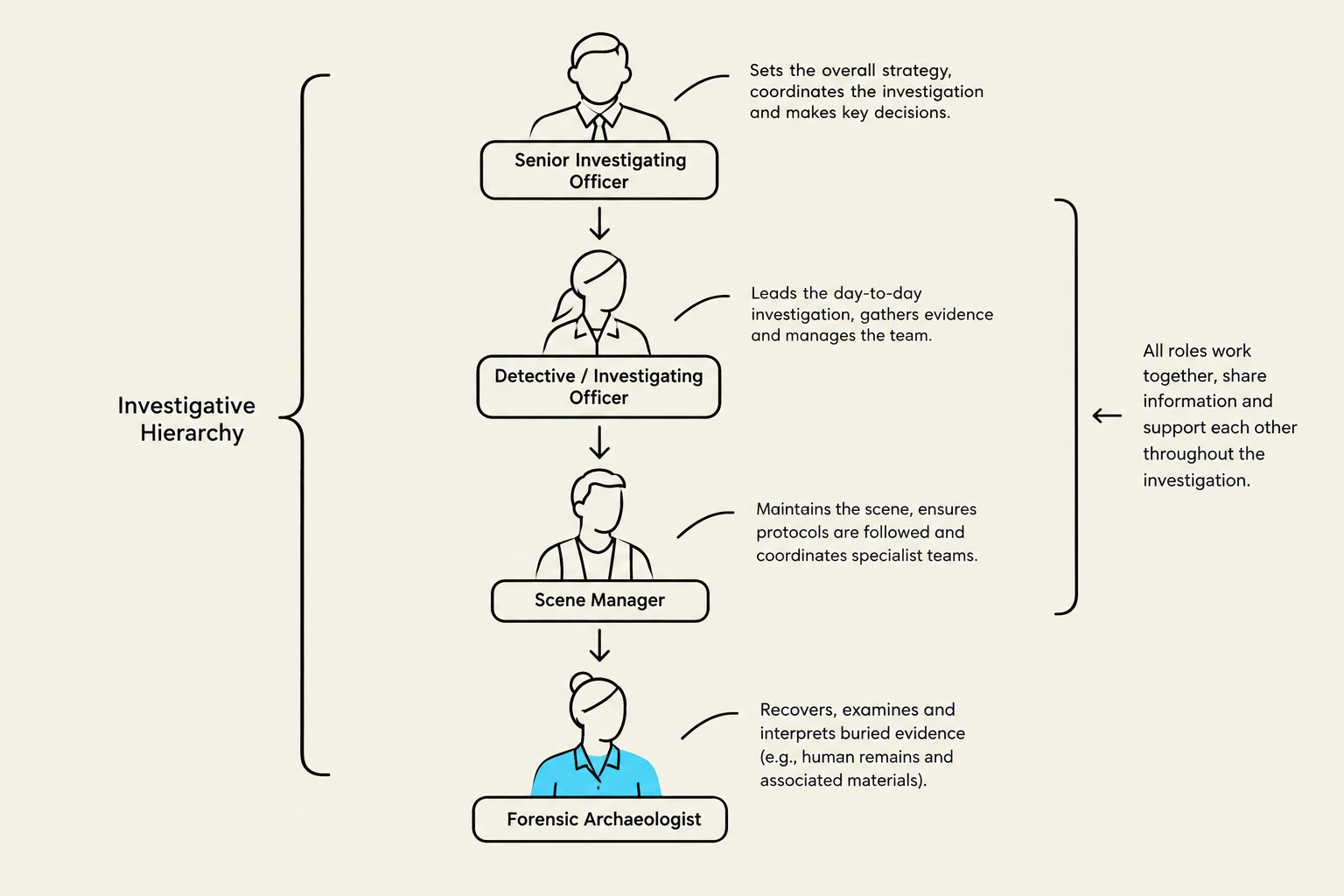
In these scenarios, the archaeologist is part of a strict investigative hierarchy:
Senior Investigating Officer (SIO)
Scientific Support Manager (SSM)
Crime Scene Manager (CSM)
Crime Scene Investigator (CSI)
Police Search Advisors (PolSA)
Forensic Archaeologist
Clandestine Disposals and Civil Cases
Beyond human remains, archaeologists are often tasked with the recovery of evidence that has been hidden to evade detection, known as clandestine disposals. This can include:
Buried weaponry or drugs.
Ransom money or stolen goods.
Stolen antiquities.
In civil casework, the discipline may be applied to resolving land boundary disputes.
Mass Disaster Recovery and Humanitarian Operations
When large-scale tragedies occur, forensic archaeologists manage complex recovery strategies. Mass disaster recovery missions include events such as plane crashes, bombings (e.g., 9/11), or major fires (e.g., the Grenfell Tower fire).
On a global scale, humanitarian operations involve working with international organizations like the International Committee of the Red Cross (ICRC) or the International Commission on Missing Persons (ICMP) to assist in conflict zones or to help identify missing persons in countries such as Bosnia and Herzegovina, Rwanda, or Syria.
Hybrid Cases
"Hybrid" cases involve the intersection of crime and heritage, such as the intentional disturbance or destruction of heritage sites and assets, such as the felling of the Sycamore Gap tree or damage to Offa’s Dyke.
This diagram illustrates the investigative hierarchy, outlining the roles and responsibilities of different positions within an investigation, from Senior Investigating Officer to Forensic Archaeologist, emphasizing collaborative teamwork.
The Importance of Contamination Prevention
In a forensic context, the integrity of the evidence is paramount. If an archaeologist uses improper recovery methods, a defense barrister may argue in court that the evidence is inadmissible. To prevent this, practitioners must follow strict contamination prevention procedures.
This includes:
Wearing appropriate Personal Protective Equipment (PPE).
Adhering to strict crime scene procedures, such as documenting entrances in a crime scene log.
Using sterile equipment and maintaining a meticulous "chain of custody" through evidence logs.
The Forensic Archaeological Process
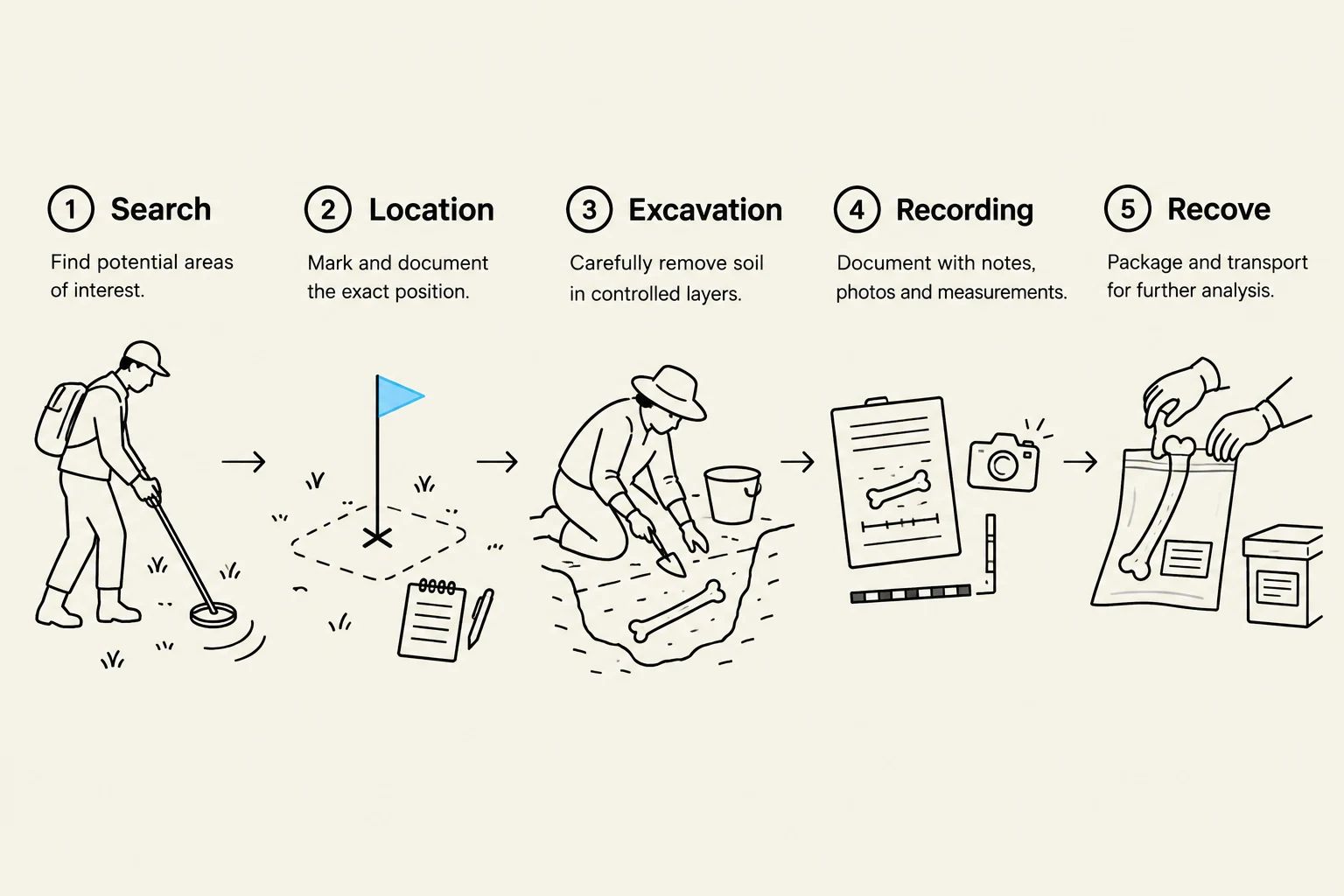
The workflow of a forensic investigation follows a logical, step-by-step progression to ensure no data is lost:
Search and Location: Using non-invasive and invasive techniques to find a burial site.
Excavation: Once a site is identified and a coroner has given permission, the grave is excavated using archaeological techniques.
Recording: Every detail is captured via photographs, videos, sketches, notes, and skeletal inventories.
Recovery: Once human remains are uncovered, a medical professional must declare life is extinct, and a forensic pathologist typically supervises the removal of the body.
Interpretation and Court: The archaeologist reviews field records and produces an expert witness report to assist judges and juries in understanding scientific data.
This illustration outlines the five key steps of an archaeological excavation: search, location marking, excavation, recording of findings, and recovery of artifacts.
Basic Human Osteology
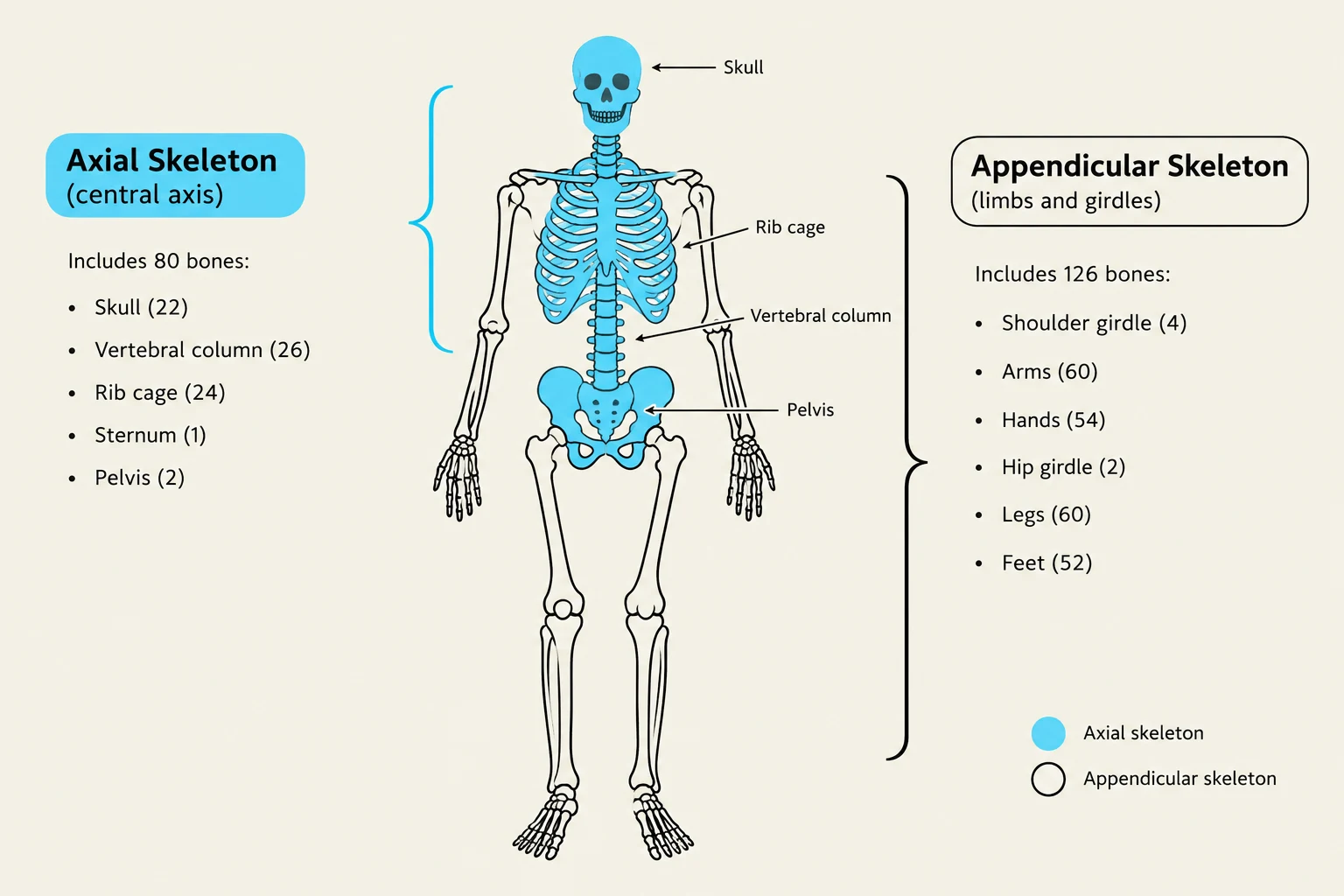
To effectively recover and interpret remains, a forensic archaeologist must understand the human skeleton. A typical adult human skeleton consists of 206 bones. The skeleton is divided into two main parts:
The Axial Skeleton
The axial skeleton forms the central axis of the body:
Auditory Ossicles: The tiny bones of the middle ear (malleus, incus, stapes).
Hyoid: The throat bone.
Vertebral Column: Including cervical, thoracic, lumbar, sacral, and coccygeal vertebrae.
Ribs and Sternum: The thoracic cage.
The Appendicular Skeleton
The appendicular skeleton includes the limbs and the girdles that attach them to the axial skeleton:
Upper Limbs: Clavicle (collar bone), scapula (shoulder blade), humerus (upper arm), radius and ulna (forearm), and the bones of the hands.
Lower Limbs: Os coxae (hip bone), femur (thigh), patella (kneecap), tibia and fibula (lower leg), and the bones of the feet.
Diagram illustrating the axial and appendicular skeletons, detailing the bones included in each.
Study Task: Practice your skeletal inventory skills. Using a diagram of a human skeleton, attempt to identify and label all major bones. This is a fundamental skill for any forensic professional.
Keep reading for free.
Create an account to finish this reading and make it part of your study routine.