Explains the role of financial markets in facilitating the flow of capital from suppliers (households) to demanders (businesses), detailing various methods businesses use to raise capital, such as early-stage funding, reinvesting profits, borrowing through loans and bonds, and selling stock. It also covers returns on i
In any thriving economy, money must move from those who have extra to those who can use it productively. This movement is not accidental; it is facilitated by a complex system of institutions and agreements known as financial markets. At the heart of this system is the concept of financial capital—the funds used by businesses to invest in new equipment, research, and expansion. By connecting those who supply capital with those who demand it, financial markets drive the business investment necessary for economic growth.
The Bridge: Financial Markets and Capital Flow
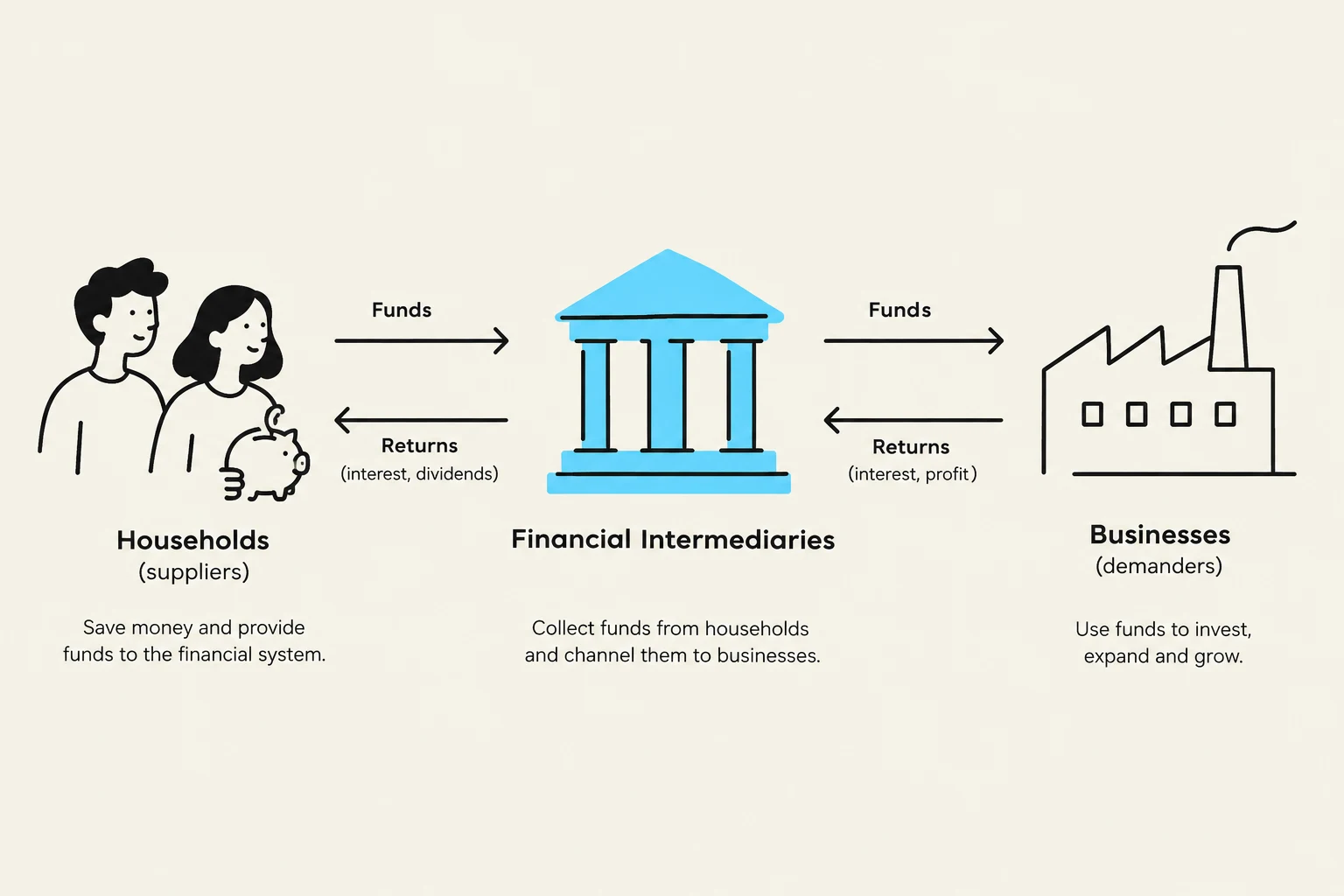
Financial markets act as essential intermediaries. On one side, we have financial capital suppliers, which are typically households looking to earn a return on their savings. On the other side are financial capital demanders, primarily businesses seeking funds to fuel growth.
Without these markets, a person with extra savings might struggle to find a reliable way to invest that money, and a brilliant entrepreneur might lack the funds to turn an idea into a reality. Financial markets solve this "gap" by providing a structured environment for these transactions to occur.
This diagram illustrates the flow of funds between households, financial intermediaries, and businesses, explaining how savings are channeled to investment and growth.
How Businesses Raise Capital
Businesses do not have a single way to get money; instead, they choose a method based on their size, age, and specific needs.
1. Early-Stage Funding
New companies often lack a proven track record of profit, making them "risky" to traditional lenders. To overcome this, they rely on:
Personal Savings: The owners' own money.
Angel Investors: Wealthy individuals who provide capital to startups.
Venture Capital: Professional firms that provide large sums of money and strategic advice in exchange for equity. Venture capitalists accept high risks for the potential of massive returns if the startup succeeds.
2. Reinvesting Profits
Once a company is established and generating corporate profits (revenues that exceed costs), it can simply use those earnings to fund new projects. This is often the most stable way to grow, as it does not require taking on new debt or giving away ownership.
3. Borrowing: Loans and Bonds
When internal funds aren't enough, companies turn to debt.
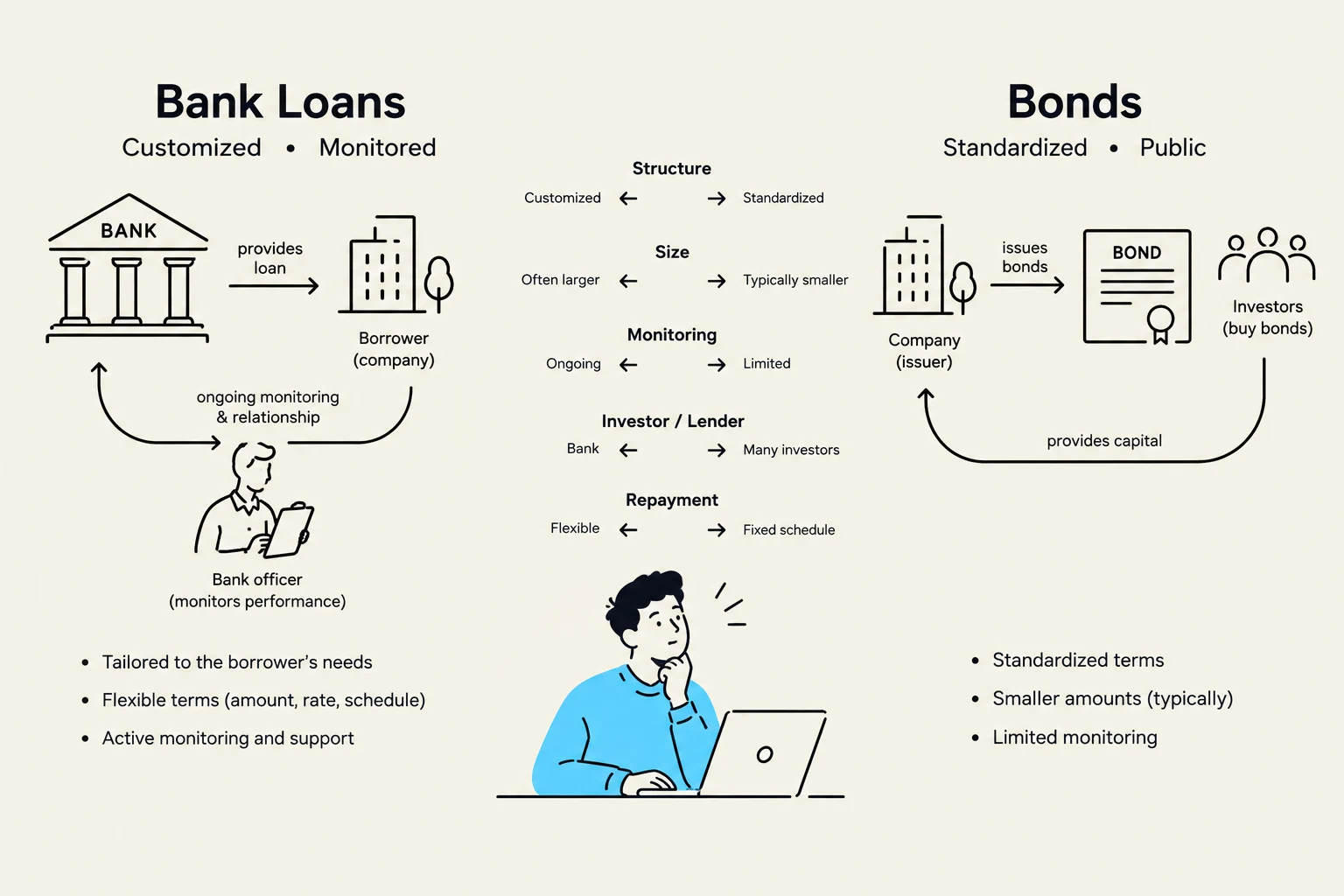
Bank Loans: These are often customized agreements, frequently used by smaller or private companies. Banks monitor the firm's health through its transaction history.
Bonds: A bond is a financial contract where a borrower (a corporation or a government) agrees to repay a specific principal amount plus interest over a set period. The people who lend the money are called bondholders.
Treasury Bonds: Issued by the federal government.
Municipal Bonds: Issued by local or state governments.
This diagram illustrates the differences between bank loans and bonds, covering aspects like structure, size, monitoring, investors, and repayment.
4. Selling Stock
A corporation is a business owned by shareholders. Unlike lenders, shareholders own a piece of the company and have "limited liability," meaning they aren't personally responsible for the company's debts.
Initial Public Offering (IPO): This is the landmark event when a company sells its stock to the general public for the first time.
Public vs. Private: Once a company goes through an IPO, it becomes a public company; otherwise, it remains a private company.
Exam Tip: Remember the difference between debt and equity. When a company takes a loan or issues a bond, it is borrowing money it must pay back with interest (debt). When it sells stock, it is selling ownership in the company (equity).
Returns on Investment
Why do households supply capital in the first place? They want a rate of return. For stock investors, this return comes in two forms:
Dividends: Direct payments made to shareholders from the company's profits.
Capital Gains: The profit made when the value of the stock increases between the time it was bought and the time it is sold.
Information, Risk, and Governance
A major challenge in financial markets is imperfect information. This occurs when company managers know much more about the firm's true health and future prospects than the outside investors do. This imbalance can lead to risky decisions by managers that don't benefit the owners.
To protect shareholders, public companies use corporate governance—a system of rules and institutions designed to oversee executives.
The Role of the Board
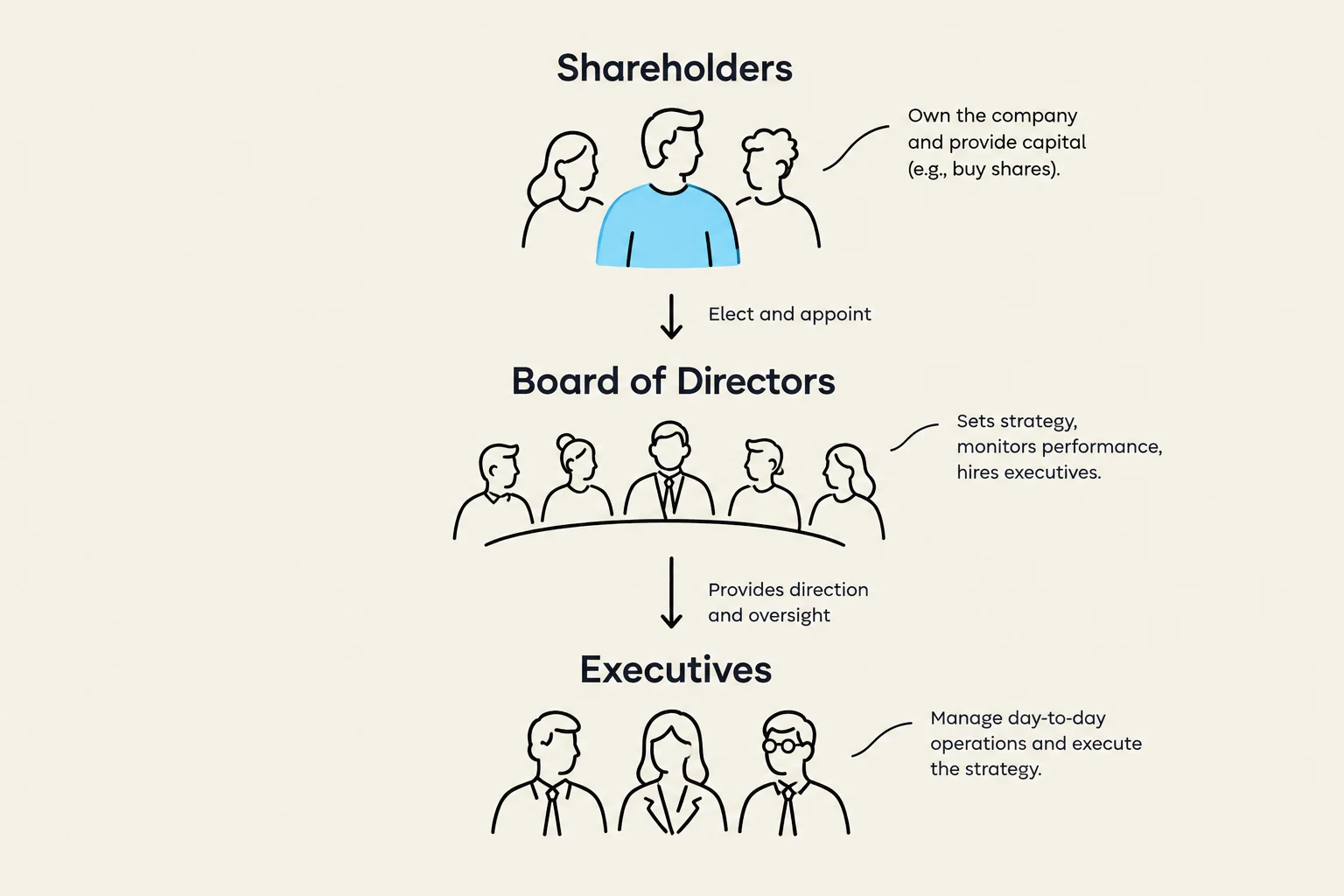
In a public corporation, shareholders elect a board of directors to represent their interests. The board's job is to oversee the high-level direction of the company and hire the executives who manage the daily operations.
This diagram illustrates the hierarchical structure of a company, showing the roles and relationships between shareholders, the board of directors, and executives.
While these systems are designed to create stability, they are not perfect. History shows that when information is hidden or markets are poorly regulated, the consequences can be severe. For example, the 2008 financial crisis demonstrated how failures in understanding risk and information can ripple through the entire global economy.
Keep reading for free.
Create an account to finish this reading and make it part of your study routine.