Explains the biological concepts of homeostasis, negative feedback, and positive feedback, using examples like thermoregulation, pH balance, and childbirth to illustrate how organisms maintain internal stability and achieve specific goals.
Imagine your body as a complex, high-tech building. To keep the occupants comfortable, the building needs a thermostat to control the temperature, a water filtration system to keep the pipes clean, and a security system to monitor everything. If the temperature gets too high, the AC kicks in; if the water becomes too acidic, a neutralizing agent is added. In biological terms, this constant state of self-regulation is known as homeostasis.
Homeostasis is the fundamental process of maintaining internal stability and equilibrium within an organism. It ensures that vital physiological variables—such as body temperature, blood pH, and nutrient concentrations—remain within a narrow, functional range. When these regulatory systems fail, the body enters a "deranged" state, which can lead to disease or even death.
The Concept of Homeostasis and the Set Point
At the heart of every homeostatic mechanism is a set point. The set point is the target value or "maintenance value" that the body strives to achieve and maintain. For example, while individual bodies vary slightly, the average human internal temperature is approximately 98.6∘F (37∘C).
To maintain this set point, the body uses feedback loops. A feedback loop is a system that performs an action, receives information about the result, and then uses that information to decide what to do next.
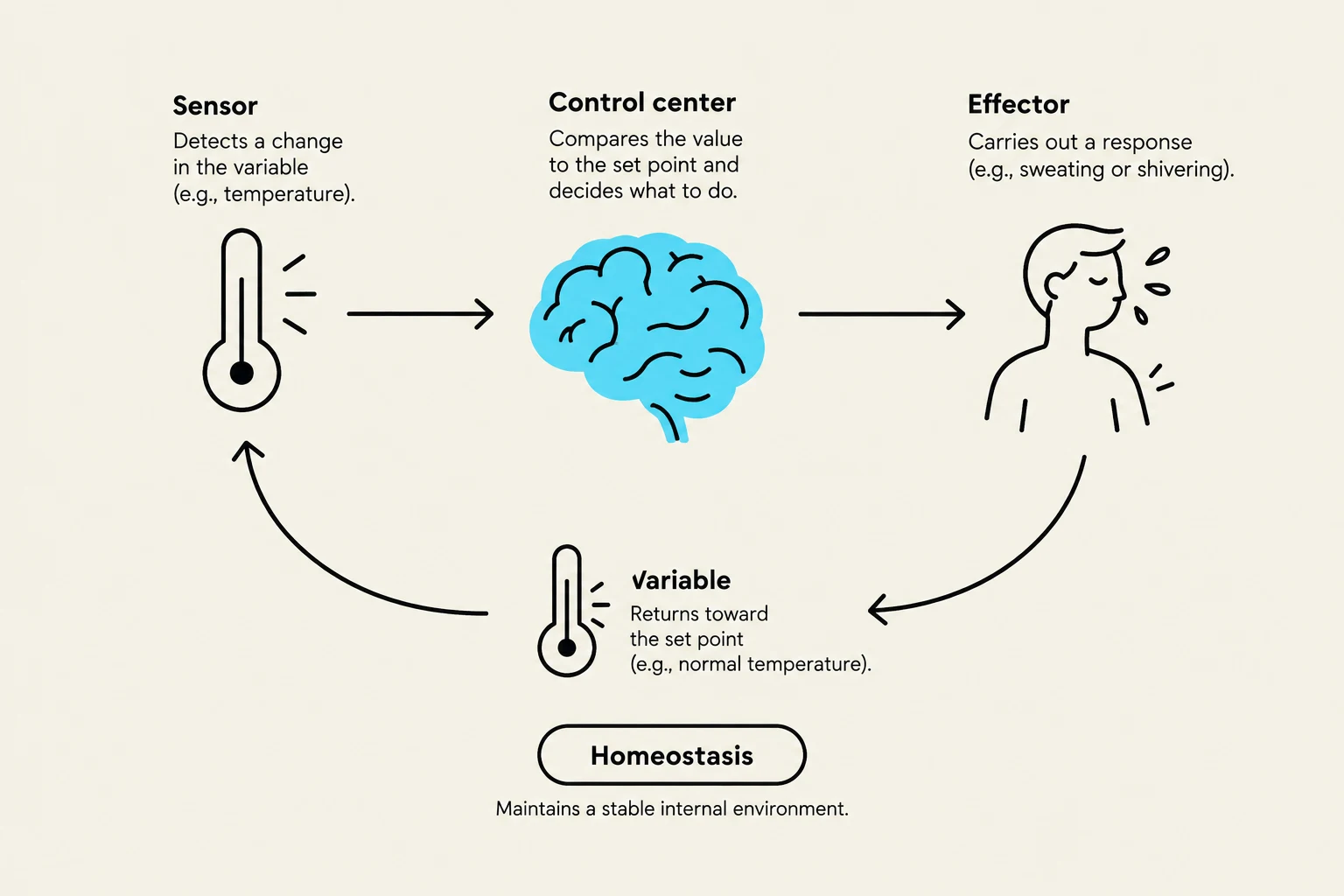
This diagram illustrates the process of homeostasis, where a sensor detects a change in a variable, a control center processes this information and initiates a response, and an effector carries out that response to maintain a stable internal environment.
Negative Feedback: The Mechanism of Stability
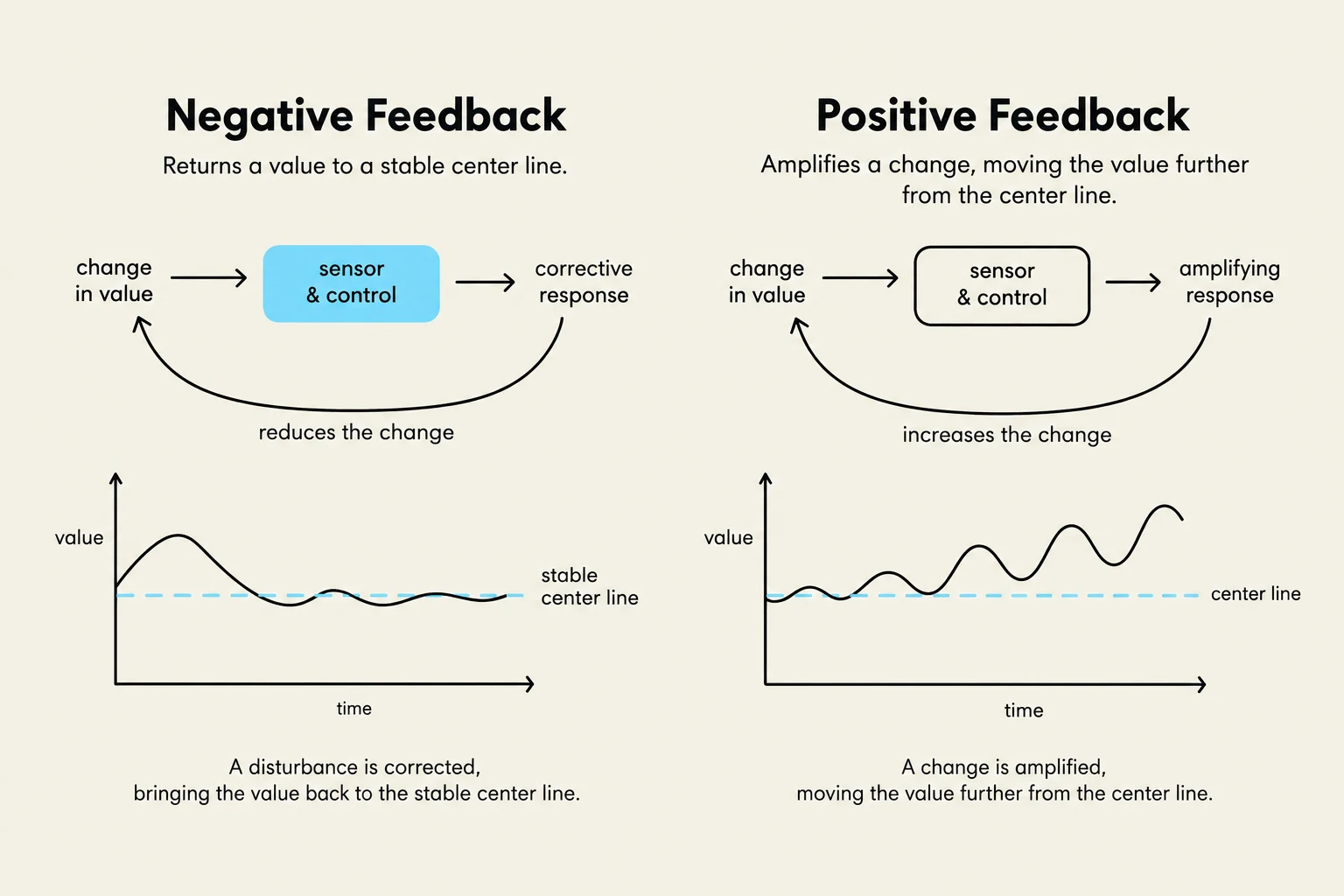
The primary way the body maintains homeostasis is through negative feedback. Despite the name, "negative" does not mean "bad"; rather, it refers to the fact that the system's response negates or counteracts the original stimulus.
In a negative feedback system, if a physiological variable diverges from its set point—whether it goes too high or too low—the body triggers a response to pull it back in the opposite direction.
Example 1: Thermoregulation
Your body acts as its own internal thermostat.
If temperature rises: The body employs cooling mechanisms, such as sweating. As sweat evaporates from your skin, it breaks the hydrogen bonds in water molecules, which consumes thermal energy and cools the body.
If temperature drops: The body initiates shivering. This involves rapid, unproductive muscle contractions that generate heat as a byproduct, helping to raise the temperature back toward the set point.
Example 2: pH Regulation
The pH of your blood is a critical variable that must be kept slightly basic, at approximately 7.4. If the blood becomes too acidic or too alkaline, it can be life-threatening.
One major danger of pH deviation is protein denaturation. Proteins (such as enzymes, motor proteins, and transporters) rely on a specific three-dimensional shape to function. If the pH shifts too far, these proteins can unfold and lose their shape, rendering them non-functional. To prevent this, the body utilizes buffers—chemical agents that resist changes in pH by absorbing or releasing hydrogen ions.
Exam Tip: Remember that negative feedback is about constraining a variable. It is not just about responding to a drop; it is about responding to any departure from the set point, whether it is an increase or a decrease.
Positive Feedback: Amplification and Goals
Unlike negative feedback, positive feedback is not homeostatic. Instead of trying to return a system to a stable set point, positive feedback amplifies a stimulus. It tells the system to "do more of what you are doing" to move the variable even further away from the starting state.
Because positive feedback creates a runaway effect, these systems are relatively rare in biology and must have a definitive endpoint or goal to prevent them from continuing indefinitely.
Example: Childbirth
The classic biological example of positive feedback is uterine contractions during childbirth.
As the baby moves against the cervix, it triggers hormonal signals.
These signals cause the uterus to contract.
These contractions push the baby harder against the cervix, which triggers even stronger hormonal signals.
This loop continues, increasing the frequency and strength of contractions until the "goal" is achieved: the birth of the baby. Once the baby is born, the stimulus is removed, and the process stops.
This diagram illustrates the concepts of negative and positive feedback loops. Negative feedback returns a value to a stable center line by reducing change, while positive feedback amplifies a change, moving the value further from the center line.
Summary of Feedback Systems
To keep these concepts straight, compare them using the following table:
Feature
Negative Feedback
Positive Feedback
Primary Goal
Stability and Equilibrium (Homeostasis)
Achieving a specific, time-limited goal
Effect on Stimulus
Counteracts/Negates the change
Amplifies/Increases the change
Direction
Returns variable to the Set Point
Moves variable away from the Set Point
Frequency
Constant/Continuous
Rare/Occasional
Quick Check: If a system is working to keep a variable constant, is it positive or negative feedback?
Answer: Negative feedback.
By utilizing these two distinct strategies, the human body can navigate a changing environment while keeping its internal "machinery" running smoothly and efficiently.
Keep reading for free.
Create an account to finish this reading and make it part of your study routine.