Introduction to Eukaryotic Organisms: Protists, Plants, and Fungi
This article provides an overview of the Domain Eukarya, detailing the characteristics, classification, and ecological roles of protists, plants, and fungi. It covers eukaryotic cell structure, the diversity within protists, adaptations of plants for terrestrial life, and the absorptive heterotrophic nature of fungi.
The biological world is characterized by an incredible diversity of life forms, ranging from microscopic single cells to massive, ancient forests. To make sense of this complexity, biologists organize life into different domains and kingdoms. One of the most significant groups is the Domain Eukarya, which includes organisms with complex cellular structures that allow for specialized functions and larger body sizes. This article explores the unique characteristics of the three major groups within this domain: protists, plants, and fungi.
The Domain Eukarya and Eukaryotic Cell Structure
The defining feature of the Domain Eukarya is the presence of a true nucleus. Unlike prokaryotes, eukaryotic DNA is enclosed within two concentric layers of membranes. Furthermore, eukaryotic cells contain a wide variety of specialized subcellular compartments, or organelles, which allow the cell to perform complex tasks efficiently.
This compartmentalization is a major evolutionary advantage. Because they can separate different chemical reactions into different organelles, eukaryotic cells can grow much larger than prokaryotic cells. On average, a eukaryotic cell's diameter is 10 times larger than a prokaryotic cell, and its total volume can be a thousand times greater.
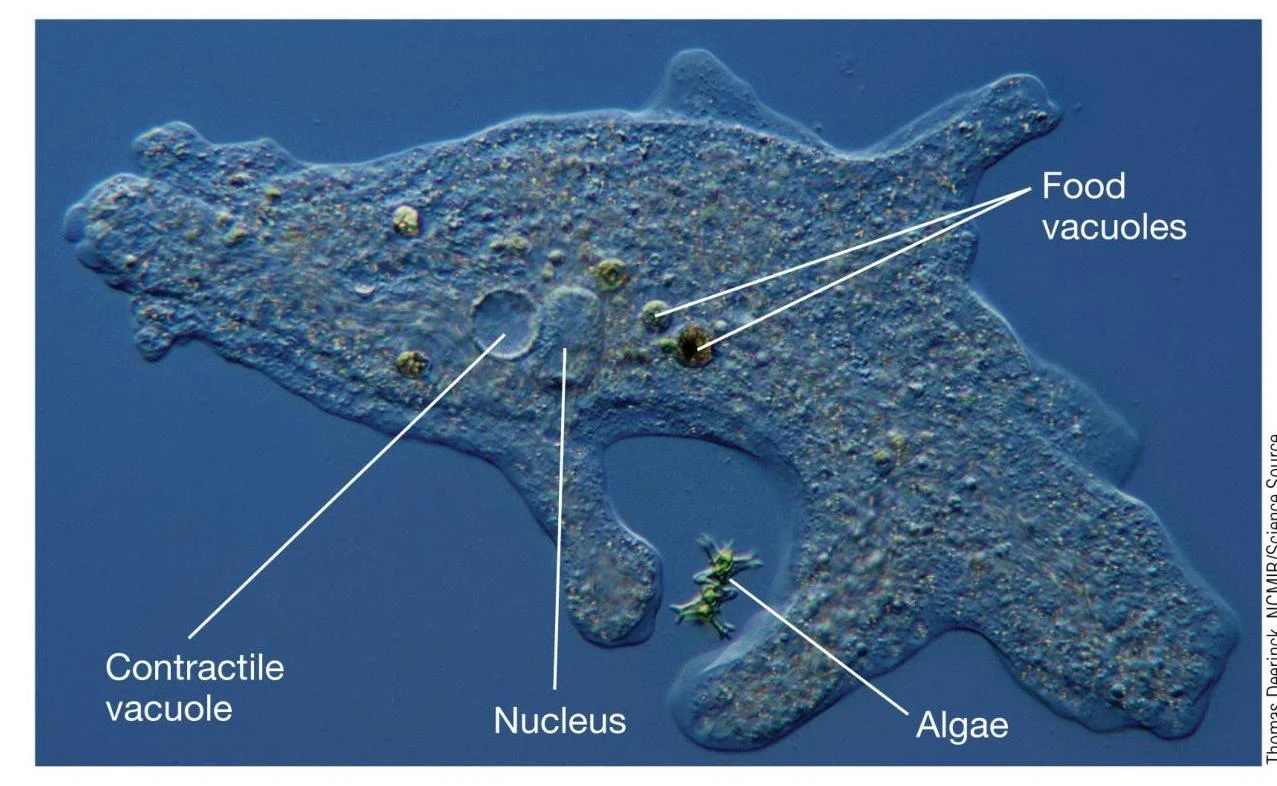
A micrograph of an amoeba, highlighting its contractile vacuole, nucleus, food vacuoles, and ingested algae.
The Peculiar World of Protists
Protists are often described as a "catch-all" group. Rather than being defined by what they share, they are often defined by what they are not: they are eukaryotes that are not plants, animals, or fungi. This makes Protista an artificial grouping, but it remains a vital way to study the vast diversity of single-celled and simple multicellular eukaryotes.
Classification of Protists
While researchers continue to debate the best way to classify them, protists are traditionally divided into two broad categories:
Protozoans: These are nonphotosynthetic and motile (capable of movement).
Algae: These are photosynthetic and may or may not be motile.
Animal-like Protists (Protozoans)
Protozoans exhibit various methods of movement and feeding:
Zooflagellates: These move using one or two flagella.
Ciliates: These move and feed using hair-like projections called cilia.
Apicomplexans: These are often specialized parasites.
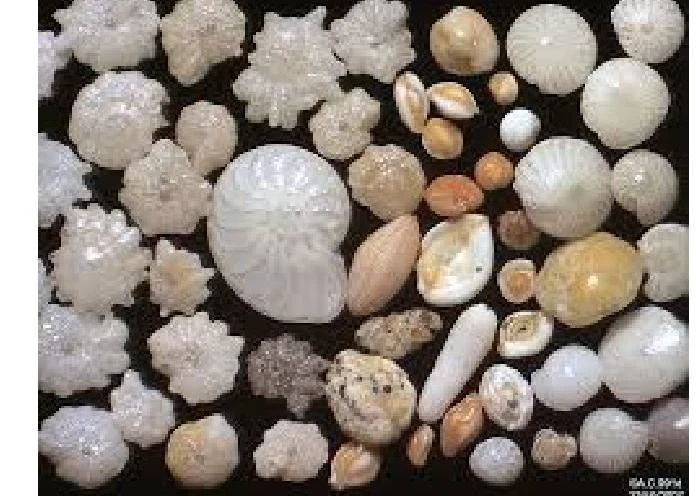
A collection of various sand grains, including foraminifera and shell fragments.
Plant-like Protists (Algae)
Algae vary significantly in size and structure:
Euglenoids: Single-celled organisms that lack a cell wall.
Dinoflagellates: Unicellular organisms with cell walls made of cellulose. Some can cause "red tides" in the ocean.
Diatoms: Unicellular organisms with unique, glass-like cell walls made of silica.
Seaweeds: Large, multicellular marine algae.
Note on Pathogens: While most protists are harmless, some are significant pathogens (disease-causing agents). For example, Plasmodium is transmitted by mosquitoes and causes malaria, while Toxoplasma gondii can be passed to humans through cat feces or poorly cooked food.
Plants: The Multicellular Autotrophs
Plants are multicellular autotrophs, meaning they produce their own food through photosynthesis. Most plants are terrestrial, having evolved from green algae. To survive on land, plants have developed several key adaptations to manage water and support their structure:
Leaves: Broad, flat surfaces designed to maximize light interception.
Stomata: Minute openings on leaf surfaces that regulate gas exchange.
Waxy Cuticle: A coating that holds in moisture to prevent dehydration.
Vascular System: A network of xylem and phloem tissues used to transport fluids.
Lignin: A strong material that links cellulose fibers together, allowing plants to grow tall and rigid.
Plant Evolution and Reproduction
Plants have evolved several reproductive strategies to ensure survival:
Bryophytes (Mosses/Liverworts): Simple, ground-hugging plants that lack a vascular system and absorb water via wicking.
Ferns: The first land plants to evolve a vascular system and lignin.
Gymnosperms (Conifers/Cycads): The first plants to evolve pollen and seeds, which removed their dependence on water for fertilization.
Angiosperms (Flowering Plants): The most diverse group today, using flowers to attract pollinators and producing fruits to protect seeds.
Exam Tip: Remember the difference between asexual and sexual reproduction in plants. Asexual reproduction (like potato tubers or aspen root suckering) creates genetically identical clones. Sexual reproduction involves the fusion of egg and sperm to create a genetically diverse zygote.
Fungi: The Absorptive Heterotrophs
Fungi are distinct from both plants and animals. While they have a protective cell wall like plants, their walls are made of chitin rather than cellulose. Like animals, they store energy as glycogen.
Fungi are absorptive heterotrophs. They do not "eat" in the traditional sense; instead, they secrete digestive enzymes into their environment to break down organic material and then absorb the nutrients.
Fungal Structure and Roles
The main body of a fungus is often hidden underground:
Hyphae: Fine, branching, hair-like threads.
Mycelium: The entire network or bundle of hyphae that makes up the organism.
Fungi play critical roles in ecosystems. As decomposers, they release inorganic chemicals back into the environment. They also form vital mutualistic relationships:
Mycorrhizal Fungi: Most wild plants partner with these fungi; the fungus provides water and minerals, while the plant provides sugars.
Lichen: A partnership between a fungus and a photosynthetic microbe (like green algae).
However, fungi can also be significant parasites, responsible for approximately two-thirds of all plant diseases.
Keep reading for free.
Create an account to finish this reading and make it part of your study routine.