


In the complex environment of a living cell, chemical reactions must occur at incredible speeds to sustain life. However, many of these reactions would naturally take hours, days, or even years to reach equilibrium if left to their own devices. This is where enzymes come in. Enzymes are biological catalysts, primarily composed of proteins, that significantly accelerate the rate of chemical reactions. By lowering the energy barriers required for a reaction to proceed, they allow life-sustaining processes to occur in milliseconds.
The Fundamentals of Catalysis
To understand how an enzyme works, we must first define its participants. The molecules that an enzyme acts upon are known as substrates. When a substrate enters the enzyme, it binds to a specific region called the active site. This active site is a three-dimensional cleft or crevice formed by amino acids that may be far apart in the protein's primary sequence but are brought together by folding.
A common misconception is that enzymes and substrates fit together like a rigid "lock and key." In reality, most enzymes undergo a conformational change upon binding the substrate, a process known as induced fit. This change in shape optimizes the interaction between the enzyme and the substrate, helping to stabilize the transition state.
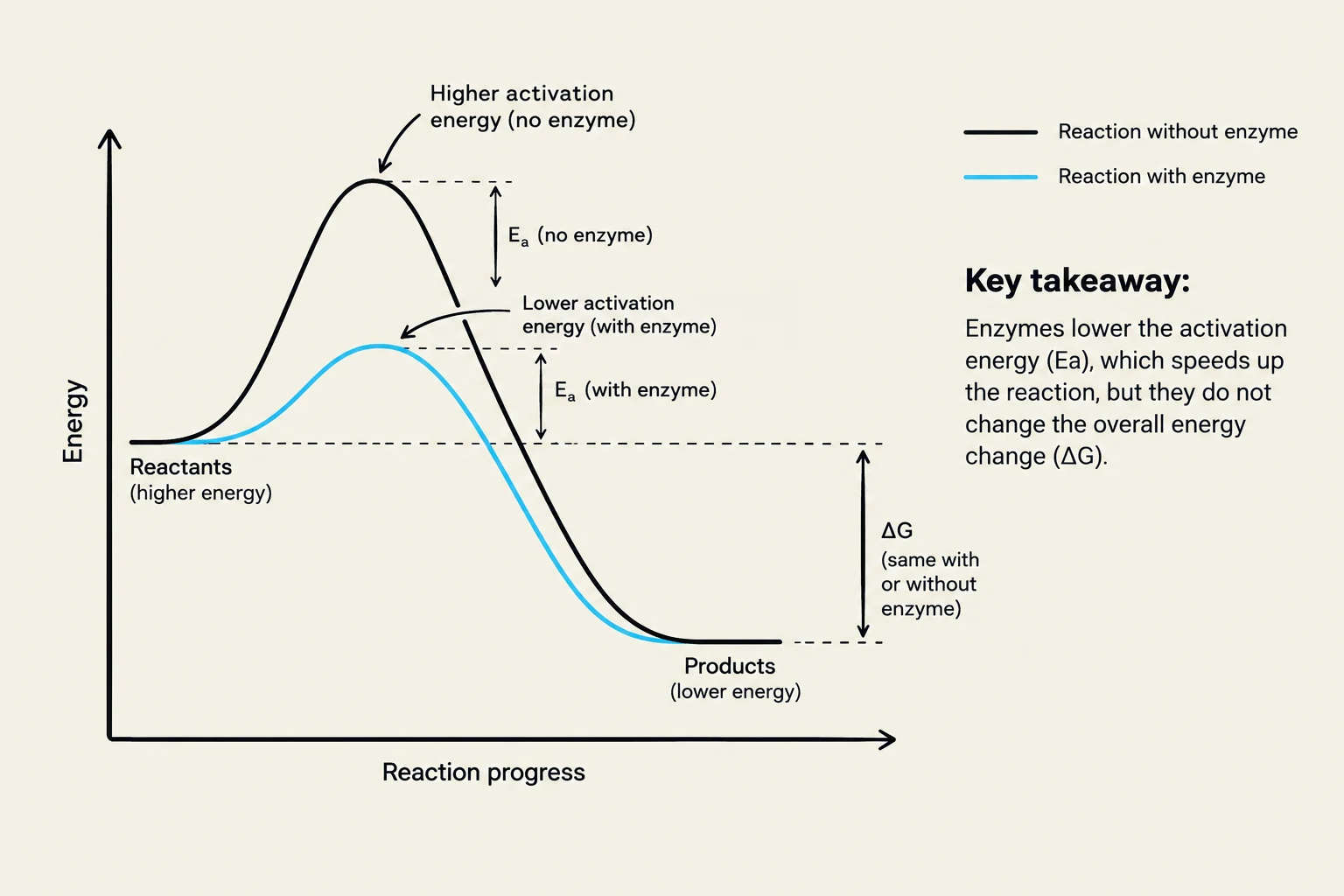
Key Concept: The Transition State A chemical reaction does not jump instantly from substrate to product. It must pass through a high-energy, unstable molecular form called the transition state (denoted by the double dagger symbol ). The energy required to reach this state from the substrate is the activation energy (). Enzymes work by lowering this activation energy.
Keep reading for free.
Create an account to finish this reading and make it part of your study routine.
Continue reading freeAlready have an account? Log in
Updated