Introduction to Environmental Science and Sustainability
An overview of environmental science, its interdisciplinary nature, and the concept of sustainability. It covers the model of environmental change, challenges in studying environmental issues, and the balance between economy, environment, and society.
Environmental science is a vast, interdisciplinary field that seeks to understand the complex interactions within our natural world. Rather than being confined to a single niche, it draws from biology, chemistry, physics, and even social sciences to study phenomena such as air pollution, natural systems, and the presence of environmental contaminants. By examining how these elements interact, scientists aim to provide the data necessary to protect our planet and ensure a stable future for all living organisms.
Defining Environmental Science and its Scope
At its core, environmental science is not merely about observing nature; it is about understanding the mechanisms of change. It involves the study of how human activities and natural processes influence the quality of our air, water, and soil. Because these issues are so interconnected, the field is inherently interdisciplinary, meaning it requires expertise from many different scientific divisions and career paths to solve a single problem.
One of the primary roles of a scientist in this field is "framing" environmental issues. This process involves making rigorous scientific observations to identify how the environment is shifting or changing, and then working to discover the underlying causes of those shifts.
This diagram illustrates how biology, chemistry, and physics contribute to environmental science, which aims to solve real-world environmental problems by focusing on biodiversity conservation, natural resource protection, pollution reduction, and building a sustainable future.
Exam Tip: Remember that environmental science is distinct from "activism." While the findings of environmental scientists often inform activist movements, the science itself focuses on objective observation, data collection, and understanding causal relationships.
The Model of Environmental Change
How does a scientific discovery actually turn into a real-world solution? The transition from observation to regulation typically follows a specific model of environmental change:
Scientific Discovery: Science identifies the specific problem (e.g., a new contaminant in a river).
Public Concern: As information spreads, the public becomes aware and concerned about the issue.
Government Action: The government adopts and implements laws and regulations to mitigate the problem.
Innovation: Scientists and businesses build new systems and technologies to provide practical solutions.
However, this model does not always function perfectly. Politics can negatively affect these steps; if accepting a problem or implementing a solution is not "politically beneficial" for those in power, the transition from science to regulation may be delayed or blocked.
Understanding Sustainability
Sustainability is the ultimate goal of much of environmental science. It is defined as meeting the needs of current social and economic requirements without degrading the ability of future generations to meet their own needs.
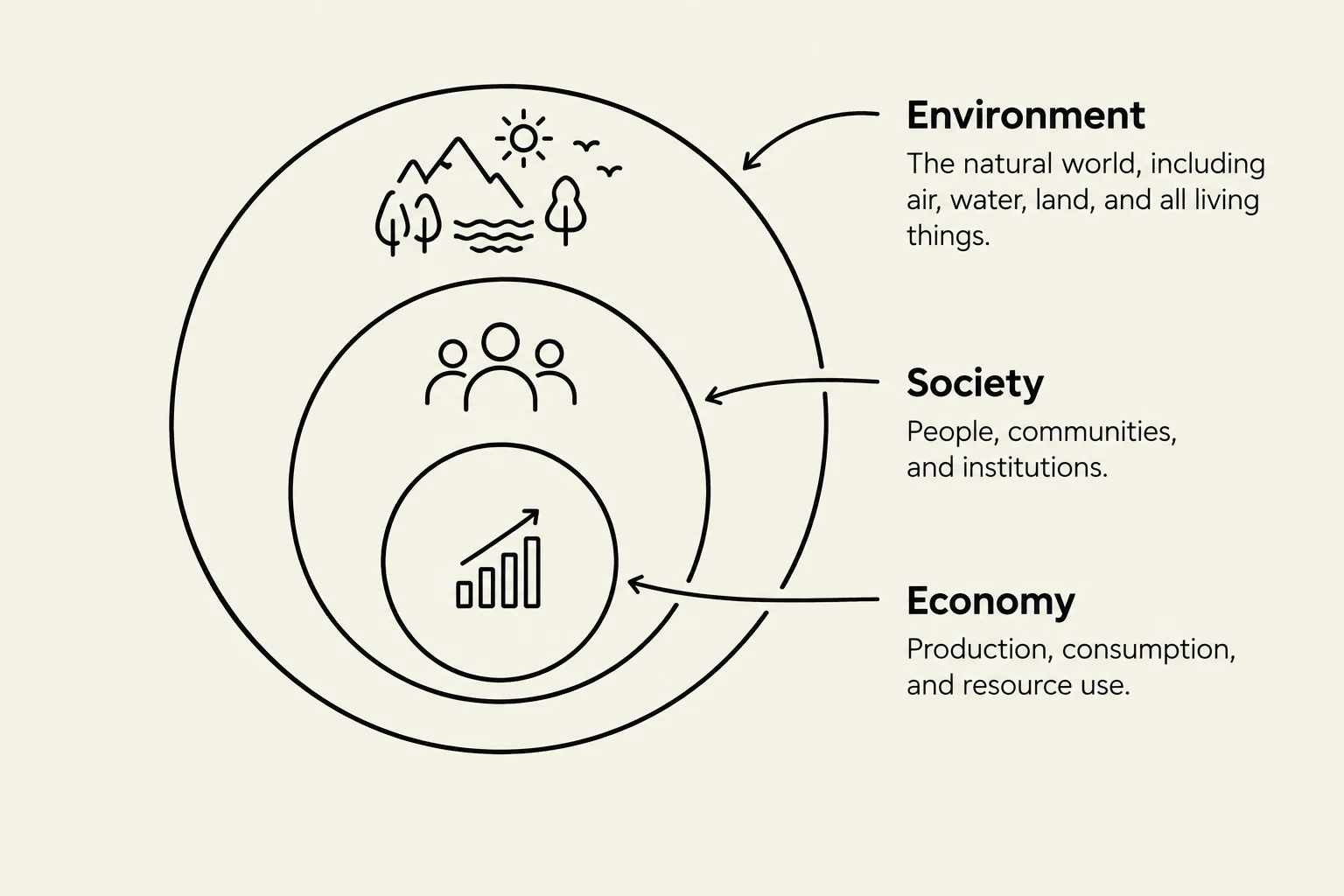
To achieve true sustainability, we must balance three interconnected pillars: the economy, the environment, and society. A helpful way to visualize this is through the Nested Model. In this model, we recognize that the economy is a subset of society, and society is a subset of the environment. Therefore, the environment is the "root" or the foundation; without a healthy environment, neither society nor the economy can exist.
This diagram illustrates the interconnectedness of the economy, society, and environment, showing how the economy is nested within society, which is itself nested within the environment.
To provide a global framework for this effort, the United Nations has established 17 specific goals designed to guide nations toward achieving global sustainability.
Challenges in Studying Environmental Issues
Studying the environment is significantly more complex than studying a controlled laboratory experiment. When researchers approach an environmental issue, they must account for several complicating factors:
Scale and Jurisdiction: An issue like air pollution might affect a single city, a nation, or the entire planet, and different laws apply depending on the borders involved.
Uncertainty, Risk, and Complexity: Natural systems are unpredictable, and calculating the exact risk of a contaminant is difficult.
Values and Politics: Scientific facts often collide with human values, political ideologies, and economic interests.
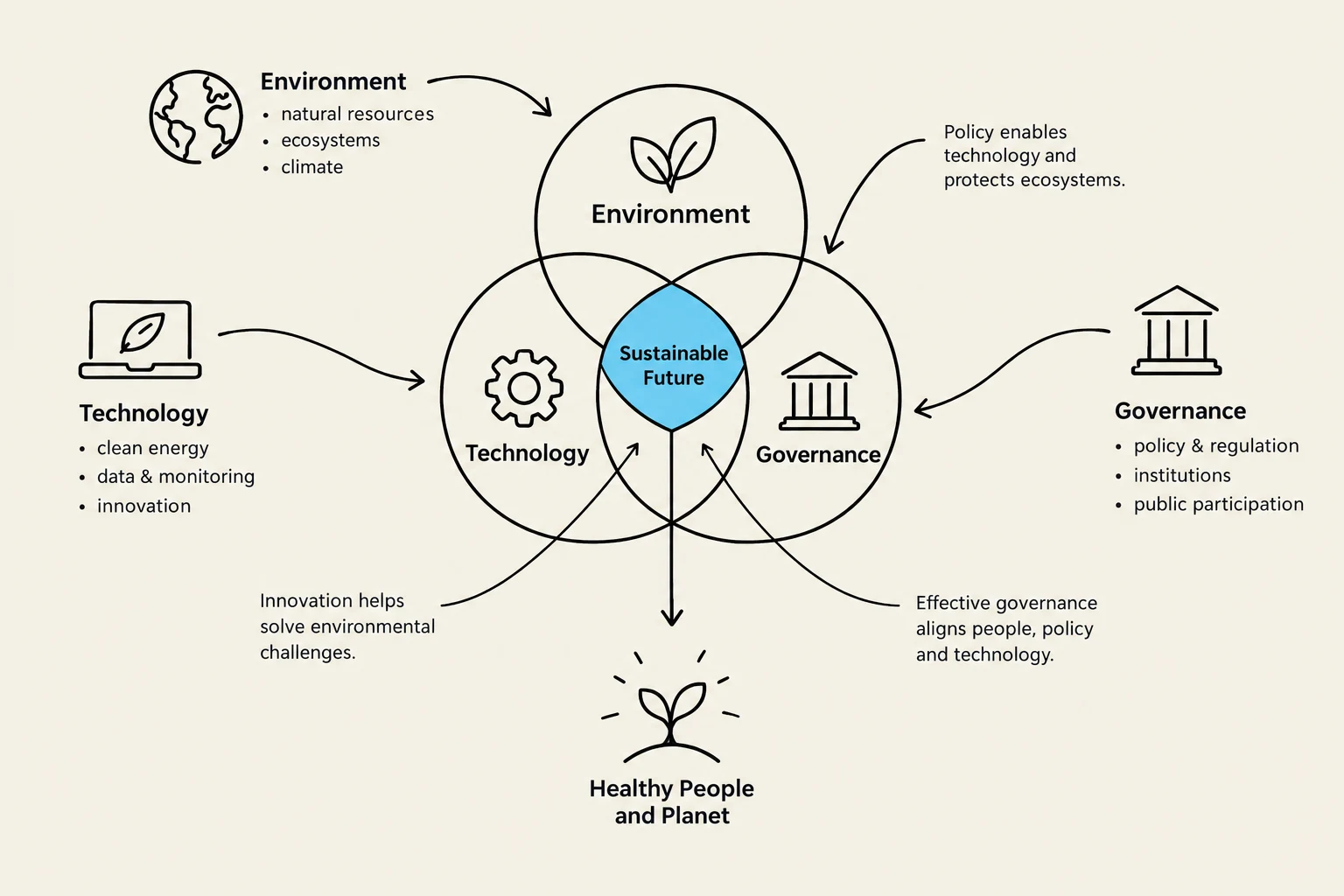
Governance and Technology: Solutions require not just scientific knowledge, but the technological tools to implement them and the governance structures to enforce them.
A diagram illustrating the interconnectedness of Environment, Technology, and Governance in achieving a Sustainable Future, which leads to a Healthy People and Planet.
Worked Example: The Path of a Contaminant
Imagine a factory begins releasing a new chemical into a local lake.
Science: An environmental scientist observes a decline in fish populations and identifies the chemical (framing the issue).
Public: Local residents notice the fish die-off and demand answers.
Politics/Government: The government must decide if regulating the factory is politically feasible and then passes a law to limit emissions.
Sustainability: A company develops a filtration system that allows the factory to operate without harming the lake, meeting economic needs while preserving the environment for the future.
Keep reading for free.
Create an account to finish this reading and make it part of your study routine.