This article explores the foundational concepts of ethics, morality, and the philosophical frameworks that guide human conduct in a professional setting, with a focus on the construction industry.
In the complex world of construction management, technical proficiency and project scheduling are only part of the equation for success. To navigate the intricate web of stakeholder interests, legal requirements, and social responsibilities, one must understand the underlying framework of ethics. Business ethics provides the compass used to navigate dilemmas where the "right" path may not be immediately obvious. This article explores the foundational concepts of ethics, morality, and the philosophical frameworks that guide human conduct in a professional setting.
Defining the Foundations: Ethics, Morality, and Ethos
To study business ethics, we must first distinguish between several closely related terms that form the bedrock of human behavior. While often used interchangeably in casual conversation, they carry specific nuances in a formal study of conduct.
Ethics is often defined as the "science of morals in human conduct." It involves the study of moral principles, rules of conduct, and the principles of human duty. In a professional context, ethics provides the systematic framework used to evaluate whether an action is acceptable.
Morality refers to the actual principles, rules, or the degree of conformity of an idea or practice to those principles. If ethics is the "science" or the study, morality is the "practice" or the system of rules being applied.
Ethos represents the characteristic spirit or the attitudes of a particular community, people, or system. In construction, a company's "ethos" is the collective attitude toward safety, quality, and honesty that defines its culture.
All aspects of human behavior are governed by sets of principles that originate from various sources, including history, religion, culture, custom, values, sociology, and philosophy. Because these influences vary across the globe, what is considered "right" or "wrong" can sometimes be viewed differently depending on the cultural or philosophical lens applied.
This diagram illustrates the relationship between Ethics (the study of right and wrong), Morality (the rules for right behavior), and Ethos (the cultural spirit that shapes values and attitudes), showing how they collectively create a culture of integrity and trust.
Philosophical Thought and Human Conduct
Human conduct is not performed in a vacuum; it is shaped by the environment and the belief systems developed during an individual's growth. When we analyze how a manager or a worker makes a decision, we are looking at the application of philosophical thought to real-world problems.
Philosophical frameworks help us categorize why we do what we do. For example, some people act based on the consequences of their actions, while others act based on a sense of obligation. Understanding these different "directions of thought" is essential for generating guidelines for ethical behavior in a construction firm.
Exam Tip: When analyzing a case study, do not just state if an action was "bad." Identify the reasoning behind the action. Was the person following a rule (Deontology) or looking at the result (Utilitarianism)?
The Deontological Perspective: The Ethics of Duty
One of the most significant frameworks in Western philosophy is deontology. The term is derived from the Greek word for "duty".
The deontological perspective proposes that an action is right if it conforms to a proper moral rule, regardless of the consequences. Conversely, an action is wrong if it violates such a rule. In this view, the "end does not justify the means." If a rule prohibits a specific action, that rule must be followed even if breaking it would result in a beneficial outcome for everyone involved.
In construction management, deontology is often seen in the strict adherence to:
Contracts and Agreements: Fulfilling the letter of a legal document because it is a promise made.
Professional Obligations: Following safety regulations not because they save money, but because it is the duty of the professional to protect life.
Relationships: Honoring the trust placed in a manager by their employees or stakeholders.
A flowchart illustrating a decision-making process based on moral rules or duties, involving action, checking against moral principles, and proceeding or reconsidering.
However, deontology presents a unique challenge for managers. A manager often faces "contradictory" or "incompatible" duties, such as the duty to maximize profit for shareholders versus the duty to provide high wages for employees.
Comparative Frameworks: Utilitarianism and Egoism
To understand deontology fully, it must be contrasted with consequentialism, specifically utilitarian ethics.
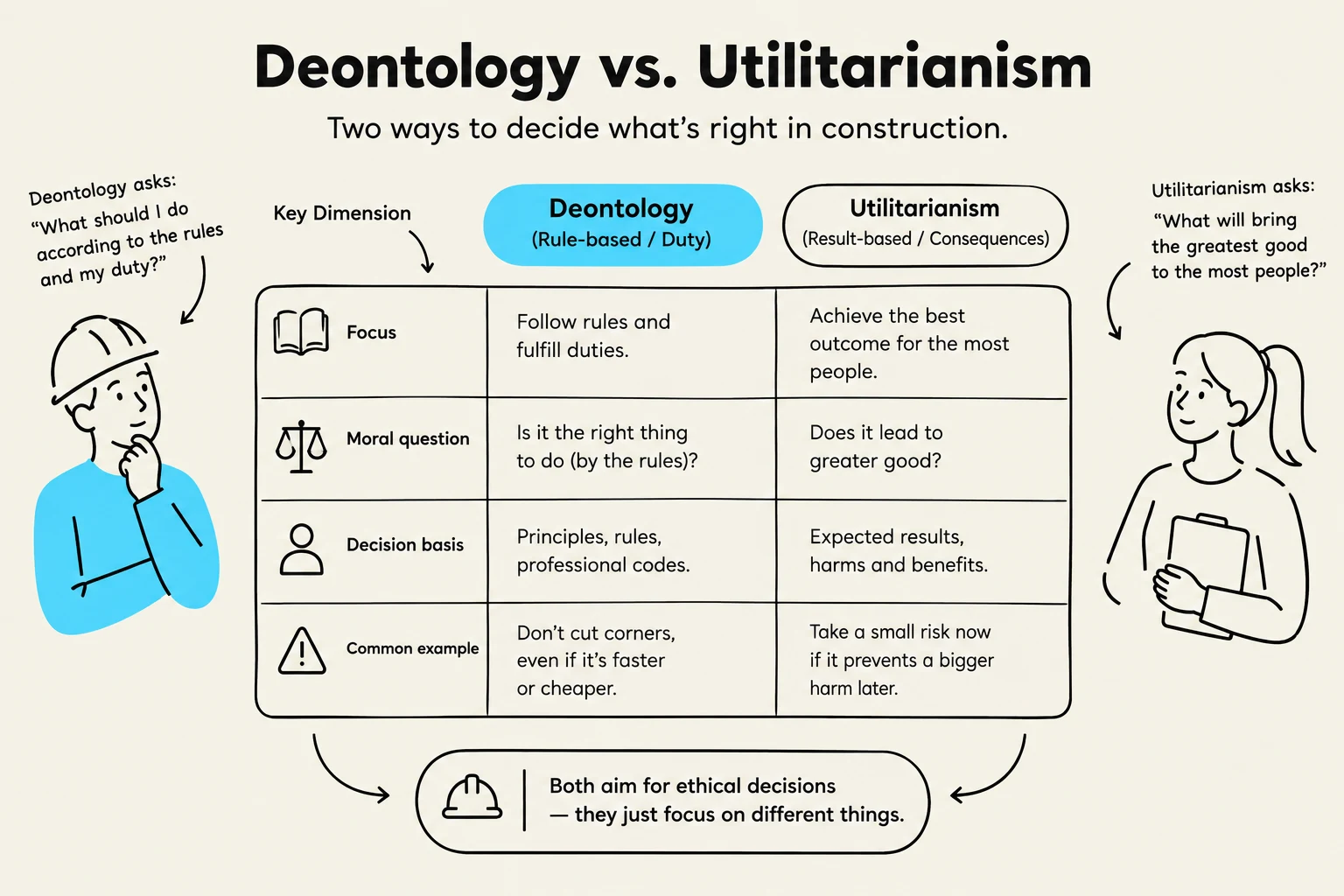
While a deontologist asks, "Is this action right according to the rules?", a utilitarian asks, "What will the result be?" For a utilitarian, the rightness or wrongness of an action is determined solely by its consequences. The goal is to achieve the "best consequences".
Within this spectrum, we find two distinct branches:
The Egoist Thesis: The choice is made based on what generates the best consequences for oneself.
The Altruist Thesis: The choice is made to afford the most benefit to the greatest number of people affected by the action.
This diagram compares Deontology and Utilitarianism, two ethical frameworks, by examining their focus, moral questions, decision basis, and common examples.
Ethical Issues in the Construction Industry
In practice, these philosophical debates manifest as specific, often difficult, professional issues. Construction professionals must navigate a landscape filled with potential ethical pitfalls. These can be categorized into several areas:
Professional Conduct and Loyalty
Honesty and Confidentiality: Protecting trade secrets and avoiding "ducking and diving" or covering up errors.
Loyalty: Balancing the promotion of an employer's interests against personal integrity.
Credit and Recognition: Avoiding the temptation to take credit for someone else's work or ideas.
Financial and Commercial Integrity
Gifts and Entertainment: Distinguishing between building professional relationships and accepting "rewards" that compromise objectivity.
Procurement: Avoiding "playing people off against one another" or using devious dealings rather than straight dealings when awarding contracts.
White-Collar Crime: Guarding against fraud, theft, and the exploitation of those at a disadvantage.
Social and Environmental Responsibility
Environmental Impact: Managing harmful substances discharged into the atmosphere or water systems and avoiding "greenwashing" (selling products as "environmentally friendly" when they are not).
Globalisation: Navigating the complexities of multi-cultural and multi-national business ethics where standards may differ.
By understanding these philosophical foundations—from the duty-bound nature of deontology to the consequence-driven logic of utilitarianism—construction professionals can better prepare themselves for the complex moral landscape of the modern industry.
Keep reading for free.
Create an account to finish this reading and make it part of your study routine.