An overview of the fundamental branches of civil law, including the law of persons, obligations, property, and succession, with a focus on the distinctions between relative and absolute rights.
Civil law is a vast and foundational legal field that governs the essential aspects of human existence, from the moment of birth to the distribution of assets after death. While legal systems vary between civil law and common law jurisdictions, they all share the fundamental goal of regulating how individuals interact, how they acquire property, and how they fulfill their obligations to one another.
To understand civil law, one must view it as a collection of specialized branches, each addressing a specific dimension of legal life: the law of persons, the law of obligations, property law, and succession law.
The Law of Persons: Personality and Capacity
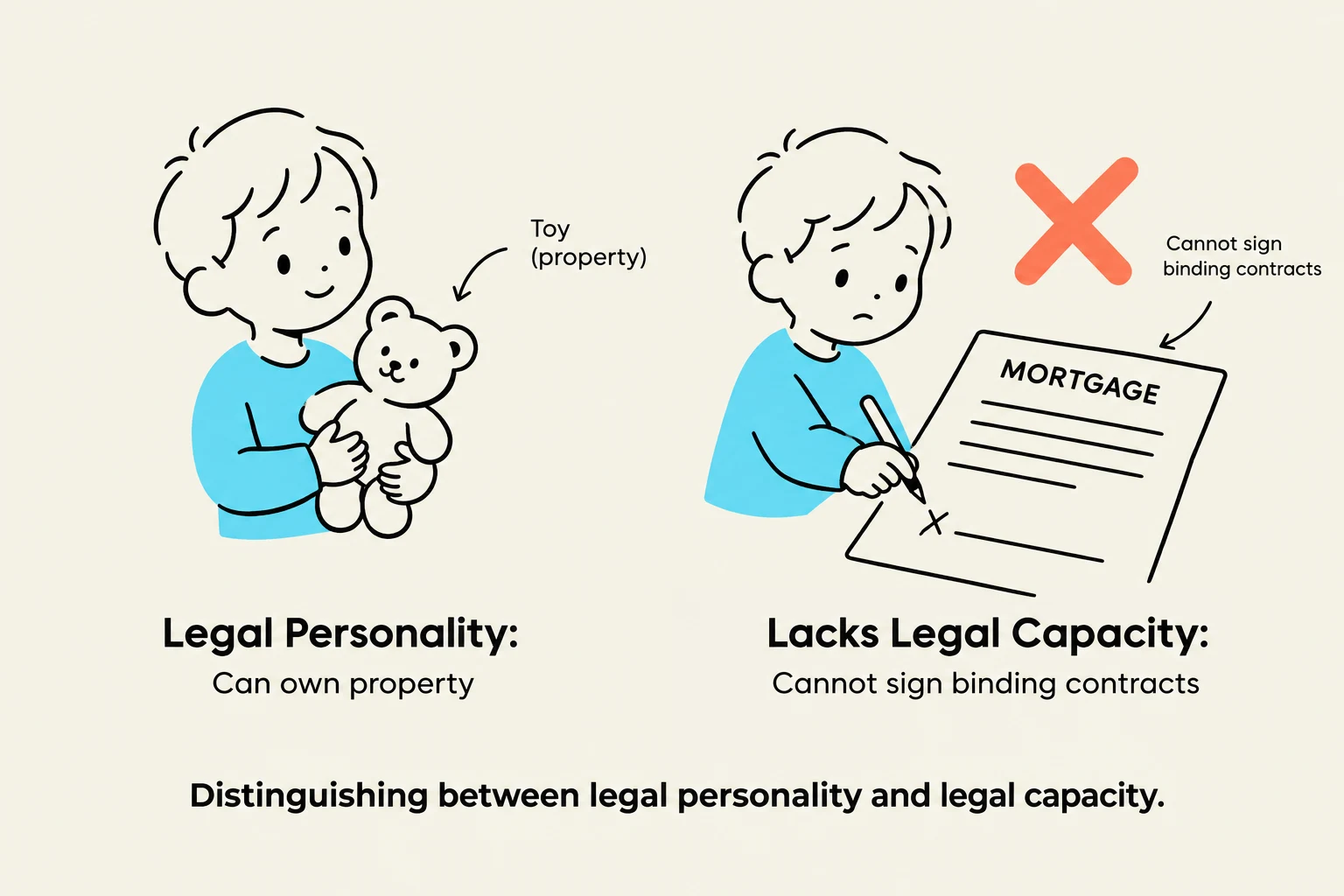
This illustration distinguishes between legal personality, the ability to own property, and legal capacity, the ability to enter into binding contracts, using a child as an example.
The journey through civil law begins with the individual. The law of persons establishes the legal status of human beings and, in many jurisdictions, legal entities like corporations. Two central concepts define this area:
Legal Personality: This is the capacity to be a subject of rights and obligations. In most jurisdictions, legal personality begins at birth. There is even a historical legal presumption in some traditions that an unborn child may acquire rights under specific circumstances.
Legal Capacity: While personality grants you the status of a "person," legal capacity refers to your ability to perform legally binding acts, such as signing a contract. For example, a minor may have legal personality (they can own a toy) but may lack the legal capacity to sign a binding mortgage agreement until they reach the age of majority (often 18).
Beyond these, the law of persons also governs family matters, including marriage regimes (such as the separation of goods versus the sharing of assets) and the obligations parents have toward their minor children.
The Law of Obligations: Contracts, Torts, and Enrichment
The law of obligations governs the relationships and duties that arise between parties. This branch is typically divided into three distinct pillars:
1. Contracts and Relative Rights
A contract is an agreement that creates relative rights. These rights are "relative" because they are personal; they only bind the specific parties who entered into the agreement. If you sign a contract to buy a book from a friend, that contract does not impose any obligations on a stranger on the street.
2. Tort Law and Civil Liability
This diagram illustrates the concept of civil liability, showing how a negligent omission (failure to prune a tree) can lead to a causal link (branch falls) resulting in damage (a broken house).
When a person causes harm to another outside of a contractual relationship, tort law applies. In civil law jurisdictions, establishing liability for a tort generally requires proving three elements:
Damage: There must be a quantifiable loss or harm.
Negligent Action or Omission: The party must have acted carelessly or failed to act when they had a duty to do so. In common law, this is often framed as a breach of a duty of care.
Causal Link: There must be a direct connection between the negligent act and the damage caused.
Worked Example: The Overhanging Tree
Imagine you have a large tree in your garden. A branch grows over your neighbor's property and eventually falls, causing damage to their house.
Damage: The neighbor's house is broken.
Negligence: You failed to prune the branch despite knowing it was a hazard (an omission).
Causation: If the branch falling was the direct cause of the house damage, you are civilly liable.
3. Unjust (Unfair) Enrichment
This doctrine addresses situations where one party is enriched at the expense of another without a valid legal reason. A classic example is an erroneous bank transfer: if you accidentally send €1,000 to the wrong person, there is no contract or tort involved, but the recipient has been "unjustly enriched" and is legally required to return the funds.
Property Law: Absolute Rights and Servitudes
Unlike the relative rights found in contracts, property law deals with absolute rights. An absolute right is enforceable against the entire world, not just a specific person.
A defining characteristic of property rights is that they follow the thing (jus persequendi). This means the right is attached to the object itself, regardless of who owns it.
The Right of Servitude
Visualizing a servitude between two plots of land.
A servitude is a specific type of property right that exists between two pieces of land. It involves:
The Dominant Plot: The land that benefits from the servitude.
The Servient Plot: The land that is subject to the servitude (the "serving" land).
For example, if a dominant plot has a right of way over a servient plot, that right remains even if both owners sell their land to new people. The new owner of the dominant plot acquires the right, and the new owner of the servient plot must respect it.
Limitations on Property Rights
Ownership is not absolute in the sense of being unlimited. Rights can be restricted by:
Public Law: Such as expropriation, where the state takes private property for public use (e.g., building a road) provided there is a public interest and fair compensation.
Private Law (Abuse of Rights): The doctrine of "abuse of rights" prevents an owner from using their property in a way that is purely intended to harm others without a reasonable benefit to themselves (e.g., a neighbor throwing constant loud parties just to annoy you).
Succession Law: The Transfer of Assets
Finally, succession law governs what happens to a person's movable and immovable goods upon their death.
Legal systems differ significantly here. Common law systems often emphasize "testamentary freedom," allowing individuals to leave their assets to whomever they choose. In contrast, many civil law jurisdictions include elements of collectivism, mandating that a certain portion of the estate must go to specific heirs, such as descendants or spouses.
Summary Table: Relative vs. Absolute Rights
Feature
Relative Rights (e.g., Contracts)
Absolute Rights (e.g., Property)
Enforceability
Only against specific parties involved
Against the entire world
Nature
Personal/Contractual
Real/Property-based
Transfer
Often ends with the person (unless inherited)
"Follows the thing" (jus persequendi)
Keep reading for free.
Create an account to finish this reading and make it part of your study routine.