Introduction to Chemical Reactions, Stoichiometry, and Solutions
An overview of chemical equations, stoichiometry, gas behavior, solubility rules, and molarity in chemistry. Learn about balancing equations, mole ratios, limiting reactants, the Ideal Gas Law, and precipitation reactions.
Chemistry is often described as the study of change, but for a chemist, that change must be predictable and measurable. To understand how much of a substance we need to create a specific amount of product, we must master the language of chemical equations, the math of stoichiometry, and the physical rules of solubility and gas behavior.
The Language of Chemical Equations
Every chemical reaction is represented by a chemical equation, which serves as a recipe for the transformation of matter. A balanced equation is essential because it adheres to the law of conservation of mass (also known as mass conservation), which states that matter is neither created nor destroyed during a chemical reaction.
To read an equation correctly, you must distinguish between two types of numbers:
Subscripts: These small numbers indicate the number of atoms of a specific element within a single molecule or formula unit (e.g., the "2" in H2O). Changing a subscript changes the identity of the substance itself.
Coefficients: These large numbers placed in front of chemical formulas indicate the number of molecules or moles involved in the reaction. We adjust coefficients to balance the equation, ensuring the number of atoms for each element is the same on both the reactant (left) and product (right) sides.
Exam Tip: Never change a subscript to balance an equation! You can only change the coefficients. Changing a subscript changes the chemical identity of the substance.
Stoichiometry and the Mole Concept
Stoichiometry is the quantitative study of reactants and products in a chemical reaction. The bridge between the microscopic world of atoms and the macroscopic world of grams and liters is the mole. One mole of any substance contains Avogadro's number of particles: 6.022×10²³.
Mole Ratios
Once an equation is balanced, the coefficients provide the mole ratios. These ratios allow us to predict how much product will form from a given amount of reactant. For example, in the reaction:
4NH3(g)+5O2(g)→4NO(g)+6H2O(l)
The ratio of NH3 to O2 is $4:5$. If you have 8.00 moles of ammonia, you can calculate the required oxygen using this ratio.
Limiting and Excess Reactants
In real-world laboratory settings, reactants are rarely present in the exact stoichiometric proportions required. This leads to two important concepts:
Limiting Reactant: The reactant that is completely consumed first, thereby limiting the amount of product that can be formed. It is the reactant that produces the lowest mass of product.
Excess Reactant: The reactant that remains in the container after the reaction has gone to completion.
Diagram illustrating a chemical reaction with representations of hydrogen and nitrogen atoms before and after the reaction.
The diagram above illustrates how, in a closed system, the total number of atoms remains constant even as they rearrange into new molecules, demonstrating mass conservation.
Combustion and Gas Behavior
A common type of reaction is the combustion reaction, such as the burning of propane (C3H8) in oxygen to produce carbon dioxide and water vapor. When these reactions involve gases, we often use the Ideal Gas Law to predict their behavior:
PV=nRT
Where P is pressure, V is volume, n is moles, R is the ideal gas constant (0.08206 L⋅atm/mol⋅K), and T is temperature in Kelvin.
When working with gases, we frequently refer to Standard Temperature and Pressure (STP), defined as 1.0 atm and 273 K. At STP, one mole of an ideal gas occupies 22.4 L. In most chemistry problems, you should assume ideal behavior for gases unless explicitly told otherwise.
Solubility and Precipitation Reactions
When two aqueous solutions are mixed, they may undergo a double-replacement reaction that results in the formation of a precipitate—an insoluble solid that "falls out" of the solution.
Solubility Rules
To predict whether a precipitate will form, chemists use solubility rules:
Highly Soluble: Most nitrate salts, and most salts containing sodium (Na+), potassium (K+), or ammonium (NH4+) cations.
Often Insoluble: Most hydroxide, sulfide, carbonate, and phosphate salts, unless they are paired with Na+, K+, or NH4+.
Exceptions: Most chloride salts are soluble, except for those containing silver (Ag+), lead (Pb2+), or mercury(I).
Net Ionic Equations and Spectator Ions
When a precipitate forms, we can write a net ionic equation to show only the species actually participating in the chemical change.
For example, in the reaction between silver nitrate and potassium carbonate:
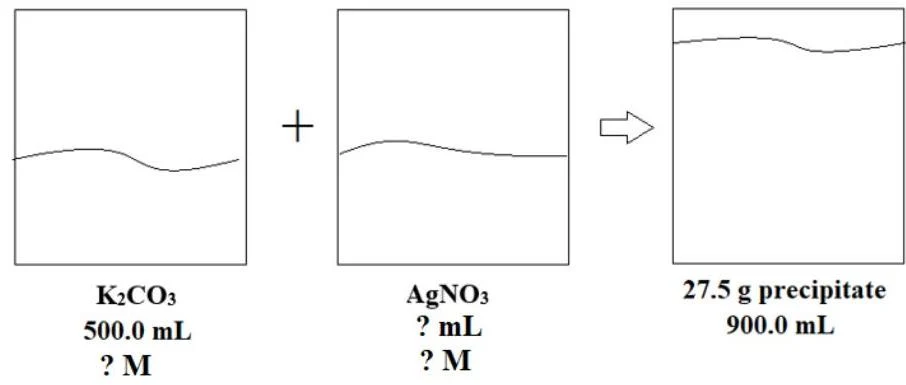
K2CO3(aq)+2AgNO3(aq)→Ag2CO3(s)+2KNO3(aq)
The potassium (K+) and nitrate (NO3−) ions do not participate in the formation of the solid; they remain dissolved in the water. These are called spectator ions. The net ionic equation focuses only on the formation of the precipitate:
2Ag+(aq)+CO32−(aq)→Ag2CO3(s)
Molarity and Concentration
In aqueous chemistry, we express the amount of solute in a solution using molar concentration, commonly known as molarity (M). Molarity is defined as the number of moles of solute per liter of solution:
Molarity (M)=Liters of solutionmoles of solute
It is important to note how concentration changes during laboratory procedures:
Dilution: Adding water to a solution increases the total volume and decreases the concentration, but the total number of moles of solute remains the same.
Concentration Changes: Adding more solute without adding water will increase the molarity, whereas pouring a portion of a solution into a new container does not change the concentration of the liquid being poured.
A chemical reaction diagram showing the combination of potassium carbonate and silver nitrate to form a precipitate.
The mixing of two clear solutions can result in a sudden change in appearance, such as the formation of a solid, as illustrated in the diagram above.
Keep reading for free.
Create an account to finish this reading and make it part of your study routine.