Introduction to Chemical Reactions: Reactants, Products, and Balancing Equations
This article explains the fundamental concepts of chemical reactions, including the identification of reactants and products, the structure and meaning of chemical equations, and the Law of Conservation of Mass. It provides a worked example of balancing a simple chemical equation.
At the heart of chemistry lies the concept of change. Whether it is the rusting of an iron nail, the combustion of fuel in an engine, or the complex metabolic pathways within a human cell, these processes are all driven by chemical reactions. To study these changes scientifically, we must move beyond mere observation and learn to describe them using a standardized language. This article explores the fundamental building blocks of chemical reactions: distinguishing between the substances that start a reaction and those that result from it, and mastering the notation used to represent these transformations.
The Anatomy of a Reaction: Reactants vs. Products
Every chemical reaction involves a transformation of matter. During this process, chemical bonds between atoms are broken and new bonds are formed, resulting in the creation of new substances with different properties than the original ones. To keep track of this process, chemists categorize substances into two primary groups: reactants and products.
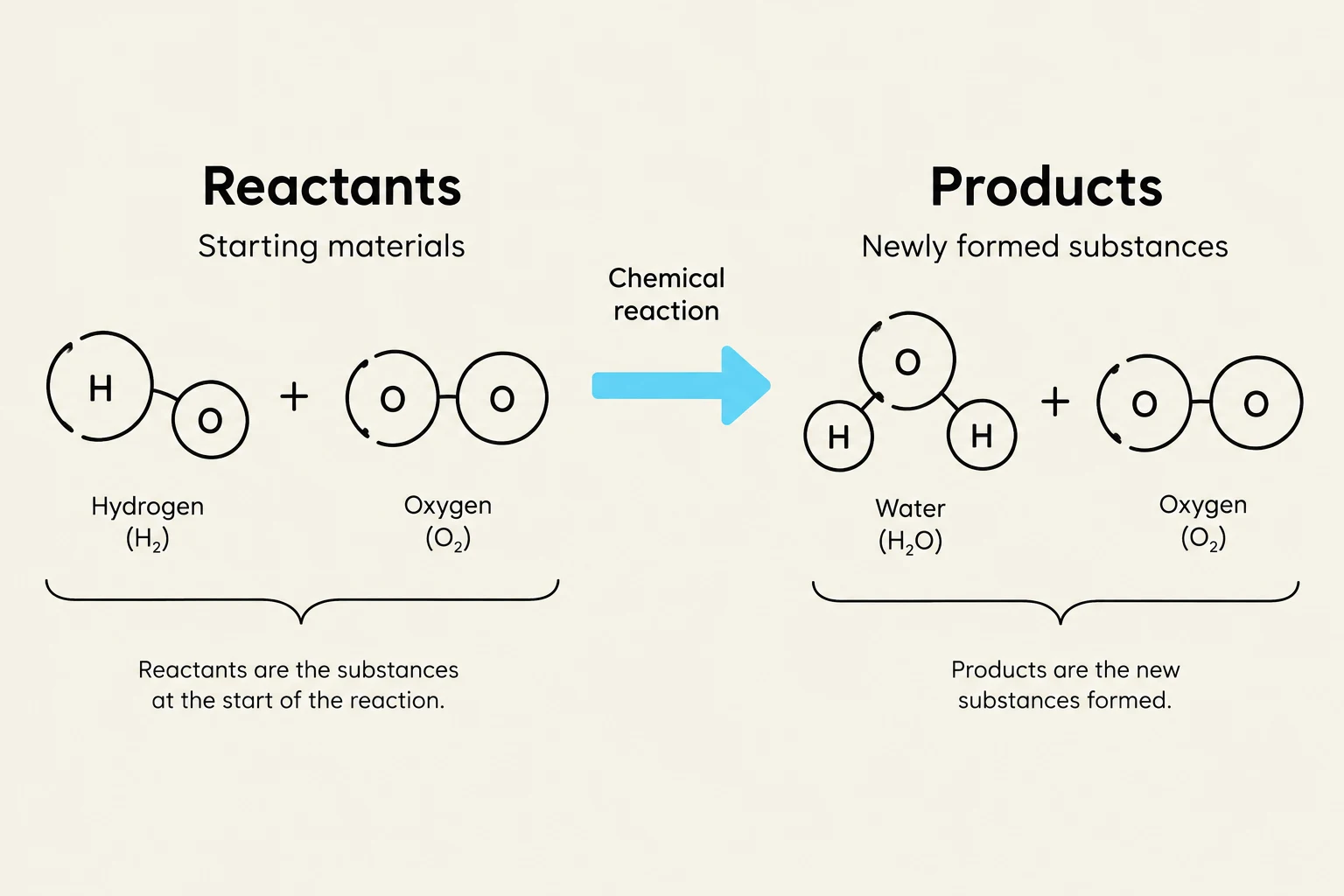
Reactants are the starting materials in a chemical reaction. They are the substances that exist before the transformation occurs and are consumed during the process. In a written equation, reactants are always placed on the left side.
Products are the substances that are formed as a result of the reaction. They are the end results of the chemical change and are placed on the right side of the equation.
Exam Tip: When reading a word problem, look for keywords like "reacts with," "combines with," or "is consumed to form." The substances being "consumed" are your reactants, while the substances "formed" are your products.
This diagram illustrates the chemical reaction where hydrogen and oxygen combine to form water, with oxygen also being a product.
Decoding the Chemical Equation
A chemical equation is a symbolic representation of a chemical reaction. It serves as a mathematical-like shorthand that tells us exactly which substances are involved and in what proportions. A standard equation consists of several key components: the chemical formulas of the reactants, an arrow, and the chemical formulas of the products.
The arrow (→) is perhaps the most critical symbol in the equation. It is often read as "yields" or "produces." It indicates the direction of the chemical change, pointing from the reactants toward the products.
Consider the classic reaction of hydrogen gas reacting with oxygen gas to produce liquid water:
H2(g)+O2(g)→H2O(l)
In this example, H2 and O2 are the reactants, while H2O is the product. Note the use of subscripts, which indicate the number of atoms of an element within a single molecule, and state symbols (like g for gas or l for liquid) which provide additional context about the physical state of the substances.
This diagram illustrates the chemical reaction where hydrogen and oxygen combine to form water, showing the reactants, yield arrow, and products.
The Law of Conservation of Mass
One of the most important rules in chemistry is that matter is neither created nor destroyed during a chemical reaction. This is known as the Law of Conservation of Mass. In the context of a chemical equation, this means that the total number of atoms of each element must be exactly the same on both the reactant side and the product side.
If you start with four atoms of oxygen in your reactants, you must end with four atoms of oxygen in your products. Because of this law, chemical equations must be "balanced."
Worked Example: Balancing a Simple Equation
Let's look at the combustion of methane (CH4). If we simply write the reactants and products, we get:
CH4+O2→CO2+H2O
If we count the atoms on each side:
Left (Reactants): 1 Carbon, 4 Hydrogen, 2 Oxygen
Right (Products): 1 Carbon, 2 Hydrogen, 3 Oxygen (2 from CO2 and 1 from H2O)
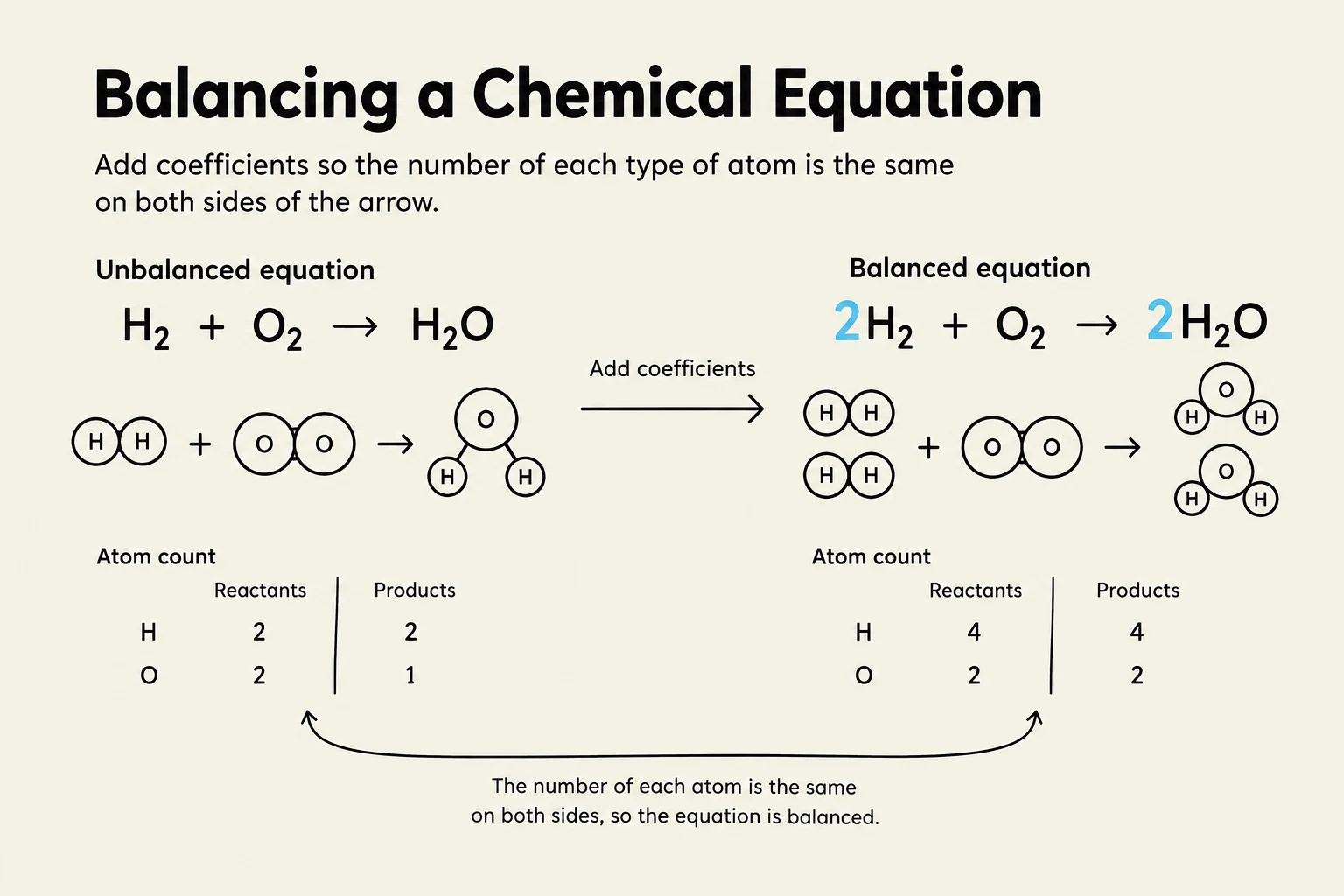
The equation is unbalanced because the hydrogen and oxygen counts do not match. To fix this, we use coefficients—large numbers placed in front of chemical formulas to multiply the number of atoms in that molecule. We cannot change the subscripts (the small numbers), as that would change the identity of the substance itself.
To balance the hydrogen, we place a 2 in front of H2O:
CH4+O2→CO2+2H2O
Now we have 4 Hydrogens on both sides. However, the Oxygen count on the right is now 4 (2 from CO2 and 2 from 2H2O). To balance the Oxygen on the left, we place a 2 in front of O2:
CH4+2O2→CO2+2H2O
Final Check:
Reactants: 1 C, 4 H, 4 O
Products: 1 C, 4 H, 4 O
The equation is now balanced and obeys the Law of Conservation of Mass.
This illustration demonstrates how to balance a chemical equation by adjusting coefficients to ensure an equal number of atoms on both the reactant and product sides.
Summary Table of Components
To consolidate your understanding, refer to the following table which summarizes the essential elements of a chemical equation.
Component
Symbol/Location
Function
Reactants
Left side of arrow
The starting substances being consumed.
Products
Right side of arrow
The new substances being formed.
Yield Arrow
→
Indicates the direction of the reaction.
Subscript
Small number (e.g., H2)
Indicates the number of atoms in a molecule.
Coefficient
Large number (e.g., 2H2O)
Indicates the number of molecules/moles present.
By mastering these fundamentals, you build the necessary foundation for more advanced topics, such as stoichiometry and thermochemistry, where the precise quantities of reactants and products become the primary focus of study.
Keep reading for free.
Create an account to finish this reading and make it part of your study routine.