Cellular respiration is the fundamental process by which cells convert glucose and oxygen into ATP, the energy currency of life, through a series of redox reactions and metabolic stages.
At its core, cellular respiration is the process by which cells harvest energy from food molecules, such as glucose, to produce ATP (adenosine triphosphate). This process is essential for life, as ATP serves as the primary energy currency for biological work. In aerobic organisms, this process occurs in the presence of oxygen.
The overall chemical equation for the breakdown of glucose can be summarized as follows:
C6H12O6+6O2→6CO2+6H2O+Energy
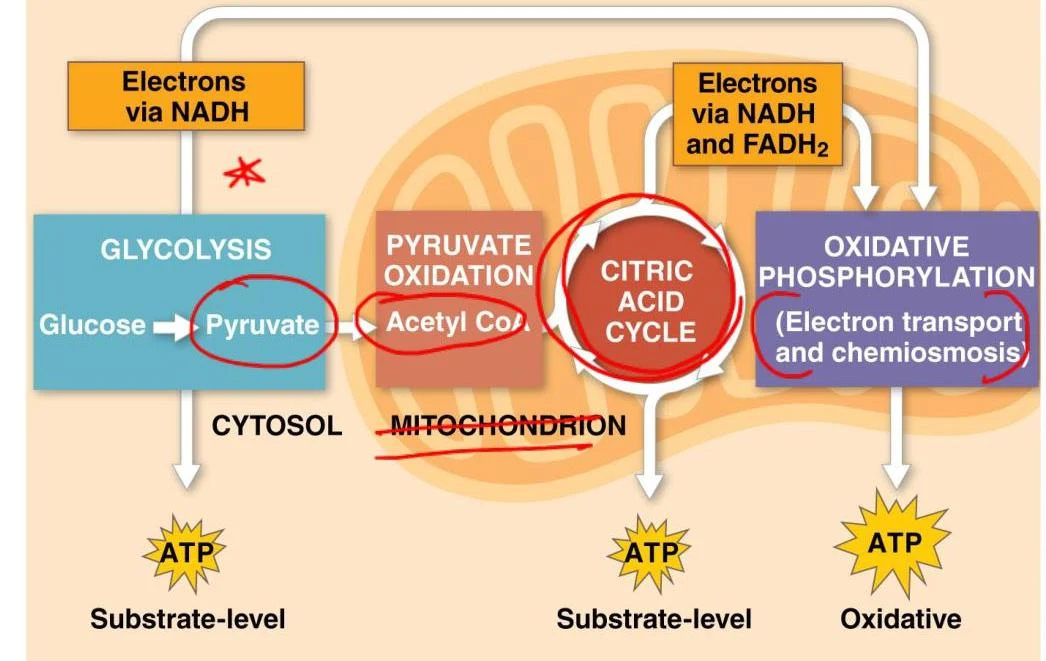
This diagram illustrates the key stages of cellular respiration, including glycolysis, pyruvate oxidation, the citric acid cycle, and oxidative phosphorylation, showing the production of ATP in the cytosol and mitochondria.
The process is not a single explosion of energy but rather a controlled series of steps that allow the cell to capture energy efficiently.
The Chemistry of Energy: Redox Reactions
Cellular respiration relies heavily on redox reactions, which are chemical reactions involving the transfer of electrons from one molecule to another. These reactions are divided into two parts:
Oxidation: The loss of electrons from a molecule.
Reduction: The gain of electrons by a molecule.
In the context of cellular respiration, organic molecules like glucose are oxidized (losing electrons), while oxygen (O2) is reduced (gaining electrons). When electrons are transferred from a less electronegative atom to a more electronegative one, potential energy is released.
To facilitate this transfer, cells use electron carriers. One of the most important is NAD+. When NAD+ accepts electrons (and protons), it becomes reduced to NADH. NADH essentially acts as a shuttle, storing the energy from the electrons to be used later in the respiration process.
Exam Tip: Remember the mnemonic "OIL RIG" — Oxidation Is Loss, Reduction Is Gain of electrons.
The Three Stages of Cellular Respiration
The harvesting of energy from glucose occurs in three major stages: Glycolysis, Pyruvate Oxidation/the Citric Acid Cycle, and Oxidative Phosphorylation.
1. Glycolysis: The Splitting of Sugar
Glycolysis is an ancient metabolic pathway that occurs in the cytosol of the cell. During this stage, a single molecule of glucose is oxidized and broken down into two molecules of pyruvate.
This stage involves two phases: an energy investment phase and an energy payoff phase. While the cell must initially spend 2 ATP to start the process, it ultimately produces 4 ATP, resulting in a net gain of 2 ATP per glucose molecule. Additionally, NAD+ is reduced to NADH during this process.
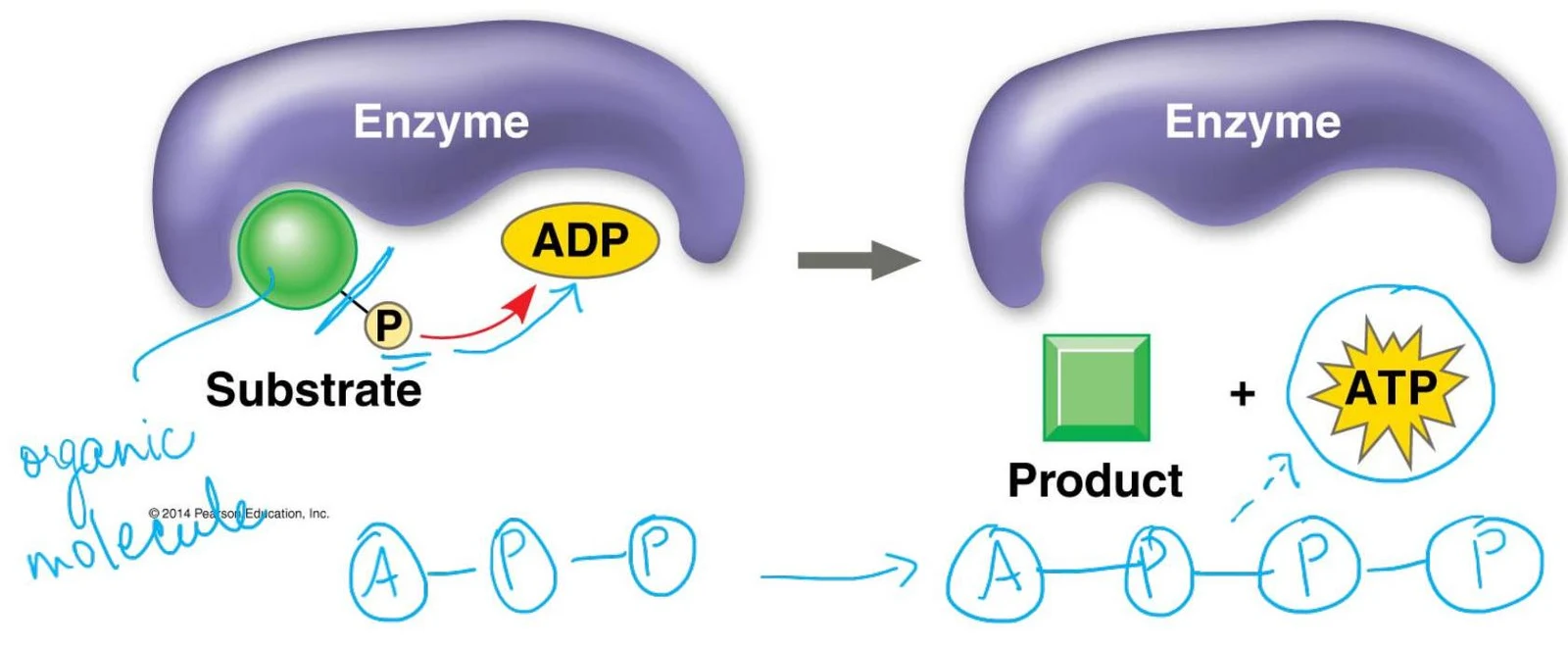
The ATP produced in glycolysis is generated via substrate-level phosphorylation, which is the direct transfer of a phosphate group from an organic molecule to ADP by an enzyme.
This diagram illustrates the action of an enzyme on a substrate, resulting in the formation of a product and ATP from ADP and a phosphate group.
2. Pyruvate Oxidation and the Citric Acid Cycle
If oxygen is present, the pyruvate molecules move into the mitochondrion to complete the breakdown of glucose.
Pyruvate Oxidation:
First, pyruvate is oxidized into a two-carbon molecule called Acetyl-CoA. During this step, CO2 is released as a waste product, and NAD+ is reduced to NADH.
The Citric Acid Cycle (Krebs Cycle):
Next, Acetyl-CoA enters the Citric Acid Cycle. This cycle further oxidizes the remains of the original glucose molecule. The cycle releases more CO2 and produces:
1 ATP (via substrate-level phosphorylation)
3 NADH
1 FADH2
3. Oxidative Phosphorylation: The Big Payoff
While the previous stages produce some ATP, the vast majority of ATP synthesis occurs during oxidative phosphorylation. This stage takes place in the inner membrane of the mitochondrion and consists of two interconnected parts: the Electron Transport Chain (ETC) and chemiosmosis.
The Electron Transport Chain (ETC):NADH and FADH2 (produced in earlier steps) donate their high-energy electrons to a series of protein complexes located in the inner mitochondrial membrane. As electrons move through these complexes in small steps, energy is released. This energy is used to pump protons (H+) from the mitochondrial matrix into the intermembrane space, creating a proton gradient. At the end of the chain, the electrons are accepted by oxygen (O2), which combines with protons to form water (H2O).
Chemiosmosis:
The proton gradient created by the ETC represents stored potential energy. In a process called chemiosmosis, these protons move back down their concentration gradient into the matrix through a special protein complex called ATP synthase. The movement of protons through ATP synthase provides the energy necessary to add a phosphate group to ADP, creating ATP.
Summary of Energy Yield
When all stages are complete, the cell has successfully converted the chemical energy in one molecule of glucose into approximately 30-32 molecules of ATP.
Stage
Location
Main Output (per glucose)
ATP Method
Glycolysis
Cytosol
2 Pyruvate, 2 NADH, 2 ATP (net)
Substrate-level
Pyruvate Oxidation
Mitochondrion
Acetyl-CoA, CO2, NADH
N/A
Citric Acid Cycle
Mitochondrion
CO2, NADH, FADH2, ATP
Substrate-level
Oxidative Phosphorylation
Inner Mitochondrion
~26-28 ATP, H2O
Oxidative
Keep reading for free.
Create an account to finish this reading and make it part of your study routine.