Explores the fundamental role of cells as the basic units of life, detailing their diverse structures, organelles, and the processes of transport, division, and differentiation.
The study of cells is known as cytology. Cells serve as the fundamental basic units of all living matter, and they are incredibly diverse; they vary significantly in size, shape, and function to meet the specific needs of the organism. Because of this diversity, a cell's specific structures are direct reflections of its specialized roles within the body.
The Cell Membrane and Surface Specializations
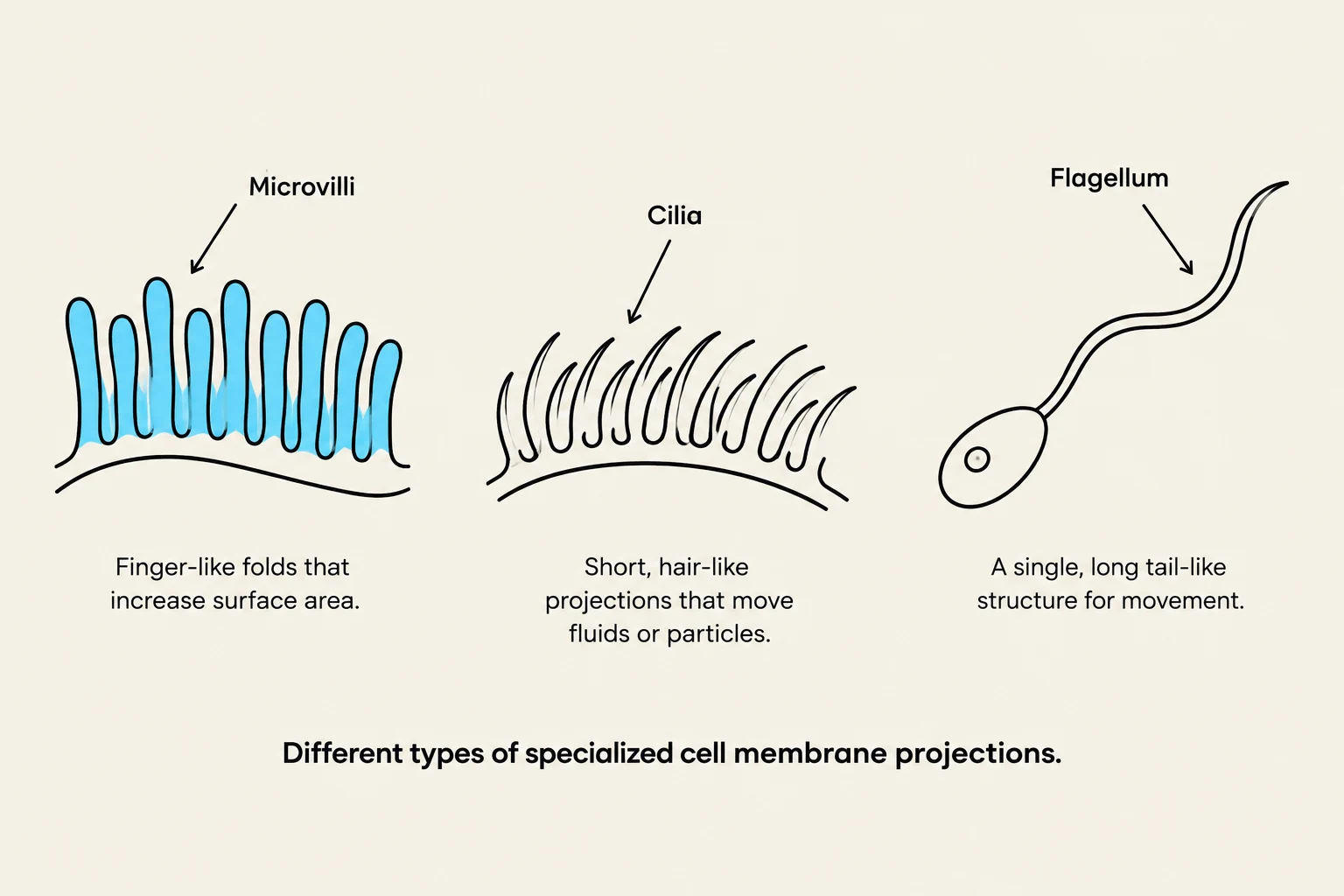
Diagrams illustrating microvilli, cilia, and flagellum, which are specialized projections of cell membranes.
Every cell is enclosed by a cell membrane, which acts as a selective barrier. Depending on the cell's function, the membrane may feature various specialized structures to enhance its capabilities:
Microvilli: These are folds in the membrane that increase surface area, which is essential for the efficient absorption of fluids and dissolved solutes.
Cilia: These hair-like projections move substances across the surface of the cell.
Flagella: These are longer structures used to move the entire cell itself, such as the tail of a sperm cell that enables it to swim.
Inside the Cell: The Nucleus and Cytoplasm
The interior of a typical cell is divided into two main regions: the nucleus and the cytoplasm.
The Nucleus
The nucleus serves as the control center of the cell. Within the nucleus, you will find:
Nucleolus: A structure within the nucleus responsible for various functions, including ribosome production.
Chromatin: The material containing genetic information.
The Cytoplasm
The cytoplasm is often described as the "gel in the cell". It consists of the cytosol (the fluid component) and various organelles (specialized structures).
Cellular Organelles: The Cell's Machinery
Organelles are the "little organs" that perform specific tasks to keep the cell alive and functioning.
Organelle
Primary Function
Mitochondria
The "power plants" of the cell; they produce energy
Use powerful enzymes to break down intracellular waste and kill ingested bacteria
Cytoskeleton
Maintains cell shape and assists in cellular movement
Centrioles
Form the spindle apparatus during cell division
Movement Across the Cell Membrane
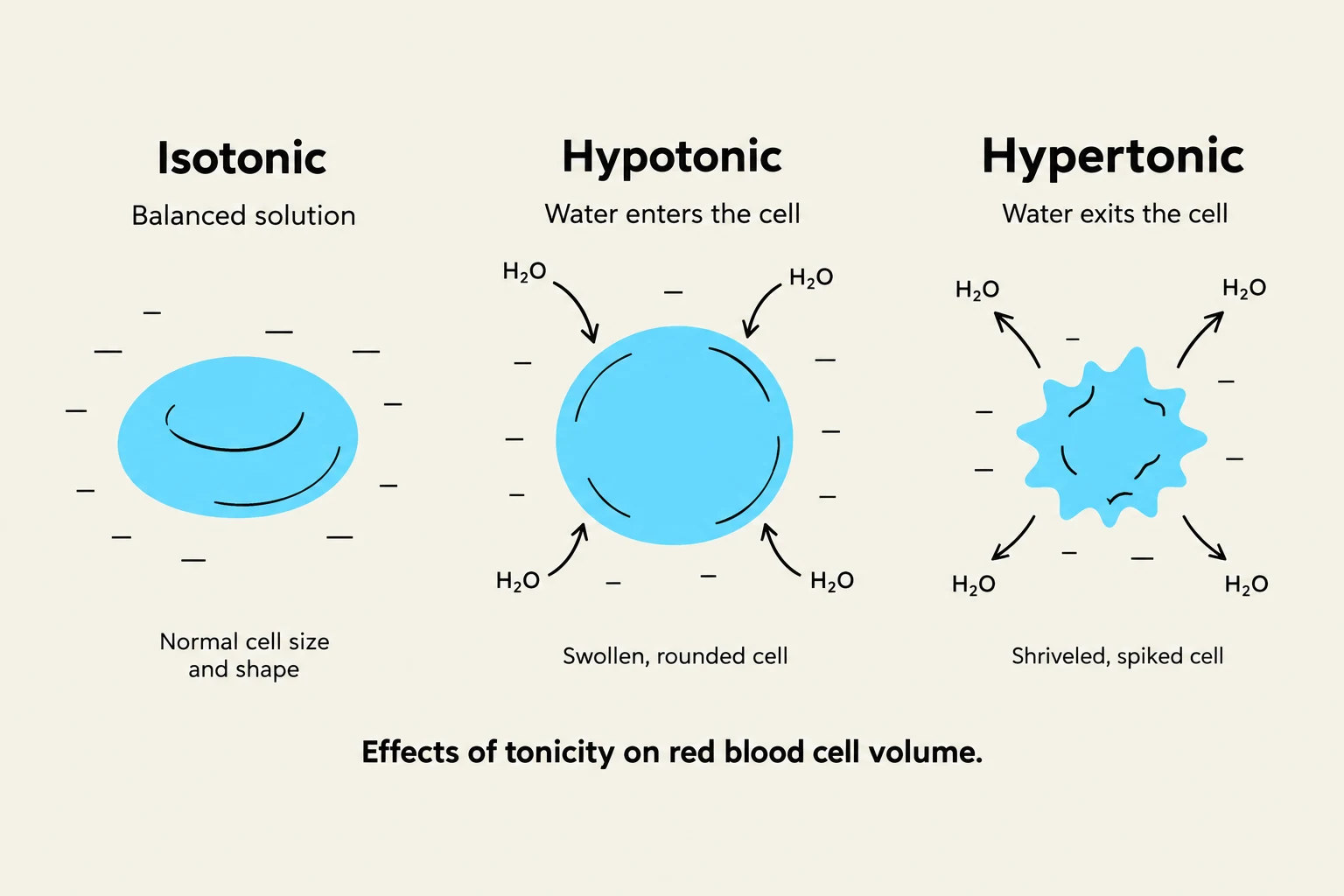
This diagram illustrates the effects of isotonic, hypotonic, and hypertonic solutions on red blood cell volume, showing how water movement affects cell shape.
Cells must constantly exchange materials with their environment. This movement is categorized into two main types: passive and active transport.
Passive Transport
Passive transport does not require an input of energy because substances move along a concentration gradient (from high to low concentration).
Diffusion: The movement of a substance from an area of high concentration to an area of low concentration.
Facilitated Diffusion: A process where a "helper molecule" assists the movement of substances from high to low concentration.
Osmosis: The specific diffusion of water (the solvent) across a semipermeable membrane.
Filtration: The "pushing" of water and dissolved substances from an area of high pressure to an area of low pressure.
Exam Tip: Understanding Tonicity
Tonicity describes how a solution affects the volume and pressure within a cell.
Isotonic solution: The concentration is the same as the intracellular fluid; the cell remains stable.
Hypotonic solution: The solution has a lower concentration than the cell, causing water to rush in and potentially causing Red Blood Cells (RBCs) to burst (lyse).
Hypertonic solution: The solution has a higher concentration than the cell, causing water to leave and the cell to shrink (crenate).
Active Transport
Active transport requires energy in the form of ATP (adenosine triphosphate) because it moves substances "uphill"—from an area of low concentration to an area of high concentration. A classic example is the sodium-potassium pump, which allows a cell to maintain higher levels of potassium ($K^+$) inside the cell than in the surrounding vascular space.
Active transport also includes bulk movement:
Endocytosis: Taking in or ingesting substances. This includes phagocytosis (engulfing solid particles, like a white blood cell eating bacteria) and pinocytosis (engulfing liquid droplets).
Exocytosis: The secretion of cellular products out of the cell.
The Cell Cycle and Division
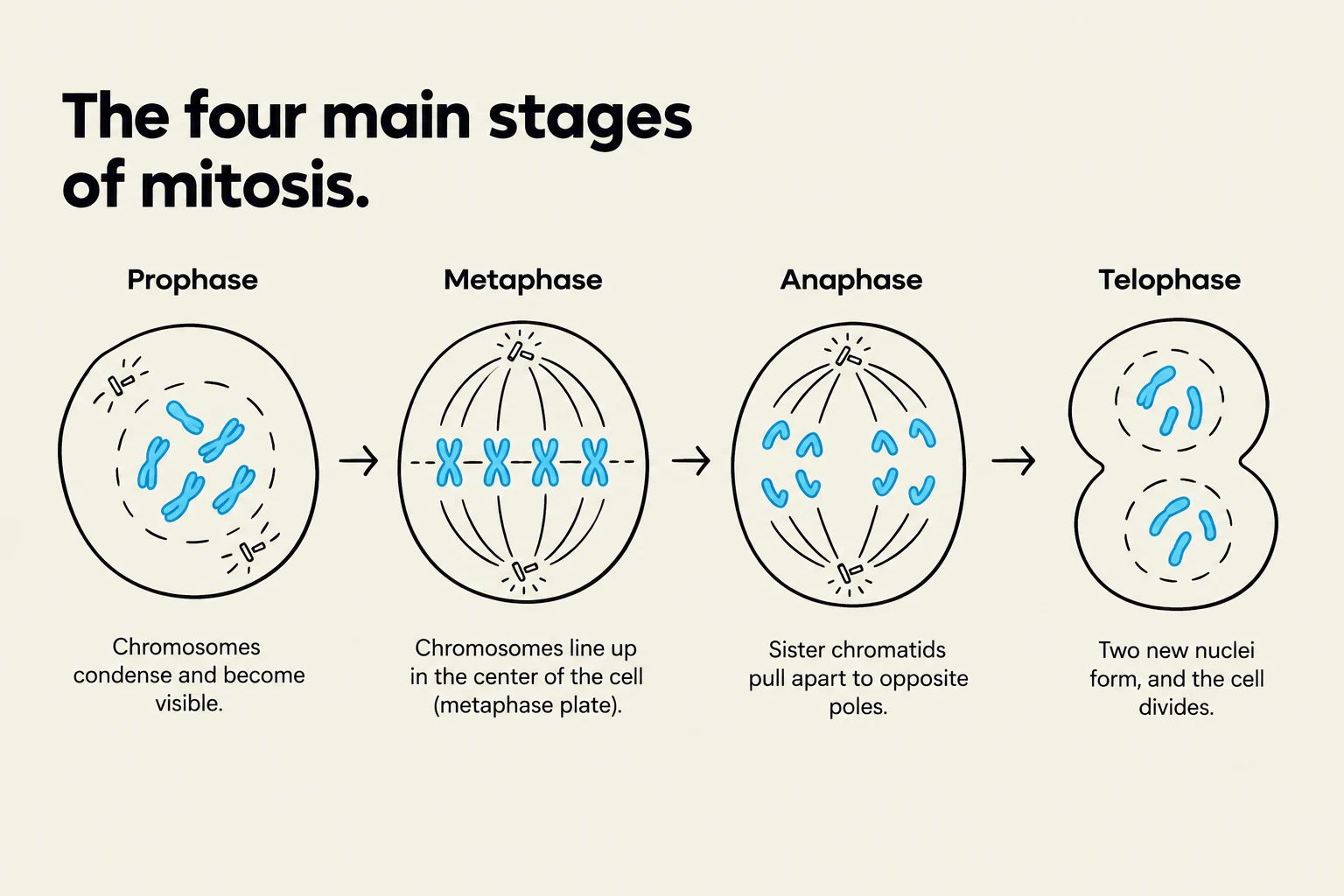
Diagram illustrating the four main stages of mitosis: Prophase, Metaphase, Anaphase, and Telophase, with accompanying descriptions of chromosomal behavior in each stage.
Cells reproduce through a process called the cell cycle.
Mitosis vs. Meiosis
Mitosis: The process of splitting one mother cell into two identical daughter cells.
Meiosis: A specialized type of division that occurs only in sex cells.
Phases of the Cell Cycle
The cell cycle consists of Interphase and Mitosis:
Interphase: Includes the first gap phase (G1), the synthesis phase (S), and the second gap phase (G2).
Mitosis: This involves four distinct phases: Prophase, Metaphase, Anaphase, and Telophase. During these stages, chromosomes line up and split into two identical sets of chromatids.
Cytokinesis: The final step where the cell membrane pinches to create two separate, identical cells.
Specialization and Growth Disorders
Cell Differentiation and Stem Cells
Not all cells are the same. Through cell differentiation, cells become specialized for specific tasks. This process often begins with stem cells, which are relatively unspecialized cells whose primary function is to produce additional unspecialized cells. The rate of stem cell division varies; for example, bone marrow and skin stem cells divide frequently, while adult cartilage stem cells may remain inactive for years.
Controlled vs. Uncontrolled Growth
Cellular health depends on regulated growth and death:
Apoptosis: A programmed process of cell death that helps the body remove old, unnecessary, or unhealthy cells.
Necrosis: The death of cells or groups of cells.
Tumors: Abnormal cell growth can lead to tumors. Benign tumors are noncancerous, while malignant tumors are cancerous and have the ability to extend and invade surrounding tissues.
Keep reading for free.
Create an account to finish this reading and make it part of your study routine.