Introduction to Cardiovascular Disease and Hypertension
An overview of cardiovascular disease (CVD), including its types, the metrics for measuring cardiovascular health (Life's Essential 8), and the mechanisms, classification, and management of hypertension, including the DASH diet.
Cardiovascular disease (CVD) remains the leading cause of death in the United States, affecting an estimated 92.1 million American adults. While age-adjusted death rates have declined over the last four decades due to advancements in prevention and treatment, the economic burden is staggering, with direct and indirect costs estimated at $316 billion. Understanding the different types of CVD, the metrics used to measure heart health, and the mechanisms of hypertension is essential for anyone studying clinical nutrition or cardiovascular health.
Understanding Cardiovascular Disease (CVD)
Cardiovascular disease is a broad term referring to any disease that affects the heart or the network of blood vessels. Because the cardiovascular system is responsible for delivering oxygen and nutrients to tissues while removing waste, any disruption to this system can have systemic consequences.
CVD is not a single condition but a group of related disorders, including:
Coronary Artery Disease (CAD): Also known as coronary heart disease, this involves the blood vessels surrounding the heart. Complications include angina (chest pain caused by ischemia, or impaired blood flow) and myocardial infarction (MI).
Cerebrovascular Disease: Conditions affecting the blood vessels in the brain, often leading to a stroke.
Peripheral Vascular Disease: Diseases affecting the blood vessels outside of the heart.
Congestive Heart Failure: A condition where the heart cannot pump blood effectively enough to meet the body's needs.
Congenital Heart Defects: Structural issues present from birth.
This diagram illustrates various types of cardiovascular diseases, including Coronary Artery Disease (CAD), Cerebrovascular Disease (Stroke), Heart Failure, and Arrhythmias, along with brief explanations and visual representations.
Measuring Cardiovascular Health (CVH)
To combat the prevalence of these diseases, the American Heart Association (AHA) developed strategic goals to improve Cardiovascular Health (CVH) across the population. In 2022, the AHA updated its assessment metrics from the "Life's Simple 7" to the Life’s Essential 8.
These eight metrics are used to score an individual's cardiovascular health on a scale of 0 to 100:
Healthy Blood Pressure
Healthy Blood Glucose
Healthy Weight
Physical Activity
Healthy Diet
Non-smoking
Healthy Lipid Profile
Sleep Habits
The total CVH score is calculated by summing the scores of these eight categories and dividing by eight:
Total CVH Score=8∑Scores of 8 categories
A score of 80–100 indicates High CVH, 50–79 is Moderate, and 0–49 is Low.
Hypertension (HTN): The "Silent Killer"
Hypertension, or high blood pressure, is defined as having more than two consecutive readings that fall outside the normal range of 120/80 mmHg. It is a major risk factor for stroke, renal disease, and heart failure.
Blood Pressure Regulation and Classification
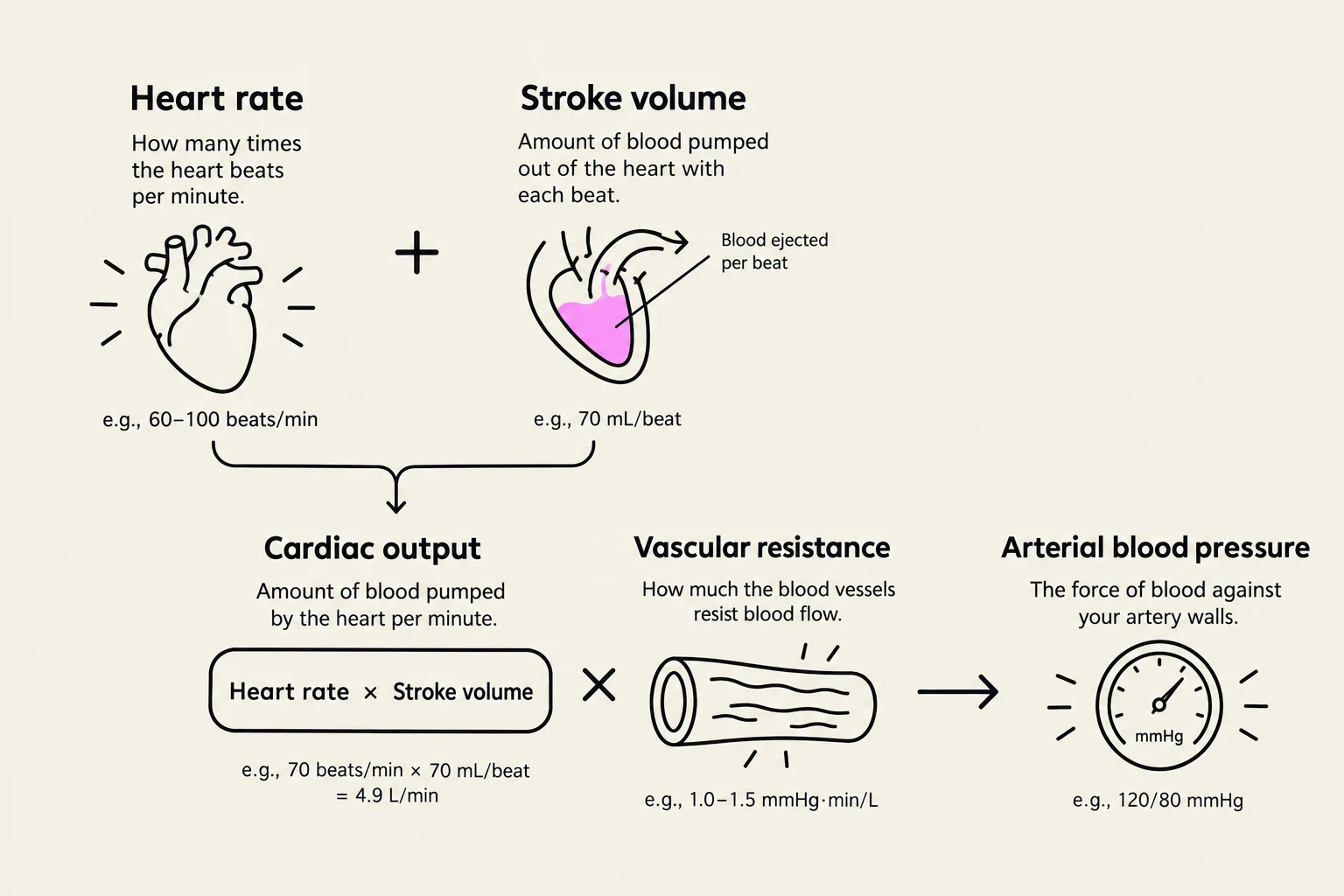
Blood pressure is determined by how much blood the heart pumps and how tight or relaxed the blood vessels are. The heart undergoes a repeating cycle of contraction (systole) and relaxation (diastole). Systolic pressure is the force exerted during contraction, while diastolic pressure is the force during relaxation.
This diagram illustrates the relationship between heart rate, stroke volume, cardiac output, vascular resistance, and arterial blood pressure, fundamental concepts in cardiovascular physiology.
The clinical classification for blood pressure is as follows:
Normal: <120/80 mm Hg
Elevated: 120–129 / <80 mm Hg
Stage 1 Hypertension: 130–139 / 80–89 mm Hg
Stage 2 Hypertension:≥140 / ≥90 mm Hg
Primary vs. Secondary Hypertension
Clinicians distinguish between two main types of hypertension:
Primary (Essential) Hypertension: This accounts for about 90% of cases. The specific cause is unknown (idiopathic), but it is influenced by genetics, obesity, high sodium intake, low potassium intake, smoking, and stress. It is generally not reversible but can be managed.
Secondary Hypertension: This is caused by an identifiable medical condition, such as renal parenchymal disease, obstructive sleep apnea, or endocrine disorders like Cushing’s syndrome. Unlike primary hypertension, this type can often be reversed by treating the underlying cause.
Exam Tip: When assessing for secondary hypertension, look for specific triggers like drug/alcohol use, thyroid disease, or renal artery stenosis. In contrast, primary hypertension is often a lifestyle and genetic multifactorial issue.
Nutritional Management: The DASH Diet
One of the most effective dietary interventions for managing hypertension is the DASH diet (Dietary Approaches to Stop Hypertension). The DASH diet is designed to lower blood pressure and LDL cholesterol by emphasizing specific nutrients and food groups.
Nutrient Profile and Food Groups
The DASH diet focuses on high intakes of potassium ($K^+$), magnesium (Mg2+), calcium (Ca2+), fiber, and protein.
Food Group
Daily Servings
Significance
Grains
6–8
Major source of energy and fiber
Vegetables
4–5
Rich in $K^+$, Mg2+, and fiber
Fruits
4–5
Important source of $K^+$ and Mg2+
Low-fat Dairy
2–3
Major source of Ca2+ and protein
Meats/Poultry/Fish
≤ 2
Lean protein and magnesium
Nuts/Seeds/Beans
4–5 per week
Energy, Mg2+, $K^+$, and fiber
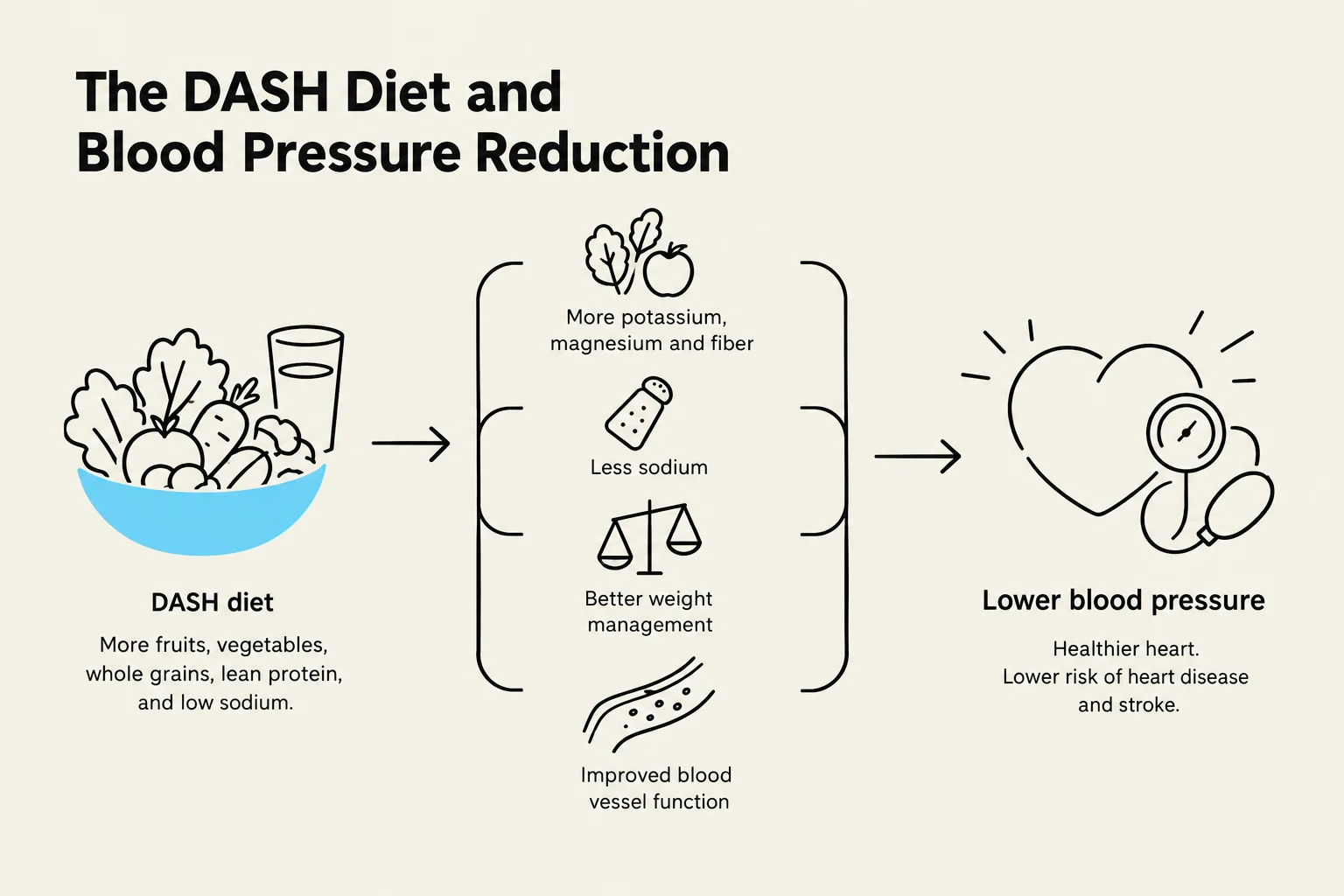
The DASH diet, which emphasizes fruits, vegetables, whole grains, lean protein, and low sodium, contributes to lower blood pressure by increasing potassium, magnesium, and fiber intake, reducing sodium, improving weight management, and enhancing blood vessel function, leading to a healthier heart and reduced risk of heart disease and stroke.
Sodium and Potassium Balance
Sodium reduction is a cornerstone of hypertension management. A single teaspoon of table salt contains approximately 2,300 mg of sodium. To stay within a 2-gram sodium diet, individual food items should ideally contain no more than 200 mg of sodium per serving.
Conversely, potassium intake has an inverse correlation with blood pressure; as potassium intake increases, blood pressure tends to decrease. However, clinicians must be cautious with patients on certain diuretics, as these can increase potassium loss.
Clinical Interventions
When lifestyle modifications like the DASH diet and increased physical activity are insufficient, healthcare providers may prescribe anti-hypertension (anti-HTN) drugs. These medications work through various mechanisms, such as altering blood volume, changing the force of heart contractions, or relaxing the blood vessels to reduce resistance.
Clinical Note: When evaluating a patient for hypertension, always ensure accurate measurement: the patient should be seated with back support, rested for 5–10 minutes, and the arm should be at heart level using an appropriately sized cuff.
Keep reading for free.
Create an account to finish this reading and make it part of your study routine.