Introduction to Cancer Biology and Treatment Principles
This content provides a comprehensive overview of cancer biology, including the cellular mechanisms of uncontrolled growth, genetic drivers of malignancy, and the progression of cancer. It also details the classification of tumors through grading and staging, and outlines the primary principles of cancer treatment, inc
Cancer is not a single disease, but rather a complex group of more than 200 different diseases characterized by the unregulated and uncontrolled growth of cells. While medical advancements have led to a declining death rate, the overall incidence of cancer continues to increase, making it a leading cause of death across all ages. To understand how to treat cancer, one must first understand the fundamental biological errors that allow a single cell to transform into a life-threatening malignancy.
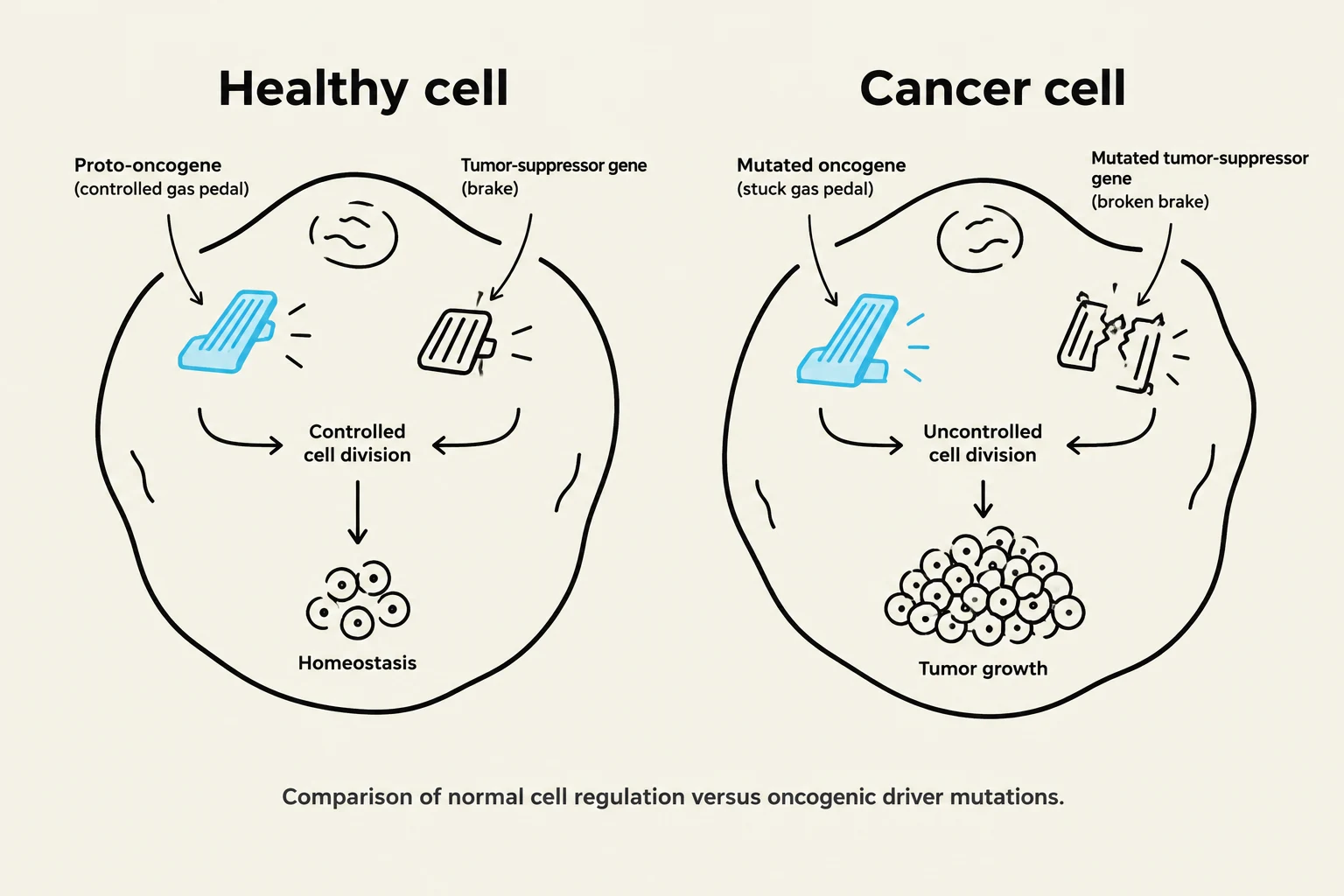
Comparison of normal cell regulation versus oncogenic driver mutations.
The Biology of Cellular Dysfunction
In a healthy body, cell growth is a tightly regulated process. This regulation relies on two primary mechanisms: proliferation and differentiation.
Proliferation and Differentiation
Proliferation refers to the process of cell division and growth. In healthy tissues, this process is managed by stem cells—undifferentiated cells that are predetermined to become specific types of functioning tissue. Normal cells also exhibit contact inhibition, a phenomenon where cells recognize when they have reached their boundaries and stop dividing to avoid invading neighboring tissues.
Differentiation is the process by which maturing cells narrow their focus to perform specific, specialized functions. In cancer, this process fails. Cancer cells often undergo anaplasia, a state where they revert to an undifferentiated, primitive form, losing the specialized functions they once held.
Genetic Drivers of Cancer
The transition from a healthy cell to a malignant one is driven by mutations in DNA within the stem cells. These mutations disrupt the balance of two critical types of genes:
Proto-oncogenes: These are the "gas pedals" of the cell; they normally promote healthy growth. When mutated, they become oncogenes, which drive continuous, tumor-inducing growth.
Tumor-suppressor genes: These are the "brakes"; they normally inhibit cell division. When mutated, they lose their ability to stop uncontrolled growth.
Furthermore, cancer cells often exploit telomerase, an enzyme that allows them to maintain their chromosomal ends, effectively making the cancer cells "immortal" and capable of endless division.
The Progression of Malignancy
Diagram illustrating the two primary routes of cancer metastasis: hematogenous spread via the bloodstream and lymphatic spread through the lymphatic system.
The development of cancer is generally viewed as a multi-stage process:
Initiation: A mutation occurs in the cell's genetic structure, often caused by carcinogens (chemical, radioactive, or viral agents).
Promotion: This stage involves the reversible proliferation of these altered cells. Factors known as "promoters"—such as obesity, smoking, or alcohol consumption—can encourage these cells to multiply.
Progression: The tumor increases in size and invasiveness. During this stage, cells may undergo repeated mutations, becoming heterogeneous (diverse in their genetic makeup), which can make them harder to treat.
Benign vs. Malignant Tumors
A key distinction in oncology is whether a tumor is benign or malignant. Benign tumors consist of well-differentiated cells that remain localized to their site of origin. In contrast, malignant tumors consist of undifferentiated cells that have the capacity to invade nearby tissues and spread.
When cancer spreads to distant sites, it is called metastasis. This occurs through two primary routes:
Hematogenous spread: Malignant cells penetrate blood vessels and travel through the bloodstream to adhere to the walls of distant organs.
Lymphatic spread: Cells travel through and become trapped in the lymph nodes.
Classification: Grading and Staging
To determine the best course of treatment, clinicians classify cancer using three main criteria:
1. Histological Class
This is based on the type of tissue from which the cancer originated:
Carcinoma: Originates from the ectoderm (skin, glands) or endoderm (mucous membranes, respiratory/GI linings).
Sarcoma: Originates from connective tissues (bone, muscle, fat, cartilage).
Leukemia and Lymphoma: Originate from the hematopoietic (blood-forming) system.
2. Grading (Histological Analysis)
Grading uses histological analysis to determine the degree of cell differentiation:
Grade I: Well-differentiated cells (look similar to normal cells).
Grade IV: Undifferentiated cells exhibiting anaplasia (look primitive and disorganized).
3. Staging (Extent of Disease)
Staging describes how far the cancer has spread:
Stage I: The tumor is limited to the tissue of origin.
Stage IV: The cancer has reached a metastatic state.
Exam Tip: Grading vs. Staging
Remember that Grading looks at the cells under a microscope (how "crazy" they look), while Staging looks at the whole patient (how far the disease has traveled).
Principles of Cancer Treatment
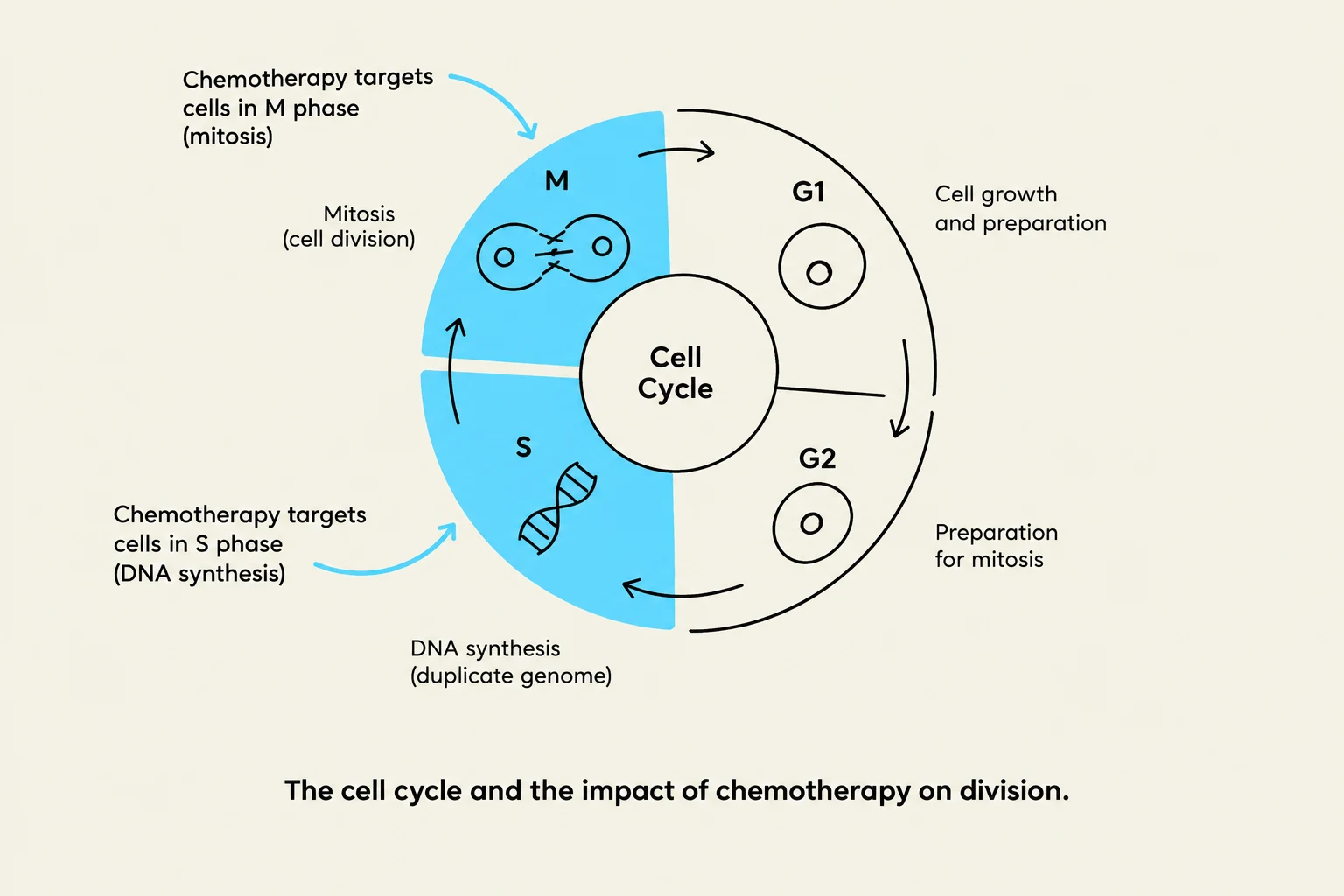
The cell cycle illustrates the stages of cell growth and division, with chemotherapy targeting cells during M phase (mitosis) and S phase (DNA synthesis).
Treatment goals vary depending on the patient's prognosis and wishes. The three primary goals are Cure (eliminating the cancer), Control (managing the cancer as a chronic disease), or Palliation (relieving symptoms and improving quality of life).
Surgical and Radiation Therapies
Surgery is the oldest method and is highly effective for localized tumors, but it is generally not effective for metastatic disease.
Radiation therapy uses energy to cause ionization in tissue, creating free radicals that break DNA bonds. Because cancer cells are less efficient at repairing DNA than healthy cells, they are more susceptible to this damage. Radiation can be delivered via external beams or through brachytherapy (internal radiation where radioactive material is implanted near the tumor).
Chemotherapy and the Cell Cycle
Chemotherapy targets rapidly dividing cells. Its effectiveness is closely tied to the growth fraction—the ratio of proliferating cells to dormant cells (G0 phase).
The cell cycle consists of four main phases:
G1: Preparation for DNA synthesis.
S: DNA synthesis occurs.
G2: Preparation for mitosis.
M: Mitosis (cell division) occurs.
Because chemotherapy targets cells in active division, it is most toxic to tissues with a high growth fraction.
Clinical Note: Major Toxicities
Because chemotherapy lacks "selective toxicity" (it cannot perfectly distinguish between a cancer cell and a healthy dividing cell), it often causes significant side effects, including:
Bone marrow suppression: Decreased production of platelets, neutrophils, and red blood cells.
GI Injury: Stomatitis (mouth sores) and diarrhea.
Reproductive Toxicity: Potential impact on sperm-forming cells and ovaries.
Biological and Targeted Therapies
Modern medicine has moved toward biological and targeted therapies, which use naturally occurring agents to either directly attack tumors or modulate the host's immune system (such as CAR-T cellular therapy) to recognize and destroy cancer cells.
Stem Cell Transplantation
For hematologic malignancies, bone marrow or stem cell transplants can be life-saving.
Autologous: Uses the patient's own stored stem cells.
Allogeneic: Uses cells from a matched donor.
Syngeneic: Uses cells from an identical twin.
Keep reading for free.
Create an account to finish this reading and make it part of your study routine.