An overview of the Canadian legal system, covering the definition of law, its relationship with morality and justice, the rule of law, divisions of law, and the plain language movement.
Understanding the law is more than just memorizing statutes; it is about understanding the framework that holds a society together. In Canada, the legal system is a complex tapestry woven from historical traditions, moral philosophies, and constitutional principles. This article provides an overview of how law is defined, how it interacts with other social norms, and the fundamental principles that ensure fairness in Canadian society.
Defining the Law
At its most fundamental level, law is defined as a system of enforceable rules that governs the relationships between individual members of a society and between those members and the society itself.
What distinguishes law from other social norms—such as etiquette or social customs—is its enforceability. While breaking a social norm might result in awkwardness or social exclusion, breaking a law triggers state-sanctioned mechanisms and institutions, such as courts or police, to enforce compliance.
The Structure of Rules
Legal rules are not all the same; they serve different functions within the system. Most rules follow a logical structure: "If A, B, and/or C, then X". These can be categorized into three types:
General Norms: These are standards of behavior that dictate how individuals should act in certain situations.
Condition Rules: These rules establish specific conditions that must be met for a legal consequence to follow.
Power-Conferring Rules: These rules grant individuals or entities the authority to perform certain legal acts, such as the power to create a will or enter into a contract.
Law, Morality, and Justice
The law does not exist in a vacuum. It is deeply interconnected with other normative systems that guide human behavior.
Morality and Ethics
Law and ethics are closely linked. As former Supreme Court Justice Earl Warren famously noted, "In civilized life, law floats in a sea of ethics". Ethical standards often serve as the foundation for legal rules, and both systems typically share a common value system. While law is descriptive (stating what is required), morality is often normative (stating what ought to be).
Models of Justice
Three primary models of justice in legal contexts: Corrective Justice (restores the harmed party through compensation), Retributive Justice (punishes wrongdoing), and Distributive Justice (allocates resources).
Justice is the principle of fairness and equity. In legal studies, justice is often categorized into three primary models depending on the context of the dispute:
Corrective Justice: This model is best suited to private law disputes, where the goal is to "correct" a wrong by restoring a balance between two parties (e.g., compensating a person for a car accident).
Retributive Justice: This is most relevant to criminal law, focusing on punishment and ensuring that those who violate the law face appropriate consequences.
Distributive Justice: This pertains to public law matters, concerning how society distributes resources, rights, and duties among its members.
Religion and Law
Historically, religious traditions have significantly influenced legal frameworks. In Canada, Christianity has played a notable role in shaping both case law and the Constitution. An example of this influence is the "neighbour principle," which has roots in religious-ethical teachings.
The Rule of Law
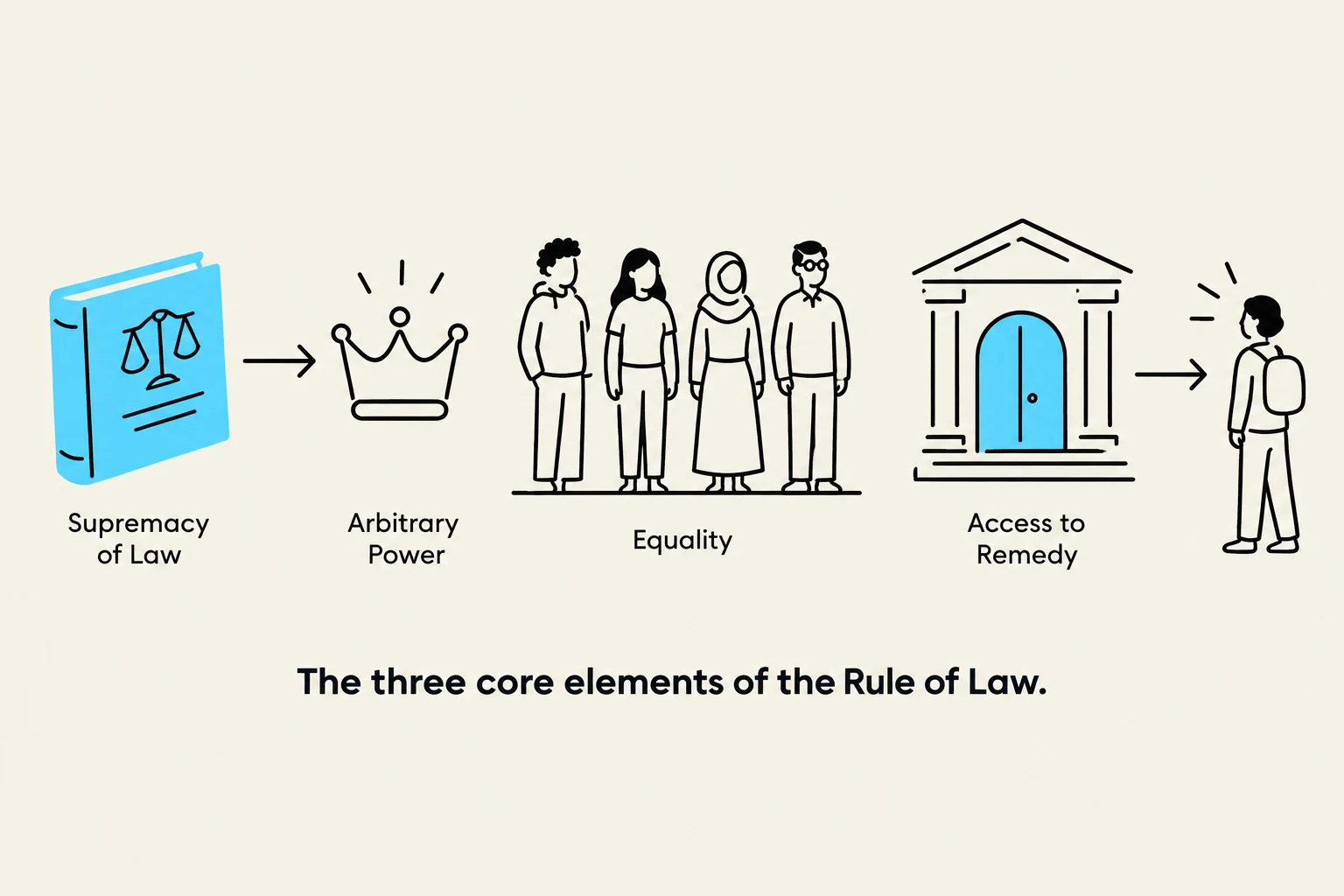
The three core elements of the Rule of Law: Supremacy of Law, Arbitrary Power, Equality, and Access to Remedy.
A cornerstone of the Canadian legal system is the Rule of Law, a principle designed to ensure fairness in the administration of justice. The concept has roots in Greek and Roman culture and was famously reinforced by the Magna Carta in 1215, which placed essential limits on the powers of the English monarchy.
According to the principles established by A.V. Dicey, the Rule of Law requires three core elements:
Supremacy of Law: The law must hold supremacy over the influence of arbitrary power; no one is above the law.
Equality: The law applies equally to everyone, regardless of their status or position.
Access to Remedy: Anyone who is denied a right or liberty must have the ability to seek a remedy through the courts.
Exam Tip: When discussing the Rule of Law, always distinguish between "arbitrary power" (power exercised without legal basis) and "legal power" (power exercised according to established rules). The Rule of Law exists to prevent the former.
Divisions of Law
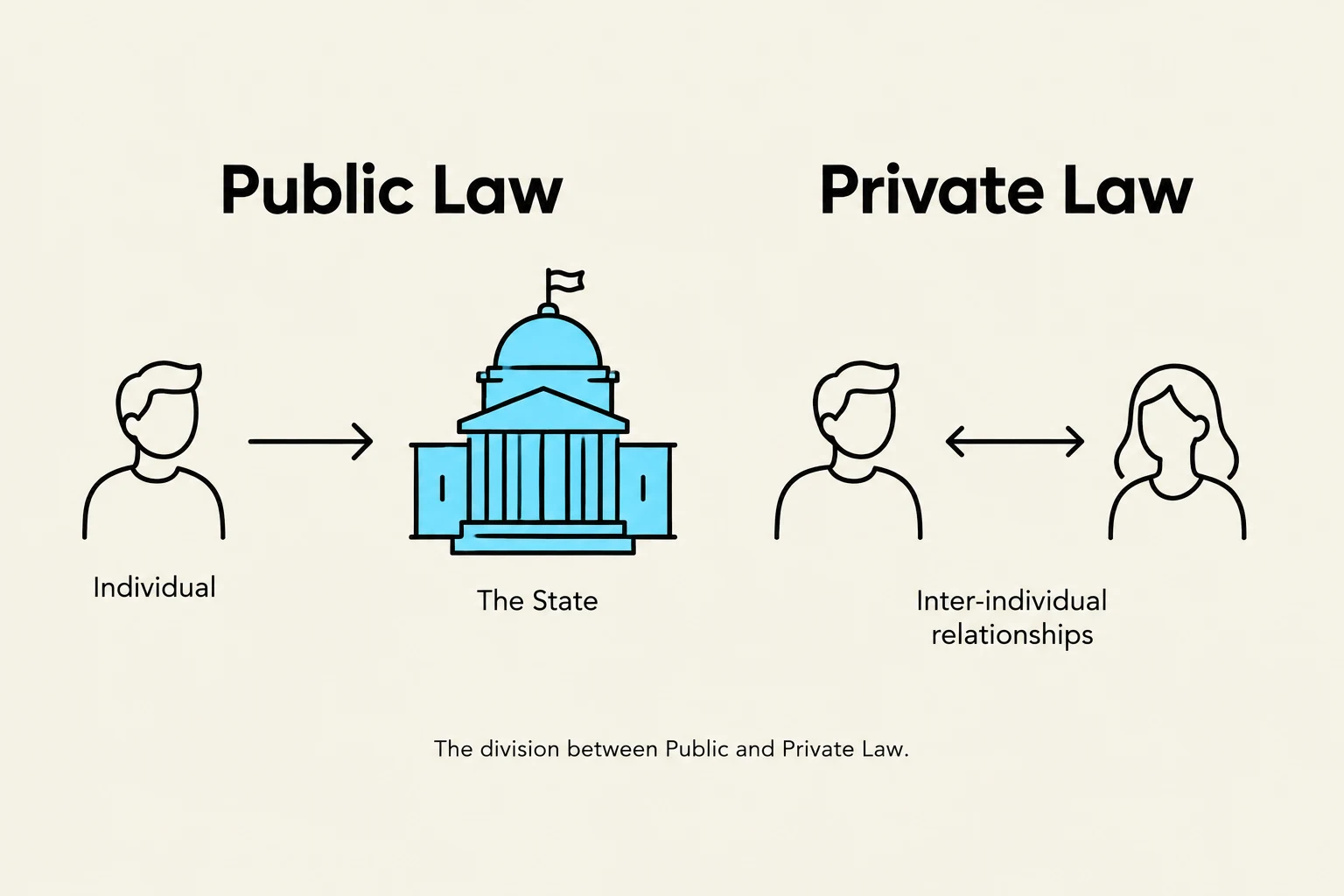
This diagram illustrates the distinction between Public Law, which governs the relationship between individuals and the state, and Private Law, which governs inter-individual relationships.
The Canadian legal landscape is divided into two main branches based on the parties involved:
Public Law
Public law governs the relationship between individuals and the state. This includes areas such as criminal law, constitutional law, and administrative law.
Private Law (Civil Law)
Private law governs the relationships between private individuals. In many contexts, this is also referred to as Civil Law. It covers matters such as contracts, torts, and property disputes.
Legal Language and the Plain Language Movement
Historically, legal language has been highly specialized, technical, and often obscure, making it difficult for non-lawyers to understand. This specialization developed over centuries as a professional tool.
However, since the 1970s, there has been a growing "plain language movement" in both business and law. This movement is a reaction against deliberately obscure language and seeks to make legal communication more accessible and transparent to the general public.
Indigenous Law and the Canadian Framework
It is essential to recognize that Canada is home to diverse legal traditions. Indigenous legal traditions have a long history and are distinct from the Canadian legal system, though they are increasingly interconnected.
Because there are hundreds of different Indigenous communities, there is no single "Indigenous law"; rather, there are many distinct traditions. These may include divine, naturalistic, positivistic, deliberative, or customary law.
While the path toward full reconciliation and legal parity remains challenging, an established interconnection between Indigenous law and Canadian law already exists within the current constitutional framework.
Keep reading for free.
Create an account to finish this reading and make it part of your study routine.