Introduction to Canadian Business Vehicles and Corporations
An overview of business vehicles including sole proprietorships, partnerships, and corporations, focusing on liability, taxes, and the separate legal entity concept.
When starting a business in Canada, one of the most critical decisions an entrepreneur faces is choosing the right legal structure. This choice is not merely administrative; it fundamentally dictates how much personal risk you undertake, how you are taxed, and how the business interacts with the law. This article explores the three primary business vehicles—sole proprietorships, partnerships, and corporations—and examines the complex legal framework that governs them.
Primary Business Vehicles
There are three main ways to structure a business, each offering different balances of simplicity, tax efficiency, and risk.
Sole Proprietorship
A sole proprietorship is the simplest form of business. You operate under your own personal name, and the business and the individual are legally the same entity.
Benefits: It is quick and easy to set up, and you simply file a personal tax return.
Drawbacks: There are no real tax benefits, and most importantly, you face unlimited personal liability. If the business is sued or incurs debt, your personal assets (like your home or car) are at risk.
Partnership
A partnership involves two or more people entering into a business together. This structure is frequently used by professionals such as lawyers, accountants, and dentists.
Benefits: Partnerships offer significant tax benefits and do not require a formal incorporation process.
Drawbacks: Partners act as agents for the firm, meaning one partner's actions can bind the others. Furthermore, partners generally share liability; if one partner commits a professional error, all partners may be held responsible. Partners also owe a fiduciary relationship to one another, meaning they must act in good faith and in the best interests of the partnership.
Corporation
A corporation is a more complex vehicle created through a formal incorporation process. It is the most common business vehicle for larger or more risk-averse ventures because it offers liability protection and various tax advantages.
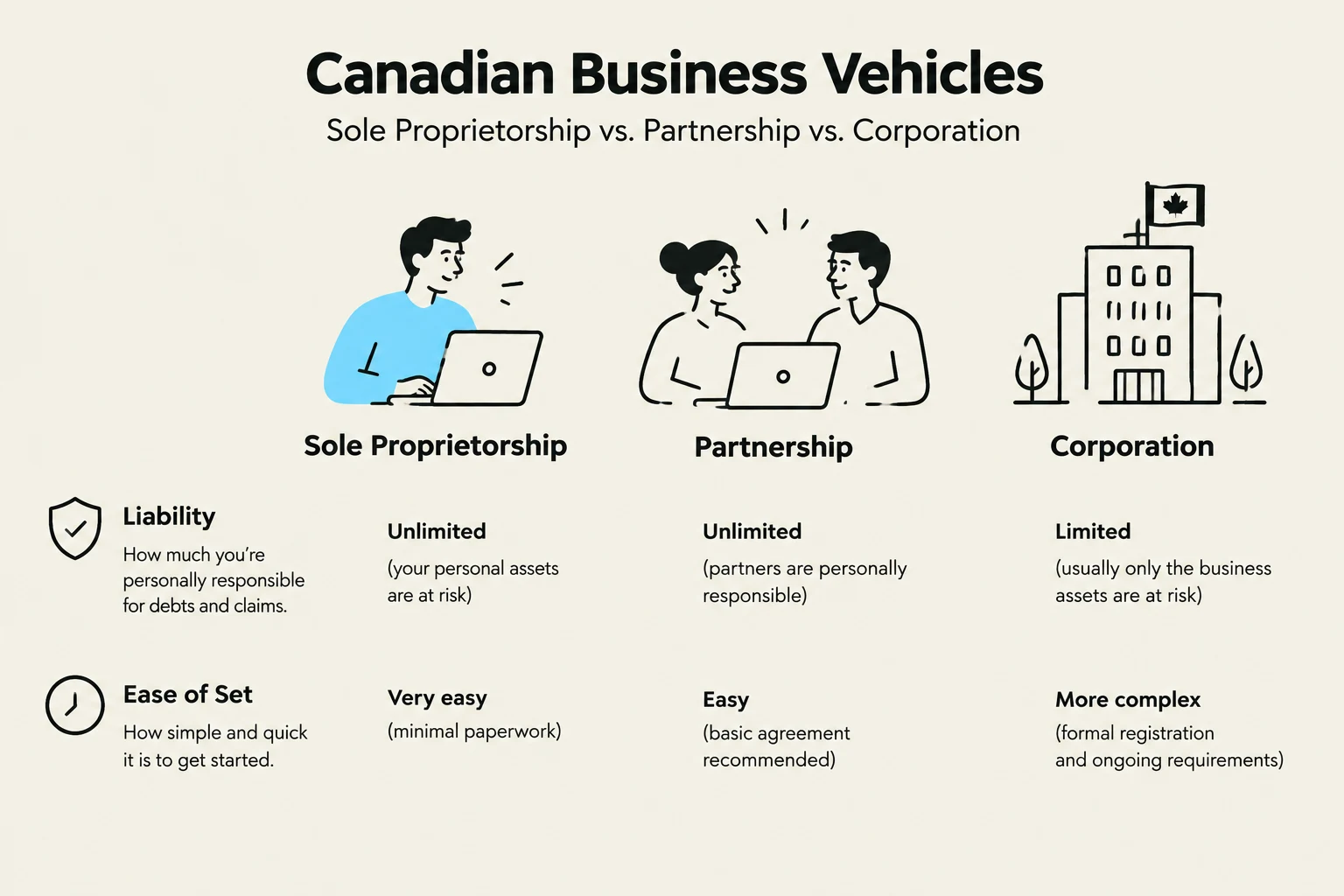
This graphic illustrates the differences between sole proprietorships, partnerships, and corporations in Canada, focusing on liability and ease of setup.
The Concept of the Separate Legal Entity
The defining characteristic of a corporation is that it is a separate legal entity. In the eyes of the law, a corporation is a "legal fiction"—it is a person in its own right, separate from the people who own or manage it.
This distinction leads to several critical legal implications:
Asset Ownership: Shareholders do not actually own the assets of the business; they own shares in the company, which in turn owns the assets.
Succession: Because the corporation is a separate entity, it can theoretically exist forever. If a shareholder passes away, the corporation continues to exist, and their shares can be transferred to others.
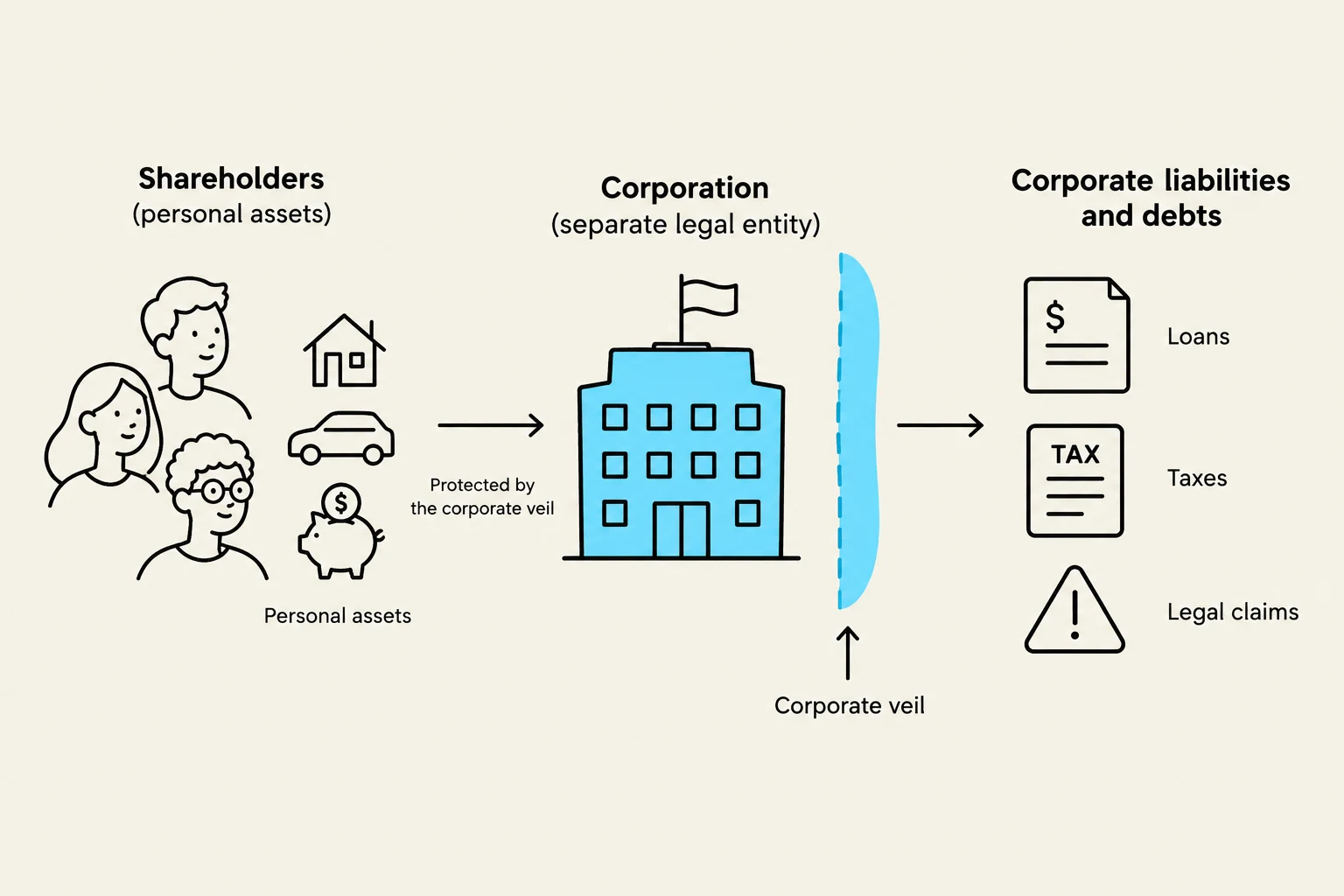
Limited Liability: This is the "shield" that protects shareholders. If a corporation goes bankrupt, creditors generally cannot seize the personal assets of the shareholders.
Exam Tip: Remember that limited liability is not absolute. It can be lost if a director or officer provides a personal guarantee for a corporate loan, or if a court decides to "pierce the veil".
Lifting the Corporate Veil
While the "corporate veil" protects shareholders, the courts have the power to lift the corporate veil. This is a rare and difficult legal maneuver, but it occurs when the court decides to hold individuals personally liable for corporate obligations—typically in cases involving fraud or when individuals use the corporation to evade legal regulations.
This diagram illustrates the concept of a corporate veil, which separates the personal assets of shareholders from the liabilities and debts of a corporation.
Corporate Structure and Governance
A corporation is organized into specific roles to manage its finances, strategy, and daily operations.
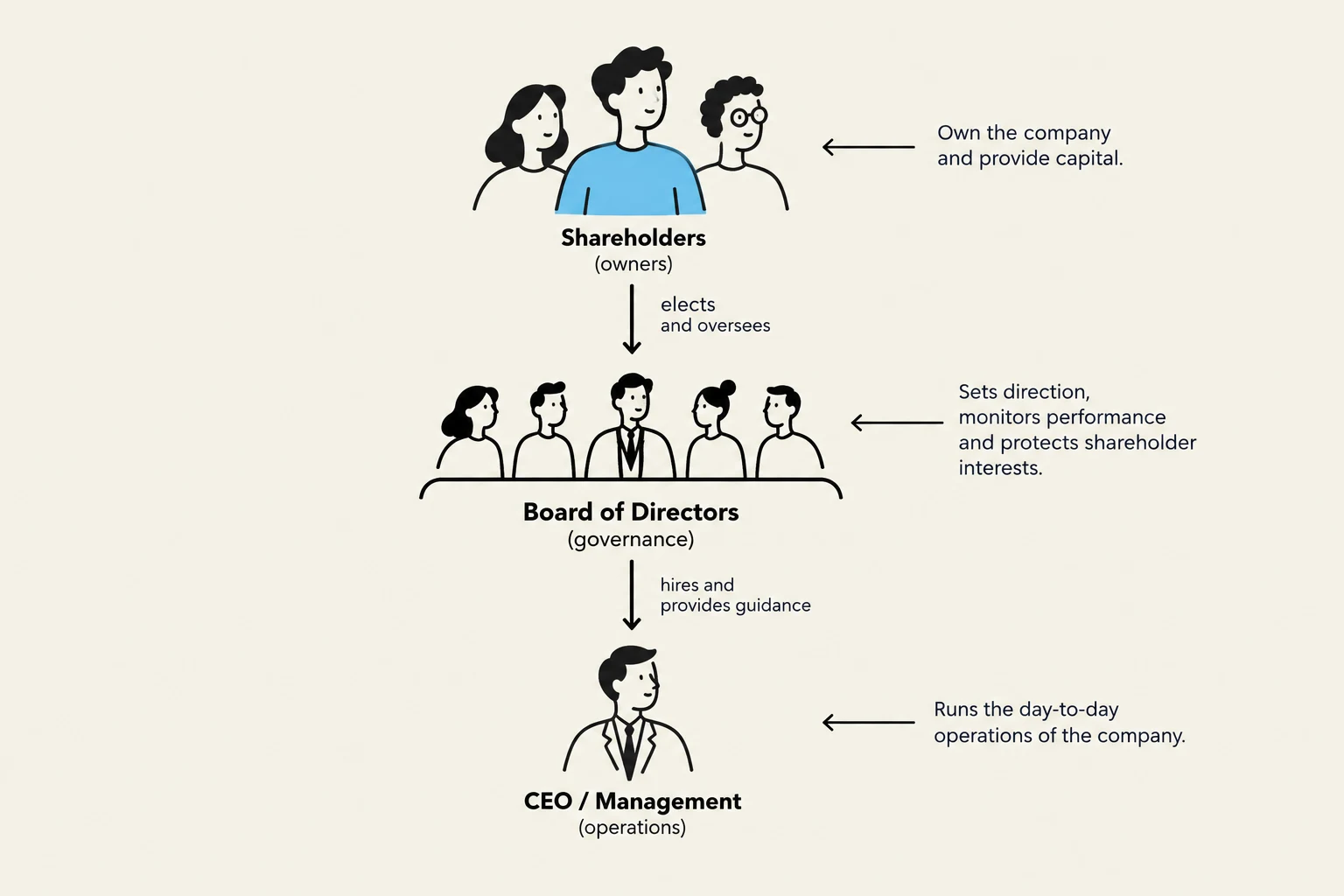
Shareholders: The Owners
Shareholders are the financiers and beneficiaries of the corporation. They hold different classes of shares, which dictate their rights:
Class A Common Shares: These typically grant voting rights, allowing shareholders to participate in major corporate decisions.
Class C Preferred Shares: These are often non-voting but provide a preference regarding dividends (the distribution of profits).
Shareholders have certain rights, such as receiving notice of annual meetings and accessing financial reports. However, minority shareholders often have a weaker position and may need to pursue "derivative actions" (suing for a wrong done to the corporation) or "oppression actions" (suing for a wrong done to them personally) to protect their interests.
Directors and Officers: The Managers
While shareholders own the company, they do not necessarily run it. Management is split between two groups:
Directors: Elected by the shareholders, directors are responsible for high-level governance and strategy. They owe a fiduciary duty to the corporation and must act with the care, diligence, and skill of a reasonably prudent person.
Officers: Appointed to handle day-to-day operations, such as bookkeeping, scheduling, or technical services.
Warning for Directors: Directors can be held personally liable for specific failures, including unpaid wages, unpaid taxes, environmental damage, or breaches of human rights and consumer protection laws.
This diagram illustrates the corporate governance structure, showing the relationship between shareholders, the Board of Directors, and CEO/Management.
Agency and Authority
Because a corporation is an artificial entity, it cannot act on its own; it must act through agents. These agents (such as employees or officers) must have the authority to bind the corporation to contracts or obligations. This authority can be:
Actual Authority: Explicitly granted through an employment contract or direct delegation.
Apparent Authority: Authority that a third party reasonably believes an agent possesses based on the corporation's actions or representations.
The Incorporation Process
To create a corporation, one must undergo the incorporation process, which involves filing specific documents with a government agency. While the specific requirements vary by province, the general components include:
Articles of Incorporation: These define the company's name, its authorized share capital (the types and number of shares it can issue), and its objects (the purpose of the business).
Bylaws: These are the internal procedural regulations that govern how the company is operated.
For example, in British Columbia, one files "Notice of Articles," whereas in other provinces or federally, one files "Articles of Incorporation".
Summary Table of Business Vehicles
Feature
Sole Proprietorship
Partnership
Corporation
Legal Entity
Same as owner
Shared among partners
Separate legal entity
Liability
Unlimited personal liability
Shared liability among partners
Limited liability for shareholders
Taxation
Personal tax return
Tax benefits available
Tax advantages/deferral possible
Complexity
Low (Quick/Easy)
Moderate (No incorporation)
High (Formal process/renewals)
Keep reading for free.
Create an account to finish this reading and make it part of your study routine.