Introduction to Biological Health Hazards and Laboratory Safety
This article provides a comprehensive overview of biological agents, including bacteria, viruses, fungi, parasites, toxins, and prions. It details their classification into risk groups, explains the chain of infection, and outlines essential laboratory safety practices and control measures such as biosafety cabinets an
In the field of microbiology and clinical laboratory science, understanding biological hazards is fundamental to ensuring both personal safety and public health. A biological agent is defined as any substance derived from a living organism, a virus, or a prion. While many of these agents are beneficial—such as the bacteria in our gut that aid digestion—others are pathogens, meaning they are microorganisms capable of causing disease.
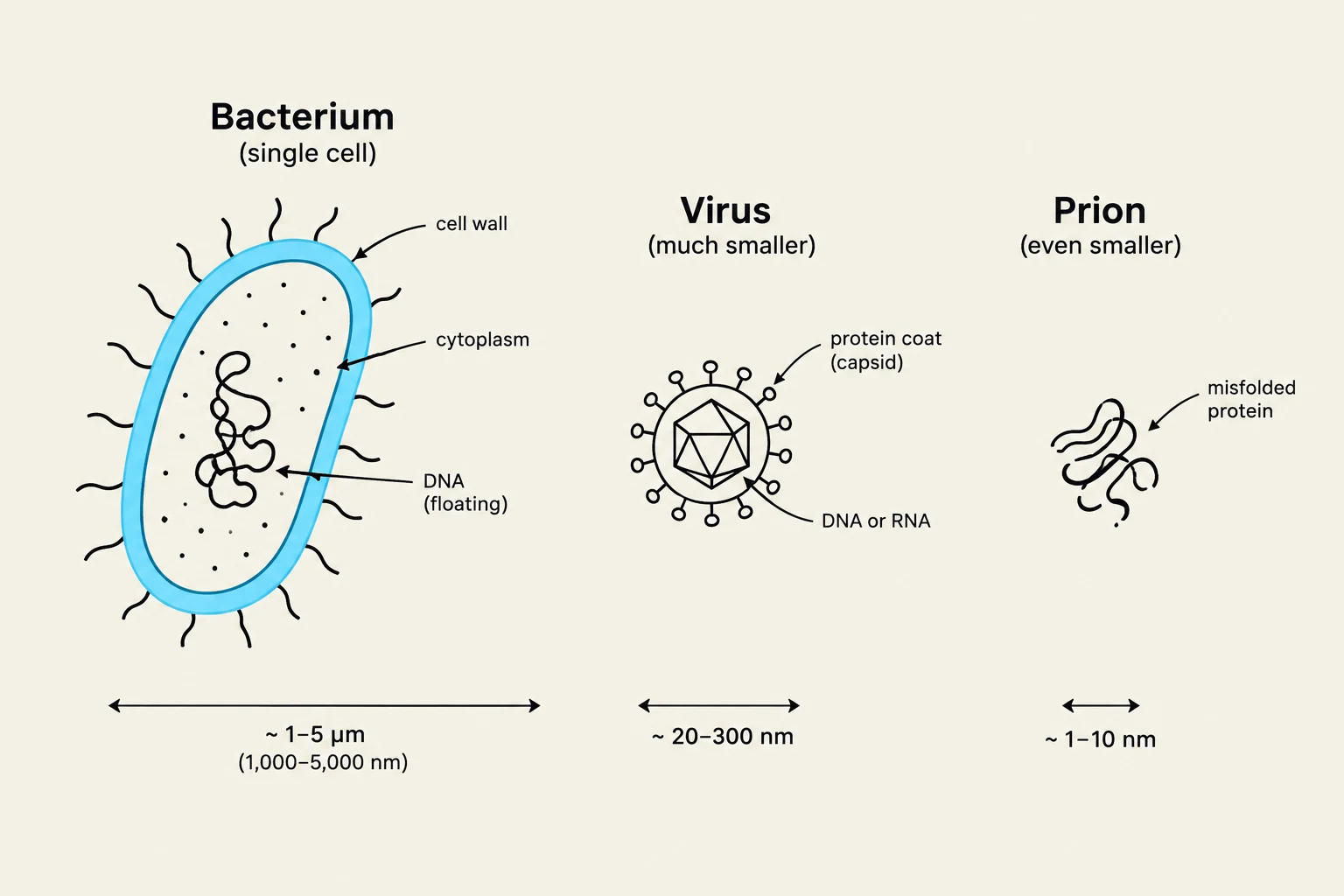
Diagram illustrating the relative sizes and structures of a bacterium, a virus, and a prion.
Because laboratory professionals often work with concentrated cultures of these agents, they face a higher risk of exposure than the general public. This article explores the different categories of biological agents, how they are classified by risk, and the methods used to break the chain of infection.
Categories of Biological Agents
Biological hazards are diverse, ranging from complex multi-cellular organisms to non-living proteins. They are generally categorized into several distinct groups:
Bacteria
Bacteria are small, single-celled microorganisms. Most possess a protective cell wall, though exceptions like Mycoplasma and Ureaplasma do not. Unlike more complex cells, bacteria lack membrane-bound organelles such as mitochondria, a Golgi apparatus, or a true nucleus; instead, their genetic information is contained in a single strand of DNA floating within the cytoplasm. Bacteria are ubiquitous, found everywhere on Earth, and can be easily visualized under a regular microscope and grown on agar in a laboratory setting.
Viruses
Viruses are significantly smaller and simpler than bacteria. A virus consists essentially of genetic material (either DNA or RNA) encased in a protein coat. They are "obligate intracellular parasites," meaning they cannot replicate on their own; they must infect a host cell and hijack its internal machinery to produce copies of themselves. Because of their minute size, they cannot be seen with a standard light microscope and require an electron microscope for visualization.
Fungi
Fungi are more complex than bacteria or viruses. This group includes multi-celled organisms like moulds and mildews, as well as single-celled organisms known as yeasts (such as Candida). Like bacteria, fungi are widespread in the environment and can be grown relatively quickly on agar and viewed under a regular microscope.
Parasites
Parasites are organisms that live on or inside a host to derive nutrients, typically at the host's expense. While bacteria and viruses can technically be viewed as parasites, in a clinical context, this term usually refers to organisms such as lice, mites (scabies), worms, or the Plasmodium protozoan, which causes malaria.
Toxins
In microbiology, a toxin is a poisonous substance produced by a microorganism. Toxins are particularly dangerous because they can cause severe disease even at extremely low concentrations.
Botulinum toxin: Produced by Clostridium botulinum, it is one of the most poisonous substances known.
"Hamburger disease": Caused by a toxin from E. coli O157.
Toxic Shock Syndrome: Caused by toxins from Staphylococcus aureus or Group A Streptococcus.
Prions
Prions are unique because they are not alive. They are misfolded proteins that trigger cellular death by transmitting their abnormal shape to normal variants of the same protein. Prions are exceptionally difficult to inactivate; they can survive most standard microbial disinfection protocols.
Risk Group Classifications
Not all pathogens pose the same level of danger. In Canada, the Public Health Agency of Canada (PHAC) regulates the handling of human pathogens and toxins under the Human Pathogens and Toxins Act (HTPA). Pathogens are organized into four Risk Groups based on the danger they pose to individuals and the community:
Risk Group
Individual Risk
Community Risk
Characteristics
Examples
Group 1
Low
Low
Generally not associated with disease in healthy adults; effective treatment available.
E. coli, Lactobacillus
Group 2
Moderate
Low
Associated with human disease but rarely cause serious infections; usually don't spread easily.
Streptococcus pyogenes, Giardia
Group 3
High
Low
High individual risk; usually do not spread by casual contact; may or may not have treatments.
Mycobacterium tuberculosis, HIV, Prions
Group 4
High
High
Dangerous, exotic, and often lethal; easily transmitted person-to-person; usually untreatable.
Ebola virus, Smallpox
Exam Tip: Note that Risk Group 4 contains only viruses. There are no bacteria, fungi, or parasites classified in Risk Group 4.
The Chain of Transmission
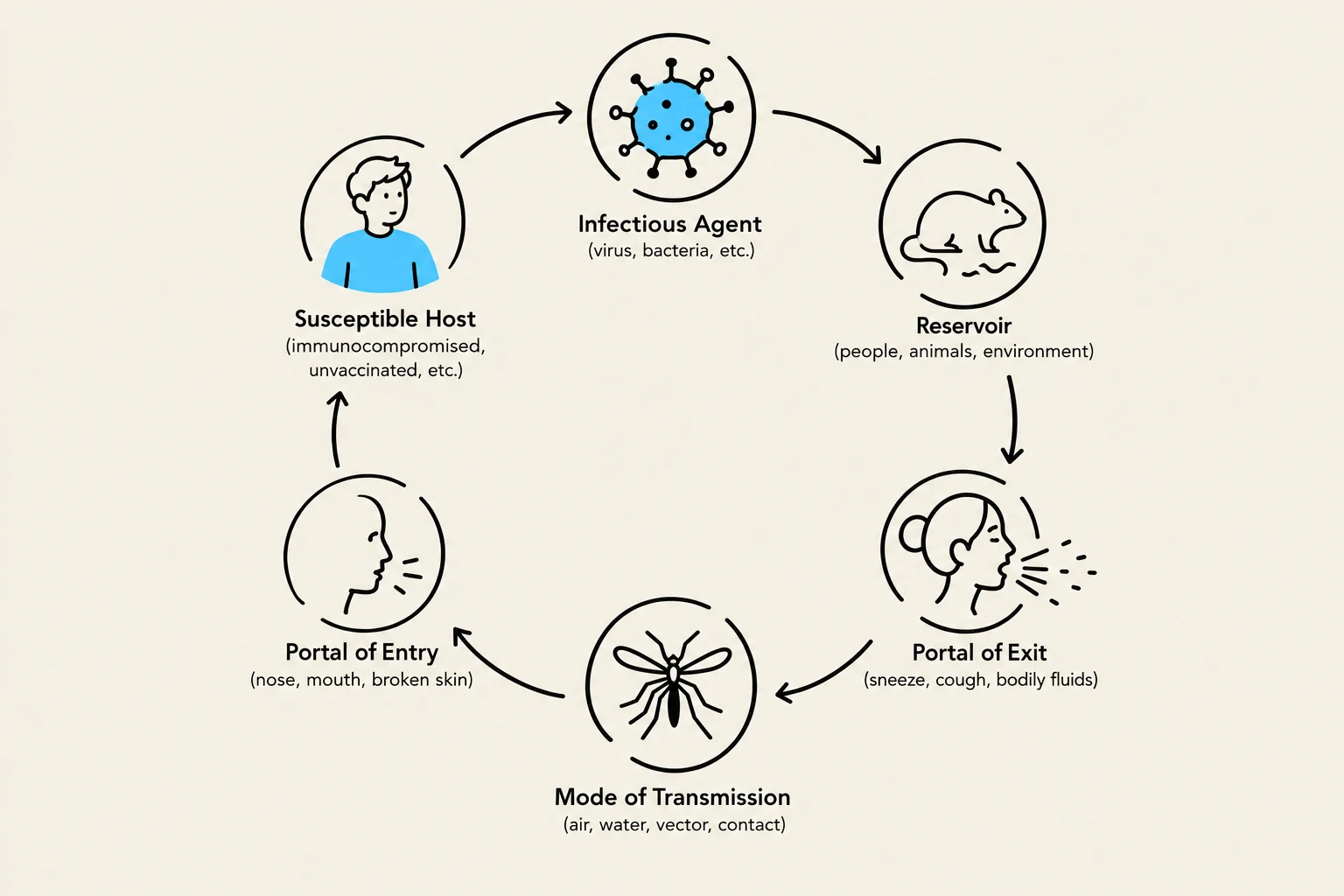
Diagram illustrating the chain of infection, including the infectious agent, reservoir, portal of exit, mode of transmission, portal of entry, and susceptible host.
To understand how to prevent infection, one must understand how it spreads. An infection requires six "links" to be present in a chain:
Infectious Agent: The pathogen (bacteria, virus, etc.).
Reservoir: Where the agent lives (person, animal, soil, water).
Portal of Exit: How the agent leaves the reservoir (e.g., coughing, sneezing).
Mode of Transmission: How it travels (direct contact, indirect contact via objects, or vector-borne like a tick bite).
Portal of Entry: How it enters a new host (inhalation, ingestion, injection, or absorption through skin/eyes).
Susceptible Host: An individual who can be infected.
Breaking the Chain: We can prevent infection by "breaking" any of these links. For example, using disinfection kills the agent, wearing PPE blocks the portal of entry, and vaccination makes the host less susceptible.
Laboratory Safety and Control
Routine Practices and Additional Precautions
In healthcare and laboratory settings, professionals follow Routine Practices and Additional Precautions. This is based on the principle that all patients and specimens are potentially infectious, even if they appear healthy (asymptomatic).
Routine practices include:
Risk Assessment: Evaluating the task, fluids involved, and potential exposure routes.
Hand Hygiene: Using soap and water or sanitizer.
Engineering Controls: Physical features like ventilation and proper waste disposal.
Administrative Controls: Training, policies, and immunization.
Personal Protective Equipment (PPE): Selecting gear based on the risk assessment.
Biosafety Cabinets (BSC)
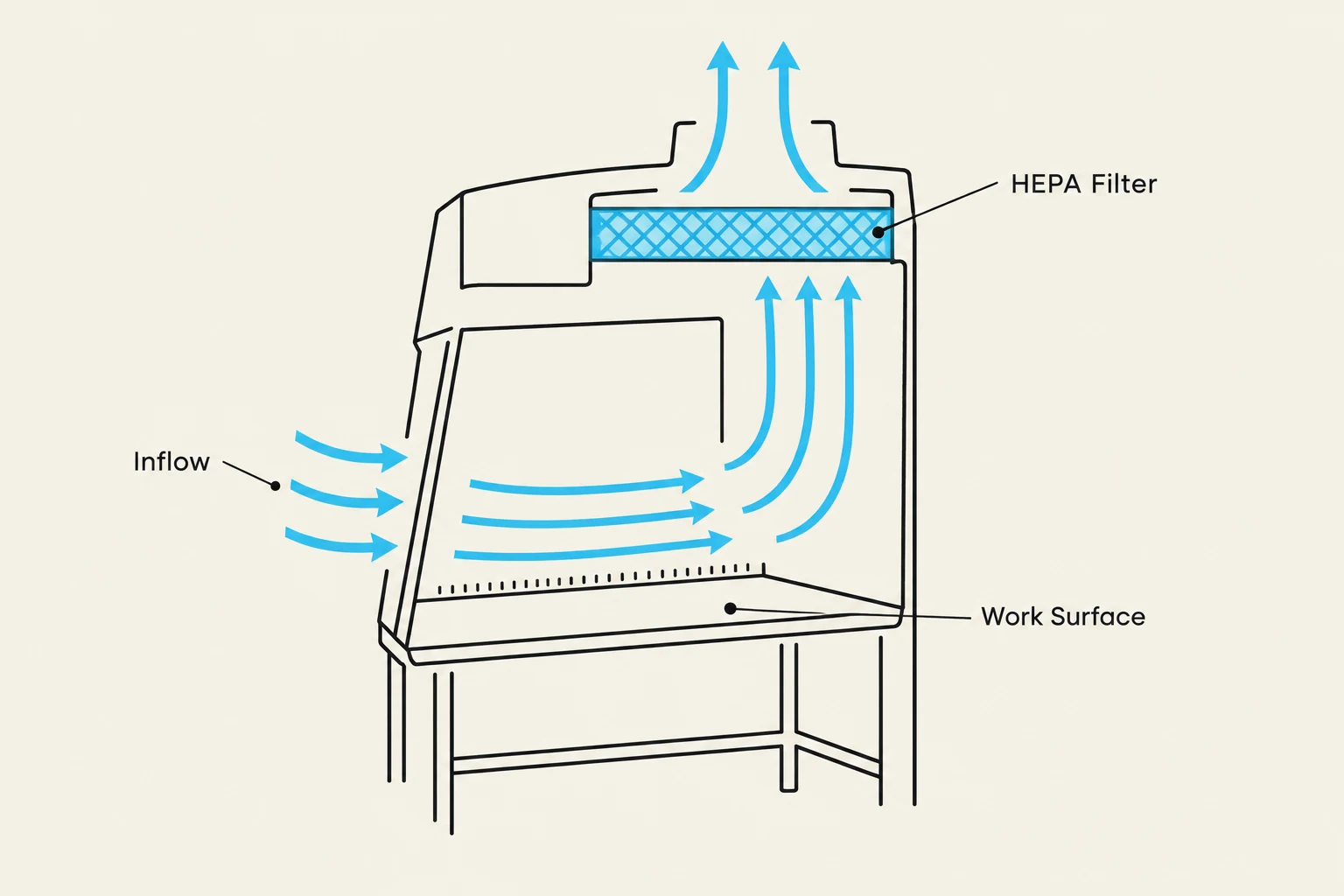
Diagram illustrating airflow in a biological safety cabinet, showing inflow of air, a HEPA filter, and the work surface.
A Biosafety Cabinet (BSC) is a critical engineering control designed to contain biological hazards. It uses air currents to prevent aerosols (tiny infectious droplets) from escaping the cabinet. The air is filtered through HEPA (High Efficiency Particulate Air) filters before being released.
Safety Protocol: Biohazard Spills
If a spill occurs in a BSC:
Notify others in the lab.
Don appropriate PPE.
Leave the BSC blower on to ensure contaminated air is filtered through the HEPA filter.
Place disinfectant wipes over the spill and allow it to sit for 30 minutes.
Dispose of all contaminated materials in a biohazardous waste container.
Keep reading for free.
Create an account to finish this reading and make it part of your study routine.