This content provides a comprehensive overview of auditing and assurance services, differentiating them from accounting. It explains the economic necessity of auditing, professional standards, and key concepts like materiality and audit risk.
In the modern business world, stakeholders—ranging from individual investors to massive banking institutions—rely heavily on financial information to make critical economic decisions. However, because this information is prepared by a company's own management, there is an inherent risk that it may be inaccurate or biased. This is where auditing and assurance services become vital, acting as a bridge of trust between a company and its stakeholders.
Defining Auditing and Assurance
To understand the profession, one must first distinguish between auditing and the broader concept of assurance.
Auditing is a systematic process of objectively obtaining and evaluating evidence regarding assertions about economic actions and events. In a financial context, an audit involves reviewing the financial statements prepared by management to determine if they comply with an applicable financial reporting framework (such as IFRS or MFRS), are free from material misstatement, and adhere to legal requirements like the Companies Act 2016.
Assurance is a much broader umbrella. An assurance engagement is any service where a practitioner expresses a conclusion designed to enhance the confidence of intended users regarding a subject matter. While a financial statement audit is a specialized form of assurance, assurance engagements can also cover non-financial performance or the effectiveness of internal systems and processes.
Auditing vs. Accounting: The Key Distinctions
A common misconception is that auditing and accounting are the same. In reality, they are complementary but distinct functions guided by different sets of rules.
Accounting focuses on the preparation of financial statements. Accountants use accounting standards (e.g., IFRS/MFRS) to ensure that transactions are consistently recognized, measured, presented, and disclosed.
Auditing focuses on verifying that the recorded information accurately reflects economic events. Auditors use auditing standards (e.g., International Standards on Auditing - ISA) to plan, perform, and report on the audit process.
The differentiating factor is that auditors possess the specific expertise required to accumulate and interpret audit evidence to determine if the accounting work was done correctly.
Feature
Accounting Standards
Auditing Standards
Primary Goal
Guide the preparation of financial statements
Guide the audit of financial statements
Main Users
Management and Accountants
External Auditors
Focus
Recognition, measurement, and disclosure
Planning, performing, and reporting
Output
Financial Statements
Auditor's Report and Audit Opinion
The Economic Necessity of Auditing
Why does the world need auditors? The demand for auditing arises from several interconnected economic frameworks:
1. Agency Theory (The Principal-Agent Relationship)
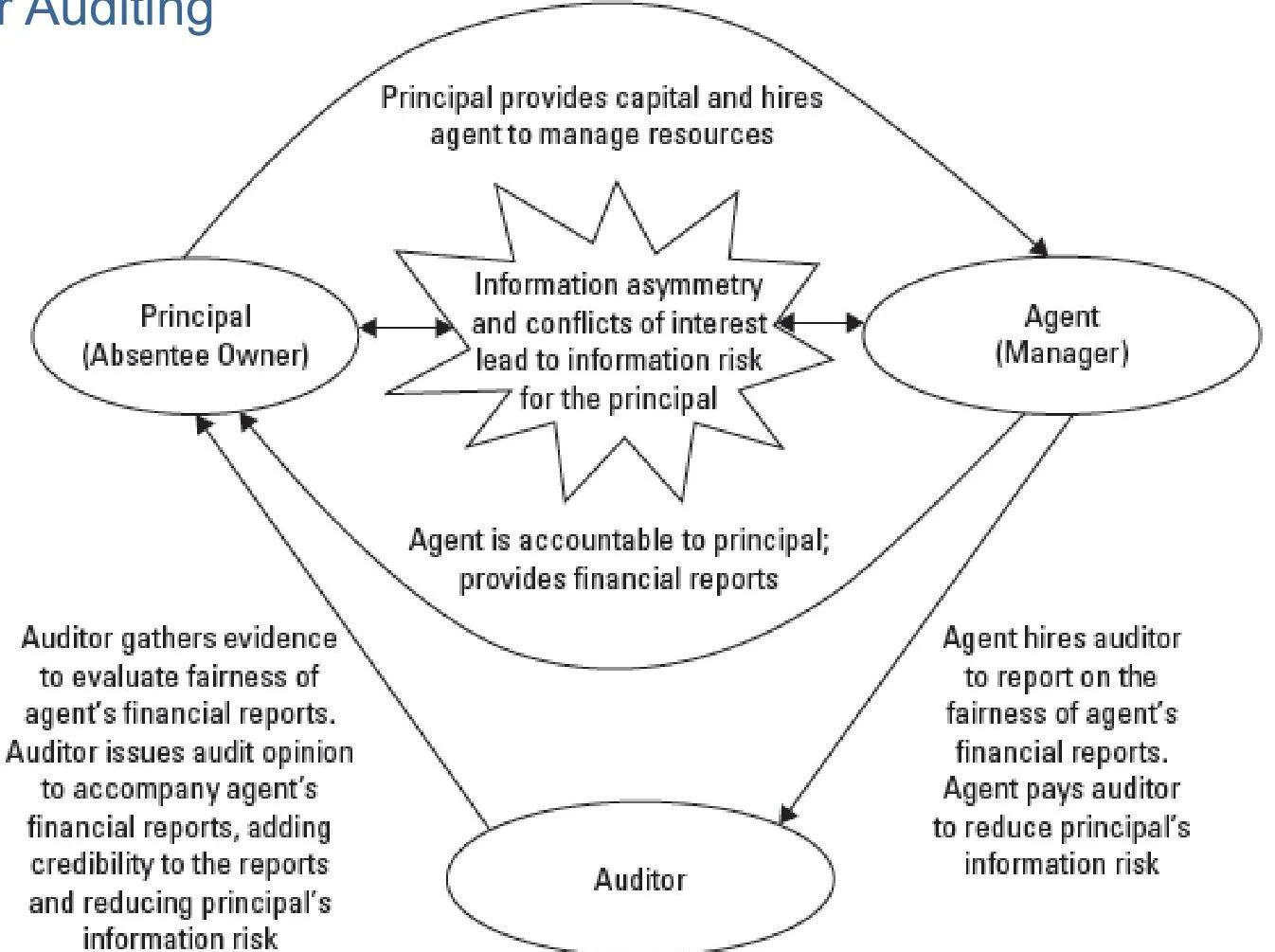
In public companies, the owners (the principals) are often not involved in the daily operations of the business. Instead, they hire management (the agents) to run the company. This creates an "information asymmetry" where managers know more about the company's health than the owners do. Owners appoint auditors to verify management's reports, thereby reducing the risk that managers might misrepresent the company's performance.
This diagram illustrates the principal-agent problem in economics, highlighting the roles of the principal, agent, and auditor in managing information asymmetry and conflicts of interest.
2. Corporate Governance
Corporate governance refers to the rules and processes by which businesses are regulated and controlled. An effective governance system requires balancing the interests of shareholders, creditors, and management. Auditors play a unique role here as independent professionals who provide an unbiased opinion on whether financial statements follow the required framework, protecting outsiders from misstated information.
3. Capital Markets
Capital markets rely on the flow of accurate information. If investors and banks cannot trust financial data, they may make incorrect decisions—such as lending money to a failing company or failing to buy shares in a healthy one. Auditing provides the credibility necessary for these markets to function efficiently.
Exam Tip: Management's Incentive to Misstate
Always remember that management often has an incentive to misstate financial statements to keep stock prices from falling. They may try to increase net income by overstating revenue or understating expenses.
Professional Standards and Mindsets
To perform their duties effectively, auditors must adhere to strict professional requirements.
Reasonable vs. Absolute Assurance
According to ISA 200, the objective of an audit is to obtain reasonable assurance, not absolute assurance. Reasonable assurance is a high level of assurance that the financial statements are free from material misstatement, but it is not 100%. Absolute assurance is impossible because:
Auditors use sampling rather than checking every single transaction.
Audit evidence is often persuasive rather than conclusive.
Fraud may involve sophisticated concealment or collusion.
Professional Judgment and Skepticism
Auditors must apply professional judgment—using their training and experience to make informed decisions during the audit. Crucially, this must be paired with professional skepticism, which is defined by ISA 200 as an attitude that includes a "questioning mind" and being alert to conditions that may indicate possible misstatement due to error or fraud.
Independence
Independence is the cornerstone of an auditor's credibility. An auditor must be independent in both fact (their actual state of mind) and appearance (how the public perceives them). If an auditor owns shares in a client company or serves as its director, their objectivity is compromised.
Key Audit Concepts: Materiality and Risk
Materiality
A misstatement is material if its omission or misstatement could reasonably influence the decisions of a user. Materiality has two dimensions:
Quantitative: The monetary size of the error (e.g., a $500,000 error in revenue).
Qualitative: The nature of the item (e.g., a small error that constitutes fraud by management).
Auditors apply materiality in three steps:
Determine Overall Materiality: Setting a threshold for the financial statements as a whole during planning.
Determine Performance Materiality: Setting an amount (often 50%–75% of overall materiality) to provide a safety margin.
Evaluate Audit Findings: Comparing the aggregate of all misstatements to the overall materiality to decide if adjustments are needed.
Audit Risk
Audit Risk (AR) is the risk that an auditor expresses an inappropriate opinion when the financial statements are materially misstated. It is modeled by the following formula:
AR &= IR \times CR \times DR
\end{aligned}$$
* **Inherent Risk (IR):** The susceptibility of an assertion to misstatement before considering internal controls (e.g., complex valuations).
* **Control Risk (CR):** The risk that the company's internal controls fail to prevent or detect a misstatement.
* **Detection Risk (DR):** The risk that the auditor's own procedures fail to detect a misstatement.
To manage audit risk, if the auditor assesses Inherent Risk or Control Risk as high, they must lower their Detection Risk by performing more extensive and persuasive testing.
## Gathering Audit Evidence
The final goal of the audit process is to gather **sufficient** (quantity) and **appropriate** (quality/relevance) **audit evidence** to support the auditor's opinion. Common methods include:
* **Inspection:** Examining documents or physical assets.
* **Observation:** Watching a process, such as an inventory count.
* **Confirmation:** Obtaining a direct response from a third party, like a bank.
* **Recalculation:** Checking mathematical accuracy.
* **Analytical Procedures:** Evaluating financial information through analysis of relationships.
* **Inquiry:** Seeking information from management or employees.
By combining these methods, the auditor can form a basis for their **audit opinion**, which is communicated to users via the **auditor's report**.
$$$
$$$
Keep reading for free.
Create an account to finish this reading and make it part of your study routine.