Introduction to Analytic Geometry: Concepts and Applications
Explore fundamental concepts of analytic geometry, including slope, midpoint, linear equations, perpendicularity, perpendicular bisectors, altitudes, and calculating the shortest distance from a point to a line.
Analytic geometry serves as a powerful bridge between algebra and geometry. By using algebraic methods—such as equations and coordinates—we can solve complex geometric problems involving points, lines, and segments. This article reviews the fundamental tools required to navigate this field, ranging from basic slope calculations to finding the shortest distance between a point and a line.
The Building Blocks: Slope, Midpoint, and Linear Equations
Before tackling complex geometric constructions, one must master three foundational concepts: slope, the midpoint, and the linear equation.
Slope (m) measures the steepness and direction of a line. Given two points (x1,y1) and (x2,y2), the slope is calculated as:
m=x2−x1y2−y1
Midpoint (M) identifies the exact center of a line segment. It is found by averaging the x-coordinates and the y-coordinates of the endpoints:
M=(2x1+x2,2y1+y2)
The Equation of a Line is typically expressed in slope-intercept form:
$y = mx + b$
where m represents the slope and b represents the y-intercept. To find the equation of a specific line, you can substitute a known slope and one point (x,y) into this formula to solve for b.
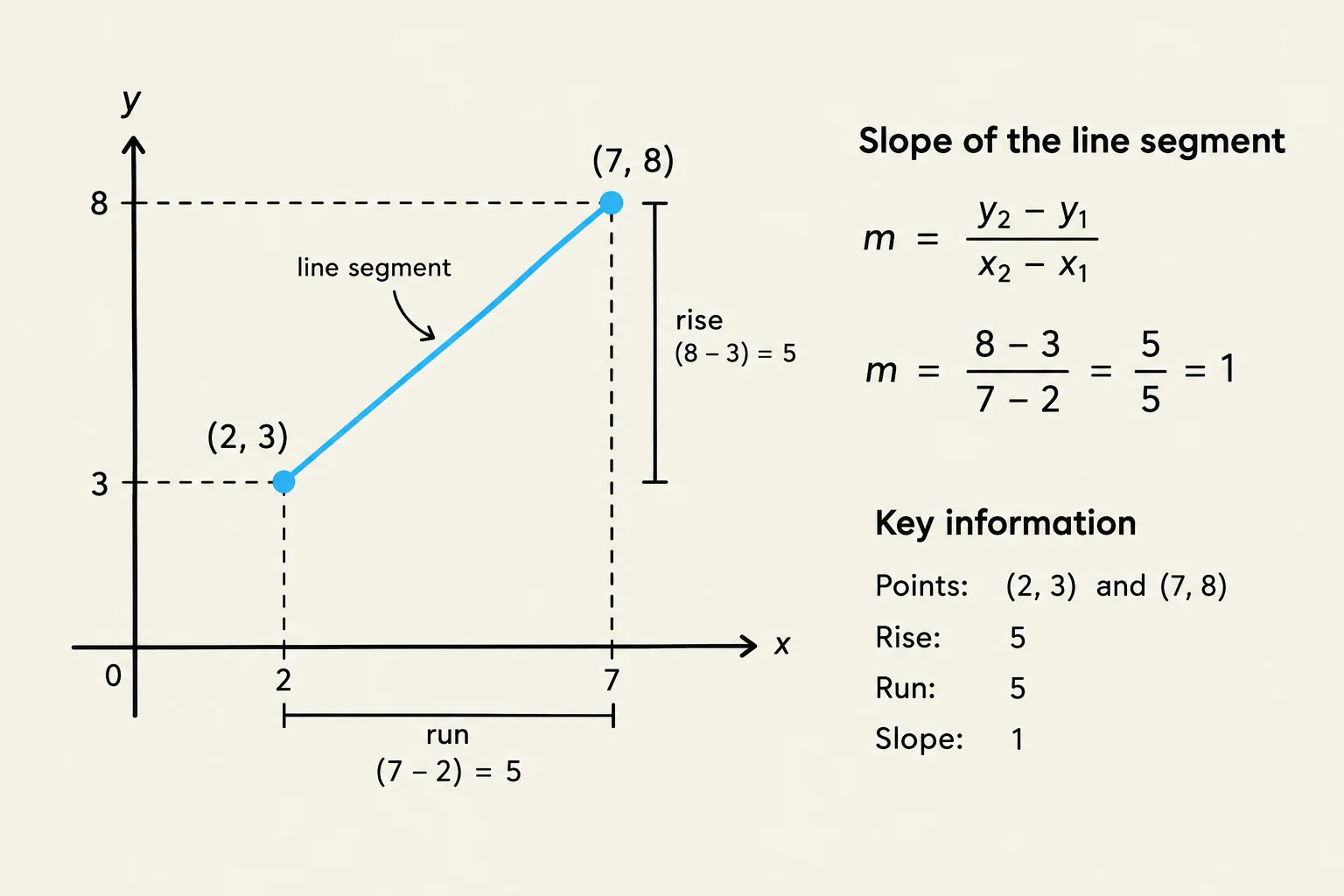
This illustration demonstrates how to calculate the slope of a line segment using two points (2, 3) and (7, 8). The formula for slope (m) is the change in y (rise) divided by the change in x (run). In this case, the rise is 8 - 3 = 5 and the run is 7 - 2 = 5, resulting in a slope of 5/5 = 1.
Perpendicularity and the Negative Reciprocal
A central theme in analytic geometry is the relationship between perpendicular lines. Two lines are perpendicular if they intersect at a 90∘ angle.
The most critical rule to remember is the negative reciprocal slope. If one line has a slope of m, the slope of a line perpendicular to it (m⊥) is:
m⊥=−m1
This means that if you multiply the slopes of two perpendicular lines, the product will always be −1.
Exam Tip: When calculating the negative reciprocal, remember to do two things: flip the fraction and change the sign. For example, if the slope is 32, the perpendicular slope is −23. If the slope is −4, the perpendicular slope is 41.
Geometric Constructions: Perpendicular Bisectors and Altitudes
We can apply the concept of perpendicularity to find specific lines within geometric shapes, most notably the perpendicular bisector and the altitude.
The Perpendicular Bisector (Right Bisector)
A perpendicular bisector, often called a right bisector, is a line that is perpendicular to a segment and passes through its midpoint, effectively dividing the segment into two equal parts.
To find the equation of a perpendicular bisector, follow these steps:
Calculate the midpoint of the line segment.
Find the slope of the original line segment.
Determine the negative reciprocal of that slope.
Use the midpoint and the new slope to solve for b in $y = mx + b$.
The Altitude (Height)
In the context of a triangle, an altitude (or height) is a line segment that originates from a vertex and is perpendicular to the opposite side.
To find the equation of an altitude from a specific vertex:
Find the equation of the side opposite that vertex.
Determine the slope of that opposite side.
Calculate the negative reciprocal of that slope.
Use the coordinates of the vertex and the new perpendicular slope to solve for b.
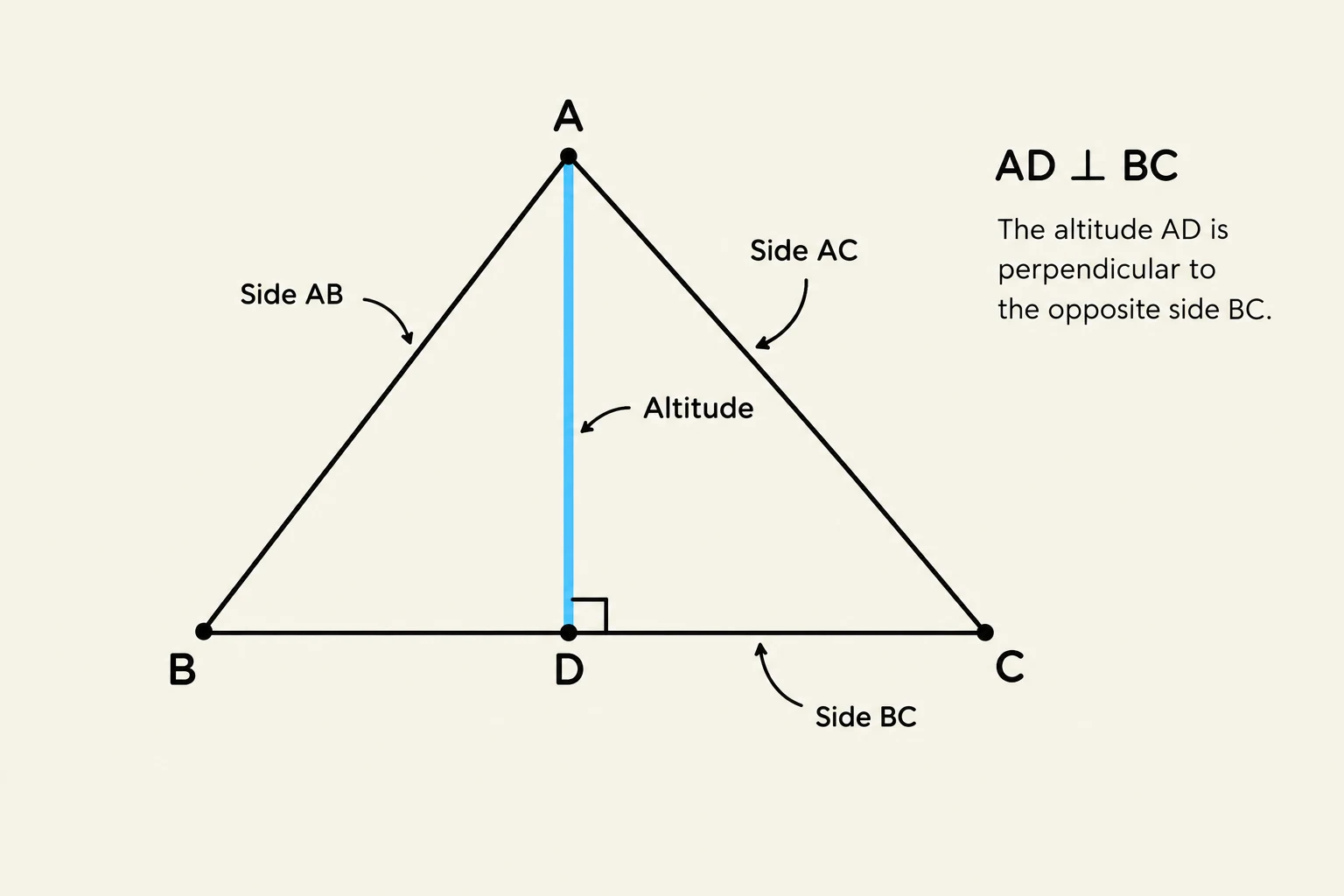
This diagram illustrates the altitude of a triangle, which is a line segment from a vertex perpendicular to the opposite side.
Finding the Shortest Distance
One of the most practical applications of analytic geometry is determining the shortest distance from a point P(x,y) to a line. Geometrically, the shortest path is always the length of the line segment that is perpendicular to the given line and connects it to the point.
To calculate this distance, you cannot simply use the distance formula between two arbitrary points; you must first find the specific point where the perpendicular path meets the line. This is known as the Point of Intersection (P.O.I.).
Step-by-Step Procedure:
Identify the given line: Ensure you have the equation of the line ($y = mx + b$) to which you are measuring the distance.
Create a perpendicular line: Find the negative reciprocal of the given line's slope. Use this new slope and the coordinates of point P to write a new linear equation.
Find the P.O.I.: Solve the system of two equations (the original line and your new perpendicular line) using either substitution or elimination. The solution to this system is the Point of Intersection.
Calculate distance: Use the distance formula to find the length between the original point P and the P.O.I..
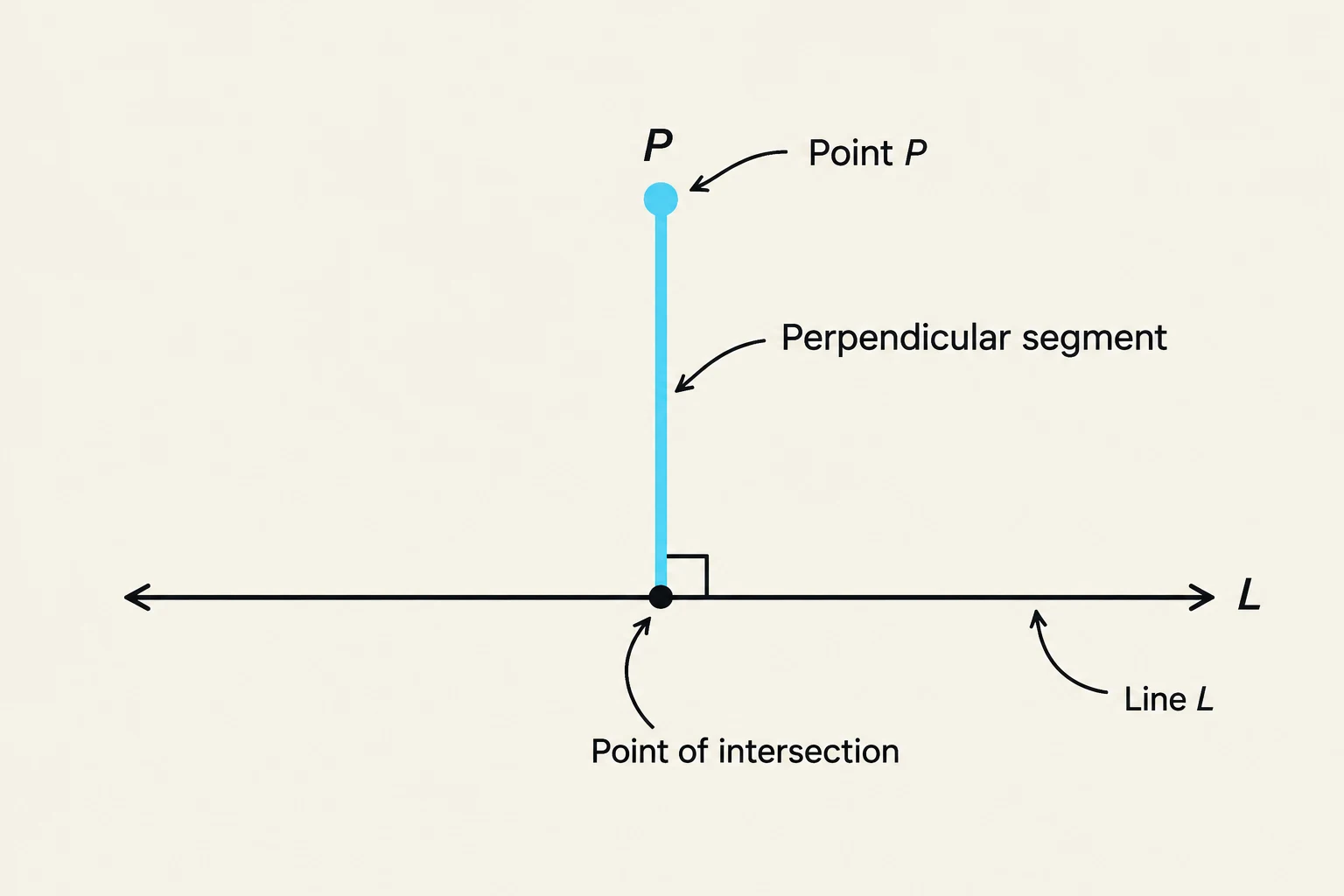
A diagram illustrating a point P and a perpendicular segment from P to line L, showing the point of intersection.
Summary Checklist for Problems:
Midpoint? Use it for bisectors.
Vertex? Use it for altitudes.
Perpendicular? Always use the negative reciprocal slope.
Shortest Distance? Find the P.O.I. first!
Keep reading for free.
Create an account to finish this reading and make it part of your study routine.