An overview of acids and bases, covering their structures, definitions (Arrhenius, Brønsted-Lowry), common examples, and methods for measuring their strength (Ka, Kb, pH).
Acids and bases are fundamental to both chemical theory and everyday life, appearing in everything from the food we eat to the cleaning products we use in our homes. Understanding their behavior requires looking at their molecular structures and how they interact with water to release or accept ions. This article explores the different types of acids, the nature of bases, and the mathematical frameworks used to measure their strength.
The Structures of Acids
Acids are not a single uniform group of molecules; rather, they are categorized by how their hydrogen atoms are bonded within the molecular structure.
Binary Acids
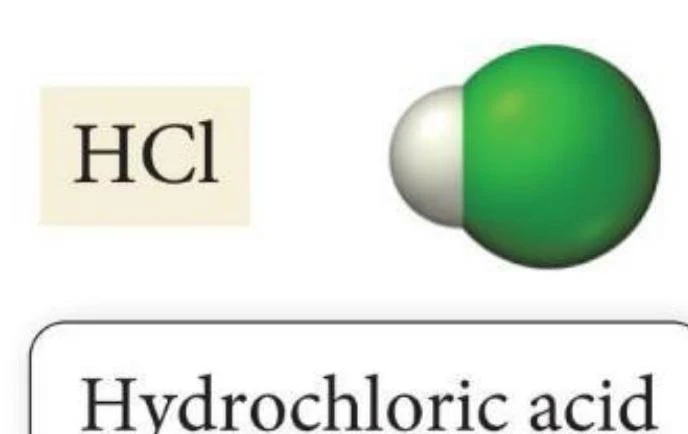
A binary acid consists of an acid hydrogen ($H^+$) attached directly to a nonmetal atom. A classic example is hydrochloric acid (HCl).
A molecular model of hydrochloric acid (HCl), showing a hydrogen atom bonded to a chlorine atom.
Oxyacids
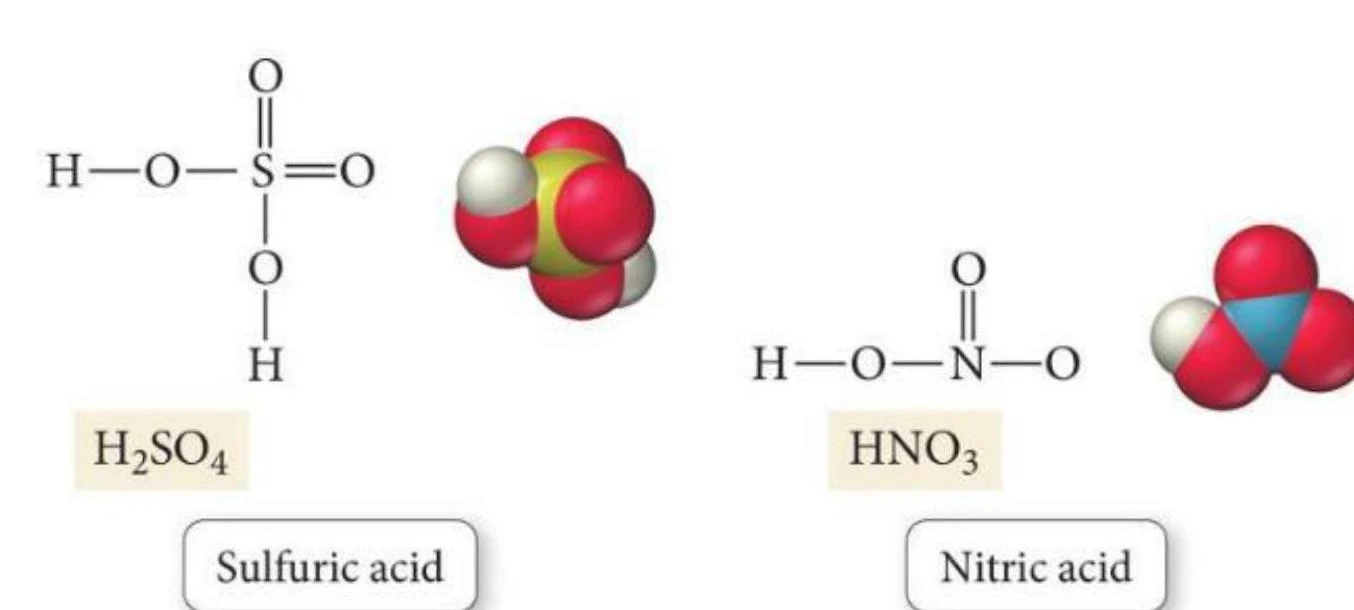
In oxyacids, the acid hydrogen is attached to an oxygen atom rather than directly to a central nonmetal. Common examples include sulfuric acid (H2SO4) and nitric acid (HNO3).
Diagrams illustrating the molecular structures of sulfuric acid (H2SO4) and nitric acid (HNO3).
Carboxylic Acids
Carboxylic acids are a specific class of organic acids characterized by the presence of a carboxylic acid group (–COOH). In these molecules, only the hydrogen atom located on the –COOH group is acidic.
Chemical structure of a carboxyl group.
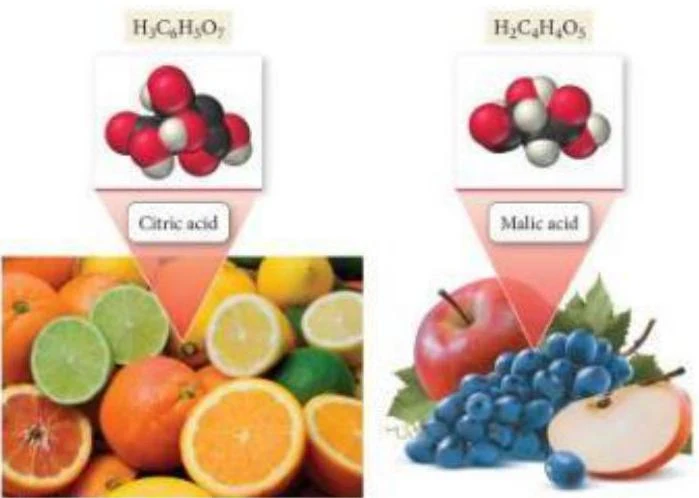
Citric acid is found in citrus fruits, and malic acid is found in apples and grapes.
Common Acids and Bases in Use
Acids and bases serve various industrial and biological roles. Below are some of the most common substances found in chemistry and daily life.
Table 1: Common Acids
Name
Occurrence/Uses
Hydrochloric acid (HCl)
Metal cleaning; food preparation; stomach acid
Sulfuric acid (H2SO4)
Fertilizers; explosives; automobile batteries
Nitric acid (HNO3)
Fertilizer and explosives manufacturing
Acetic acid (HC2H3O2)
Plastic/rubber manufacturing; vinegar
Citric acid (H3C6H5O7)
Citrus fruits; food pH adjustment
Carbonic acid (H2CO3)
Carbonated beverages
Table 2: Common Bases
Name
Occurrence/Uses
Sodium hydroxide (NaOH)
Petroleum processing; soap manufacturing
Potassium hydroxide (KOH)
Cotton processing; electroplating; batteries
Sodium bicarbonate (NaHCO3)
Baking soda; antacid
Sodium carbonate (Na2CO3)
Glass and soap manufacturing; water softener
Ammonia (NH3)
Detergent; fertilizer manufacturing
Defining Acids and Bases
To understand how these substances react, chemists use different definitions. The Arrhenius definition states that an acid produces $H^+$ in solution (which associates with water to form hydronium, H_3O+), while a base produces $OH^-$.
However, the Brønsted–Lowry definition is more widely applicable. Under this theory:
An acid is an $H^+$ (proton) donor.
A base is an $H^+$ acceptor.
When an acid and base react, they typically form a salt and water:
In a Brønsted–Lowry reaction, the relationship between reactants and products is described by conjugate pairs. When an acid donates a proton, it becomes a conjugate base. Conversely, when a base accepts a proton, it becomes a conjugate acid.
This illustration shows the concept of conjugate acid-base pairs in chemistry. The left side depicts ammonia (NH3) acting as a base, accepting a proton (H+) to form the ammonium ion (NH4+), which is its conjugate acid. The right side shows water (H2O) acting as an acid, donating a proton (H+) to form the hydroxide ion (OH-), which is its conjugate base. Both examples illustrate the formation of a conjugate acid-base pair.
Some substances are amphoteric, meaning they can act as either an acid or a base depending on the reaction partner. Water is the most famous example: it can act as a base by accepting $H^+$ from HCl, or as an acid by donating $H^+toNH_3$.
Measuring Strength: Ka, Kb, and pH
The "strength" of an acid or base refers to how completely it ionizes in water.
Strong vs. Weak
Strong acids and bases are strong electrolytes; they ionize almost 100% in water. Examples include HCl, HNO3, and NaOH.
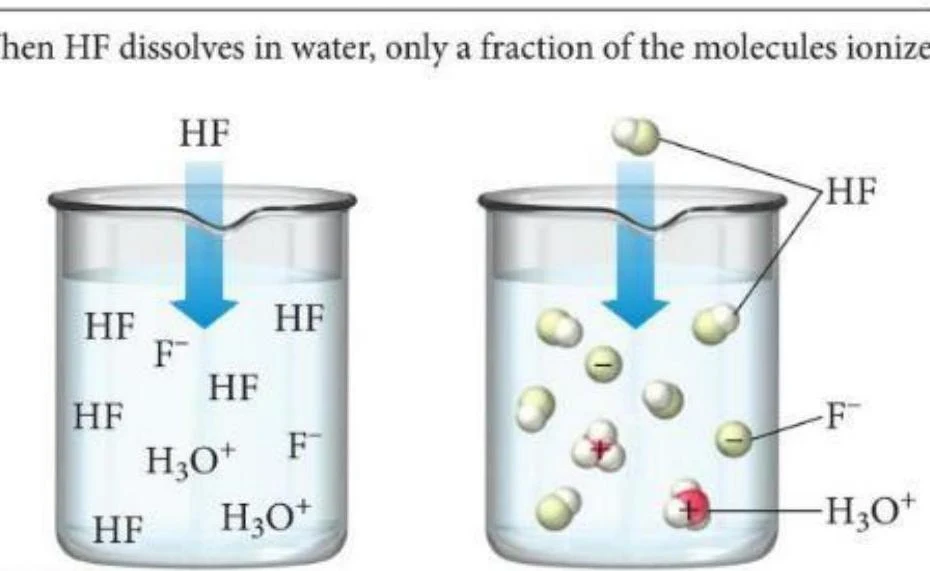
Weak acids and bases are weak electrolytes; only a small fraction of the molecules ionize. Examples include acetic acid (HC2H3O2) and ammonia (NH3).
Illustration showing the partial ionization of hydrofluoric acid (HF) in water, forming hydronium ions (H3O+) and fluoride ions (F-).
Ionization Constants
The strength of a weak acid is quantified by its acid ionization constant (Ka):
Ka=[HA][H3O+][A−]
A larger Ka indicates a stronger acid. Similarly, the base ionization constant (Kb) measures base strength.
Exam Tip: Because Ka and Kb are logarithmic scales, it is often easier to use $pK_a$ and $pK_b$. The relationship is pKa=−log(Ka). Note that a smaller $pK_a$ value means a stronger acid.
The pH Scale
The acidity of a solution is expressed as pH, defined as:
pH=−log[H3O+]
At 25∘C, the product of hydronium and hydroxide concentrations is always constant: [H3O+][OH−]=Kw=1.00×10⁻¹⁴. This leads to the relationship:
pH+pOH=14.0
pH < 7: Acidic solution
pH = 7: Neutral solution
pH > 7: Basic solution
Polyprotic Acids
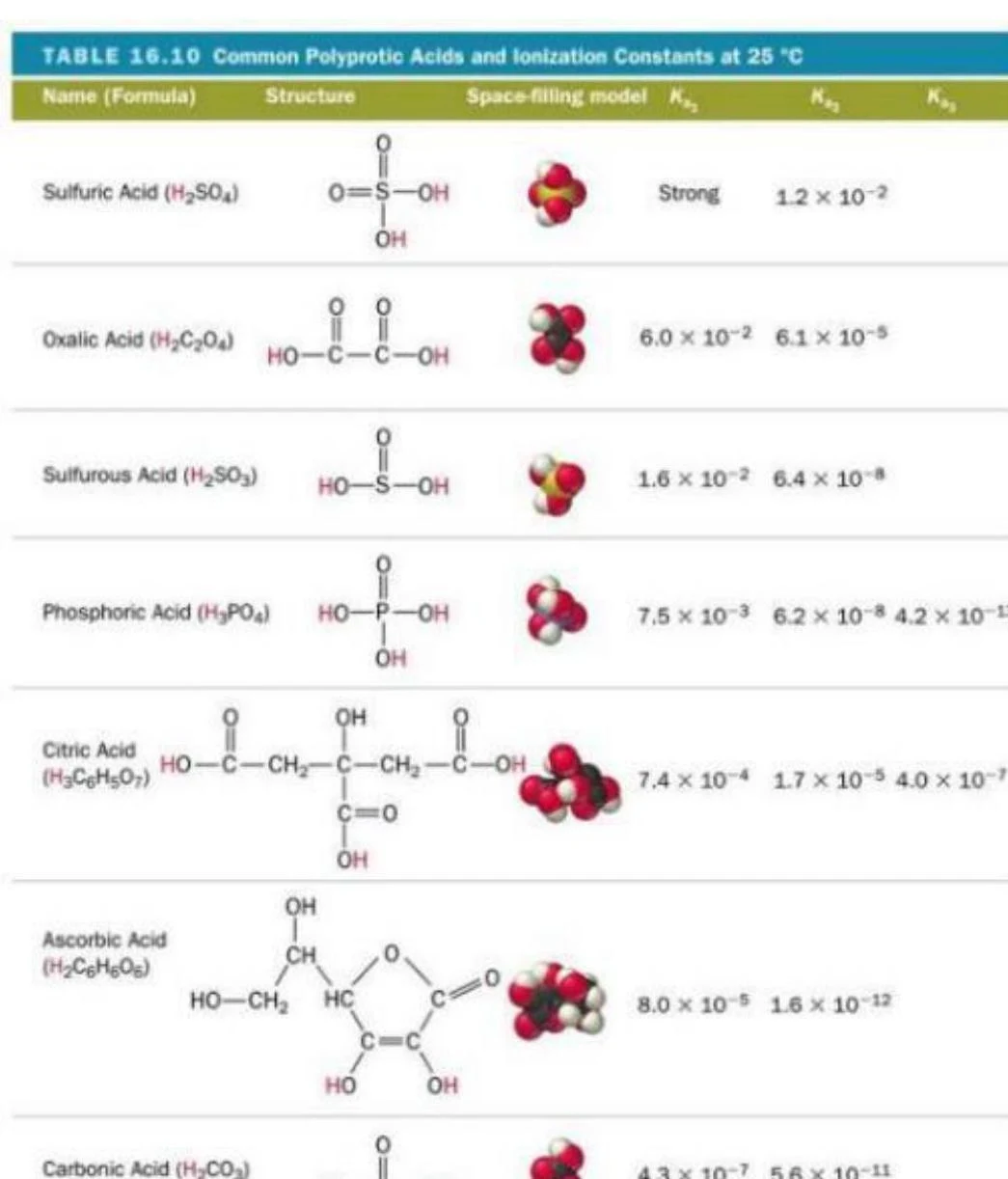
Some acids, known as polyprotic acids, can donate more than one proton per molecule. These acids ionize in steps, and each step has its own ionization constant (Ka1,Ka2, etc.). Generally, the first ionization is much stronger than the subsequent ones (Ka1>Ka2>Ka3).
For example, in sulfuric acid (H2SO4), the first ionization is considered strong, while the second ionization is a weak acid reaction with Ka2=1.2×10⁻².
Table showing common polyprotic acids, their structures, space-filling models, and ionization constants at 25°C.
Keep reading for free.
Create an account to finish this reading and make it part of your study routine.