Interviewing Methods and Employment Assessments for Hiring
This guide explains various interviewing techniques, the structure of interview questions, the behavioral interviewing model, and different types of employment assessments used in the hiring process.
In the field of Human Resources Management, the selection process is the critical bridge between recruitment and successful employment. While recruitment focuses on locating and encouraging applicants, selection is the systematic process of choosing the individuals best able to fulfill the specific requirements of a job. To make these decisions effectively, organizations rely on two primary pillars: the employment interview and various employment assessments.
Interviewing Methods
An interview is one of the most common sources of information used to make selection decisions. However, not all interviews are conducted in the same way. The format chosen often depends on the role, the volume of applicants, and the organizational culture.
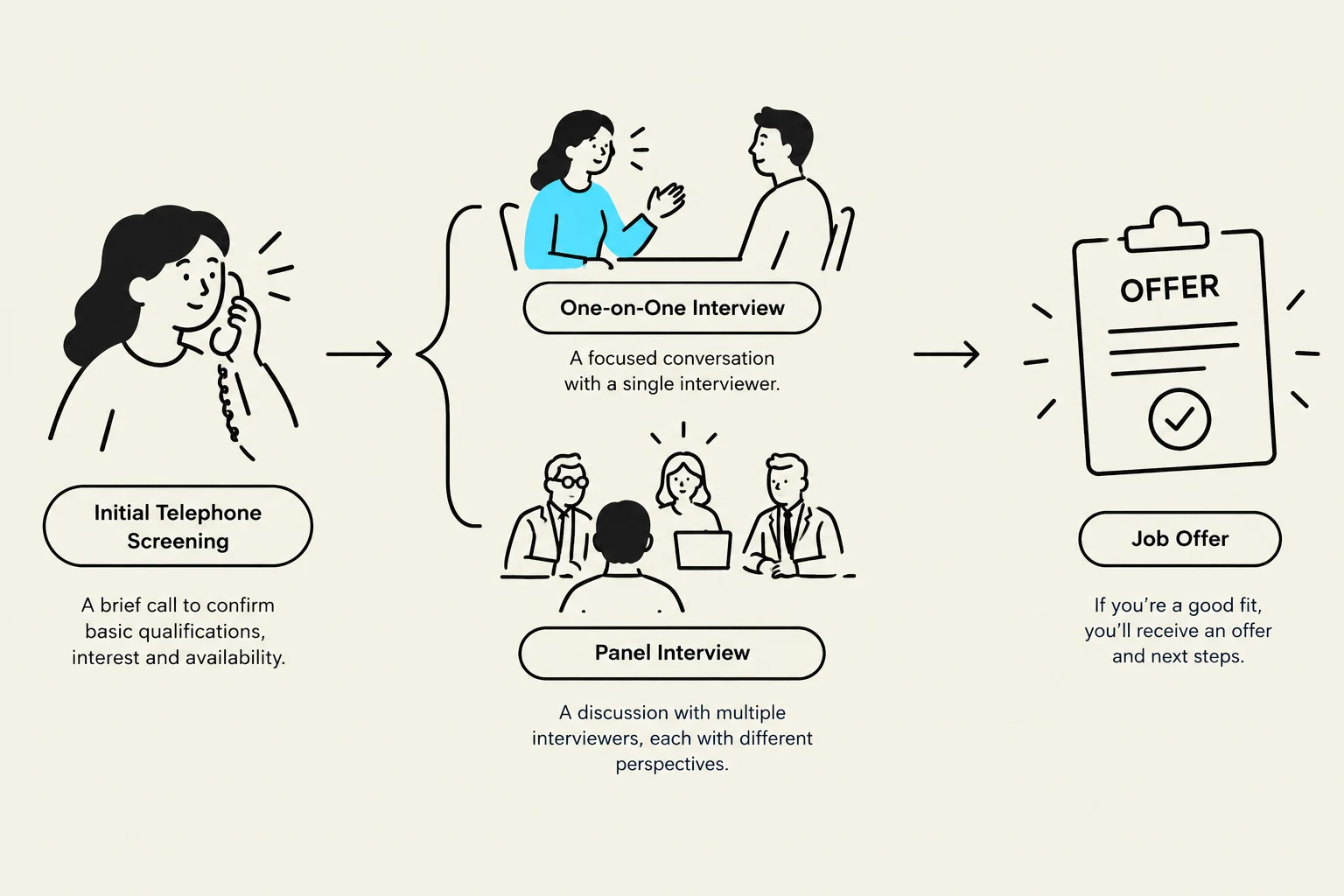
One-on-one interviewing: The most traditional format, involving a single interviewer and a single candidate. This allows for a personal connection but may be subject to individual interviewer bias.
Panel interviewing: A group of interviewers (a panel) meets with the candidate simultaneously. This can increase reliability by providing multiple perspectives on a single candidate.
Telephone interviewing: Often used as an initial screening tool to narrow down a large pool of applicants before inviting them for more intensive sessions.
Technology-based interviewing: Utilizing digital platforms, such as video conferencing or asynchronous video recordings, to conduct interviews remotely.
This diagram illustrates the typical stages of a job application process, including initial screening, one-on-one and panel interviews, and the final job offer.
The Structure of Interview Questions
The quality of an interview is largely determined by the types of questions asked. Questions can be categorized by their level of standardization and their focus on the past versus the future.
Structured vs. Unstructured Questions
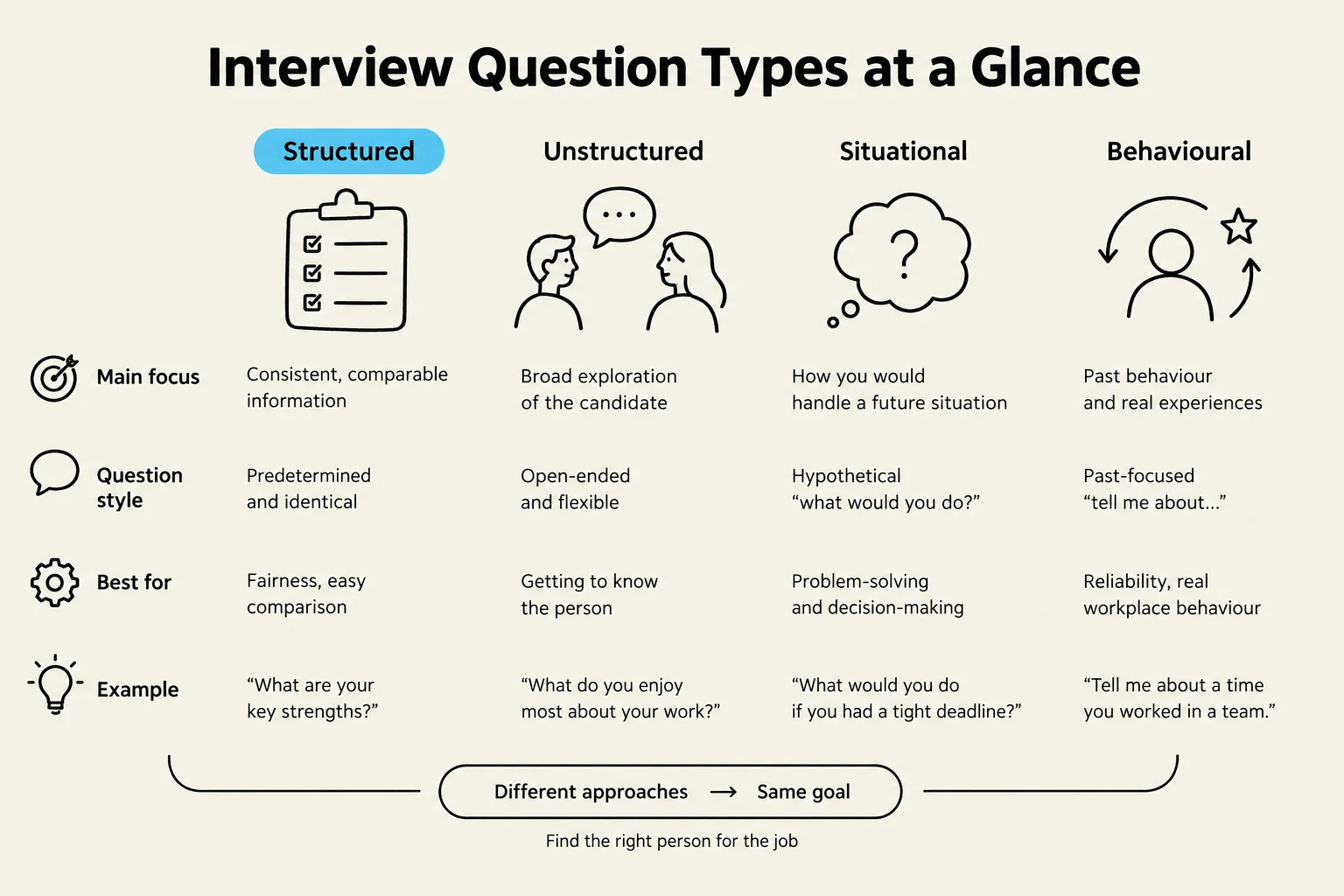
Structured questions are standardized; every candidate is asked the same set of questions in the same order. This ensures consistency and makes it easier to compare candidates objectively. In contrast, unstructured questions are open-ended and allow the interviewer to follow a conversational flow, which can build rapport but often lacks the consistency needed for fair comparison.
Situational vs. Behavioural Questions
Situational questions are hypothetical. They ask a candidate how they would react to a specific future scenario (e.g., "How would you handle a conflict with a coworker?").
However, many modern organizations prefer the Behavioural Description Interview (BDI) model. BDI is based on the fundamental premise that past behavior is the best predictor of future performance. Instead of asking what a candidate might do, BDI asks what they actually did in a specific past situation.
The Behavioural Interviewing Model
To implement a successful BDI, interviewers should follow a specific model to move beyond superficial answers and uncover true competencies.
1. Create a Behavioural Profile
Before the interview begins, the interviewer must develop a behavioural profile. This profile lists the specific attributes required for the role, such as "accepts responsibility," "consults with others," or "is a good cost controller". Rather than looking for a "perfect" human, the interviewer uses this profile to identify "deal breakers"—traits that are non-negotiable for the role.
2. Focus on Critical Incidents
During the interview, the focus should remain on critical incidents—specific, real-life events from the candidate's past. When a candidate describes an incident, the interviewer must ensure the candidate describes their individual contribution. A common pitfall is when candidates use "we" to describe a team success; the interviewer must probe to find out what the candidate specifically did by looking for "I" statements.
3. "Hide Your Hand"
To maintain objectivity and prevent candidates from giving "correct" rather than "honest" answers, interviewers should "hide their hand". This involves:
Not revealing the exact criteria or attributes you are looking for prematurely.
Avoiding leading questions that suggest a "right" answer.
Managing silence effectively; do not rush to fill a quiet moment, as the candidate may be reflecting on a genuine memory.
Exam Tip: If asked to differentiate between Situational and Behavioural questions, remember: Situational = Future/Hypothetical ("What would you do?"); Behavioural = Past/Actual ("What did you do?").
This chart outlines different types of interview questions: structured, unstructured, situational, and behavioural, along with their main focus, style, best use cases, and examples.
Interview Guidelines for Success
To ensure the selection process is both legal and ethical, interviewers must adhere to strict professional guidelines.
Preparation and Rapport: Always establish an interview plan beforehand and work to build rapport with the candidate to encourage honest communication.
Active Listening: Pay close attention to both verbal answers and non-verbal cues (such as body language).
Objectivity: It is vital to separate facts from inferences. An inference is a conclusion you draw (e.g., "They seemed nervous, so they must be incompetent"), whereas a fact is what was actually said or done.
Bias Mitigation: Recognize your own personal biases and stereotypes to prevent them from influencing the decision.
Legal Compliance: Avoid asking illegal questions (those related to protected characteristics like religion, age, or marital status) and ensure questions are standardized across all candidates to maintain fairness.
Employment Assessments
While interviews provide qualitative data, organizations often use employment assessments to gather objective, measurable data to supplement the interview process.
Assessment Type
Description
Cognitive Ability Tests
Measure mental capabilities, intelligence, and problem-solving skills.
Personality & Interest Inventories
Assess character traits, temperament, and career preferences.
Emotional Intelligence
Evaluate social competence and the ability to manage emotions in social interactions.
Physical Ability Tests
Measure the physical strength or stamina required for specific manual tasks.
Job Sample Tests
Require candidates to perform actual work tasks related to the role (e.g., a coding test for a programmer).
By combining structured interviewing methods with diverse employment assessments, organizations can increase the reliability (consistency of results) and validity (accuracy in measuring what is intended) of their selection process.
Keep reading for free.
Create an account to finish this reading and make it part of your study routine.