Interplay of Operant and Respondent Conditioning in Behavior
Explores the historical separation and modern understanding of operant and respondent conditioning, highlighting their intertwined nature and dual functions of stimuli in behavior analysis.
Historically, behavioral science treated respondent and operant conditioning as two separate domains. Respondent conditioning was often associated with involuntary, autonomic responses (like salivation), while operant conditioning was linked to voluntary, skeletal muscle movements. However, modern research has demonstrated that this separation is no longer tenable at either the behavioral or neural levels. Instead, these two processes are deeply intertwined, often occurring simultaneously and likely sharing common neural pathways.
Defining the Two Domains
To understand how they interact, we must first define the individual processes. Respondent conditioning involves behavior that is elicited by antecedent stimuli. In this process, a stimulus is paired with an unconditioned stimulus (US) until the stimulus itself elicits a conditioned response (CR).
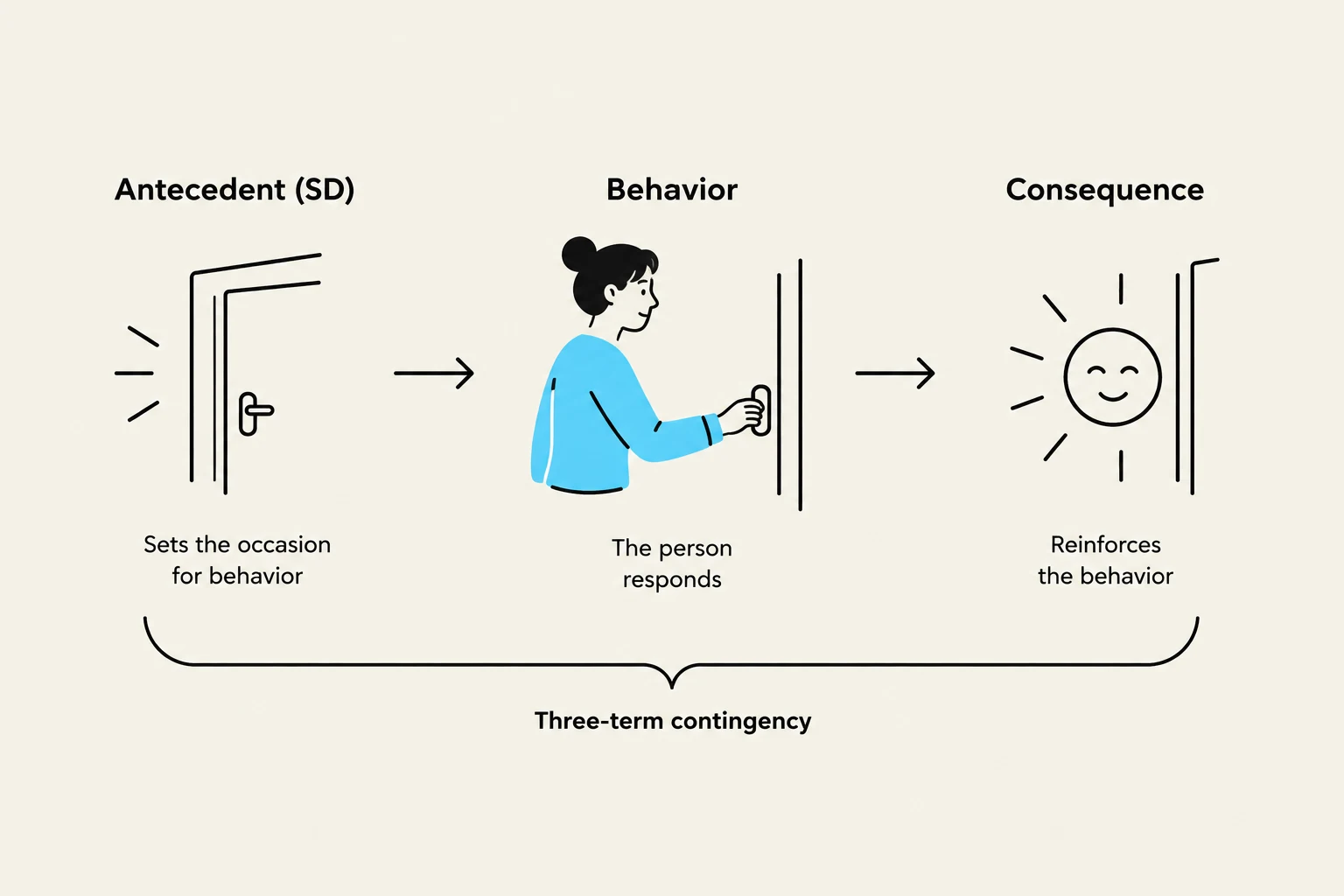
Operant conditioning, conversely, involves behavior that is modified by its consequences. This is often analyzed through the three-term contingency, which consists of the antecedent stimulus, the behavior, and the consequence:
Antecedent→Behavior→Consequence
In an operant contingency, the antecedent acts as a discriminative stimulus (SD), which sets the occasion for a specific response by signaling that reinforcement is available.
This diagram illustrates the three-term contingency in behavior analysis: Antecedent (SD), Behavior, and Consequence.
The Dual Function of Stimuli
One of the most critical realizations in modern behavior analysis is that a single stimulus can serve a dual function. A stimulus may act as an SD for an operant response while simultaneously acting as a conditioned stimulus (CS) that elicits respondent behavior.
Consider the example of a dog being trained to "sit" using food reinforcement.
Operant Function: The verbal command "Sit" acts as an SD. It signals to the dog that if it performs the operant behavior of sitting, it will receive food.
Respondent Function: Because the command "Sit" has been repeatedly paired with the presentation of food, it becomes a CS that elicits respondent salivation or food-seeking behaviors.
This interrelationship means that respondent processes are often embedded within operant contingencies.
When Biology Intervenes: Instinctive Drift
When biologically relevant stimuli (like food) are contingent on an organism's operant behavior, species-characteristic, innate behaviors may be elicited. This phenomenon is known as instinctive drift.
The Brelands documented this through their work with raccoons. They attempted to train a raccoon to pick up coins and deposit them in a metal container for food. However, as the coins were consistently paired with food, the coins became a CS that elicited the raccoon's innate "hand-rubbing" behavior—a species-characteristic behavior used to manipulate food. Instead of depositing the coins, the raccoon would obsessively rub them, effectively "drifting" away from the operant goal toward a respondent, instinctive pattern.
Exam Tip: If a question asks why a trained animal suddenly performs an innate, non-reinforced behavior during a task, look for "instinctive drift" caused by respondent procedures embedded in an operant contingency.
Sign Tracking and Autoshaping
Another complex interaction is sign tracking, where an organism responds directly to the signal (the CS) rather than the reinforcer itself.
In experiments where a light or tone precedes food, animals often exhibit "food-soliciting responses"—such as barking, prancing, or licking the light source. While an operant analysis would predict the animal should simply move toward the food, the animal's behavior is actually elicited by the signal, suggesting the signal has acquired intense "incentive salience".
This is closely related to autoshaping observed in pigeons. When a key light is paired with food, pigeons begin to peck the light even if pecking does not produce food. Research suggests that autoshaping begins as a respondent process (the light elicits a peck) which can then be reinforced as an operant behavior.
This diagram illustrates the concept of sign tracking in animal behavior, where a conditioned stimulus (CS), such as a light, becomes associated with an unconditioned stimulus (US), like food. Over repeated pairings, the animal learns to approach the CS, anticipating the US, even if the US is not presented at the CS location.
Evolution and Selection by Consequences
The interrelationship between these processes is ultimately rooted in biology. Both evolution and learning involve selection by consequences.
Evolution selects for species-wide traits through natural consequences over generations. This determines an organism's "preparedness" to learn certain associations, such as taste aversion.
Operant conditioning selects for specific response topographies and repertoires during an organism's lifetime through reinforcing feedback.
While evolution provides the biological context and the capacity for learning, operant contingencies allow for rapid, individual adaptation to a changing environment.
Summary Table: Comparing the Processes
Feature
Respondent Conditioning
Operant Conditioning
Primary Driver
Antecedent Stimuli (CS)
Consequences (Reinforcement)
Nature of Response
Elicited (Involuntary/Reflexive)
Emitted (Voluntary/Skilled)
Role of Stimulus
Acts as a CS to trigger a CR
Acts as an SD to set the occasion
Biological Basis
Species-characteristic/Innate
Learned repertoires/Individual history
Keep reading for free.
Create an account to finish this reading and make it part of your study routine.