Intermolecular Forces and Their Impact on Liquid Properties
Explains intermolecular forces (ion-dipole, dipole-dipole, London dispersion, hydrogen bonding) and how they influence physical properties of liquids such as boiling point, viscosity, surface tension, density, and meniscus formation.
When we observe the world around us, we see liquids behaving in distinct ways: honey flows slowly, water forms droplets on a leaf, and ice floats in a glass. These behaviors are not random; they are the macroscopic manifestations of microscopic forces acting between molecules. To understand why liquids behave the way they do, we must look at intermolecular forces—the attractions that exist between molecules.
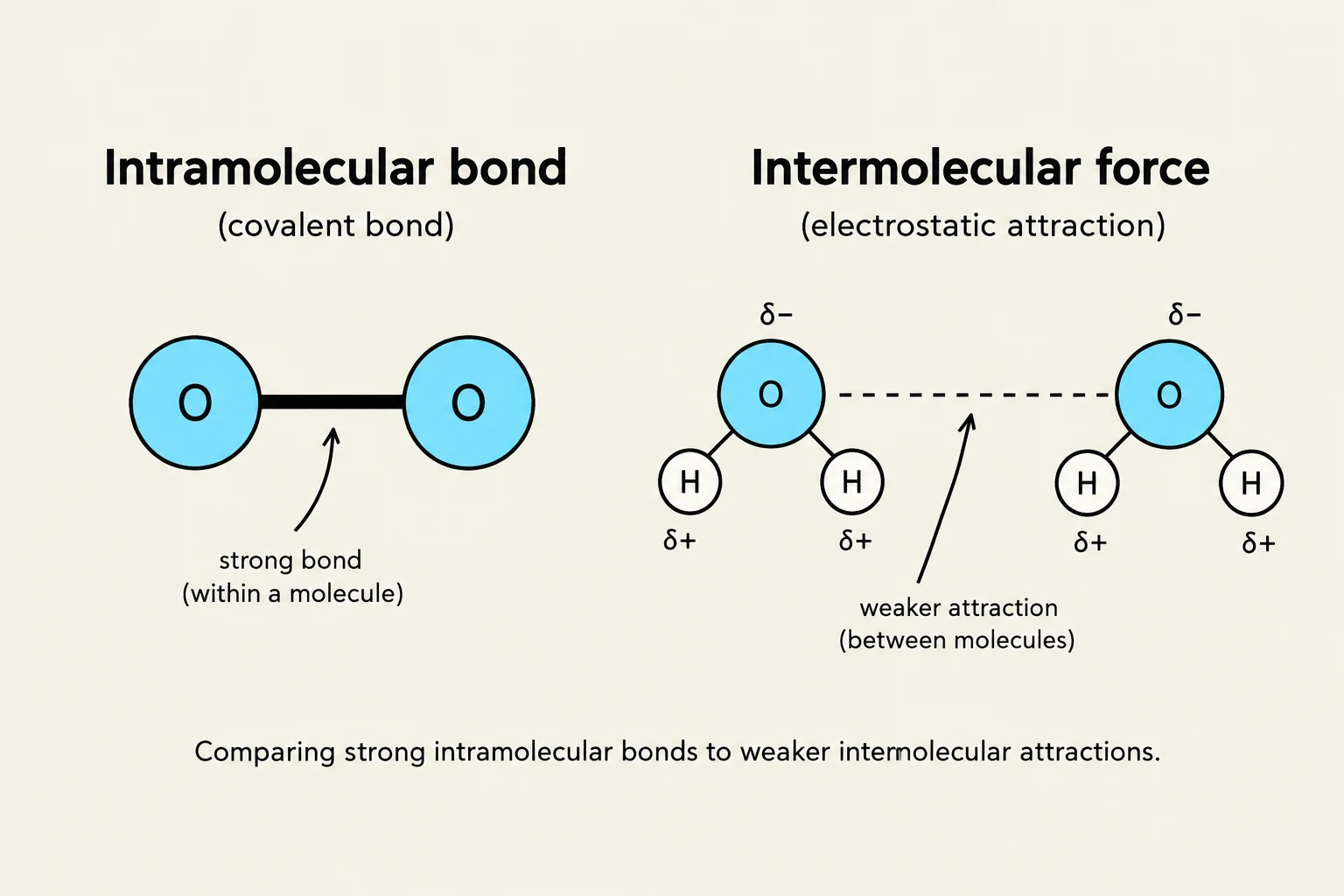
This diagram illustrates the difference between intramolecular bonds, such as covalent bonds within a molecule, and intermolecular forces, like the electrostatic attraction between water molecules.
It is important to distinguish these from intramolecular forces, which are the strong covalent or ionic bonds that hold the atoms together within a single molecule. While intramolecular bonds are much stronger, intermolecular forces are sufficient to dictate the physical properties we observe, such as boiling points and viscosity.
The Foundation: Polarity and Dipoles
The nature of an intermolecular interaction is largely determined by the distribution of electrical charge within a molecule. In many molecules, the sharing of electrons is unequal, leading to polarity.
When atoms with different electronegativities form a covalent bond, a variation in charge density occurs across the molecule. This creates dipoles, where one part of the molecule carries a partial negative charge (δ−) and another part carries a partial positive charge (δ+). These dipoles allow molecules to interact through electrostatic attraction: the δ+ end of one molecule is attracted to the δ− end of another.
There are several types of these interactions:
Ion-dipole forces: Occur between an ion and a polar molecule (e.g., salt dissolving in water).
Dipole-dipole interactions: Occur between two polar molecules.
London Dispersion Forces: Even non-polar molecules experience weak, temporary attractions caused by the constant movement of electrons, which creates instantaneous, short-lived dipoles.
Hydrogen Bonding: A Special Case of Strength
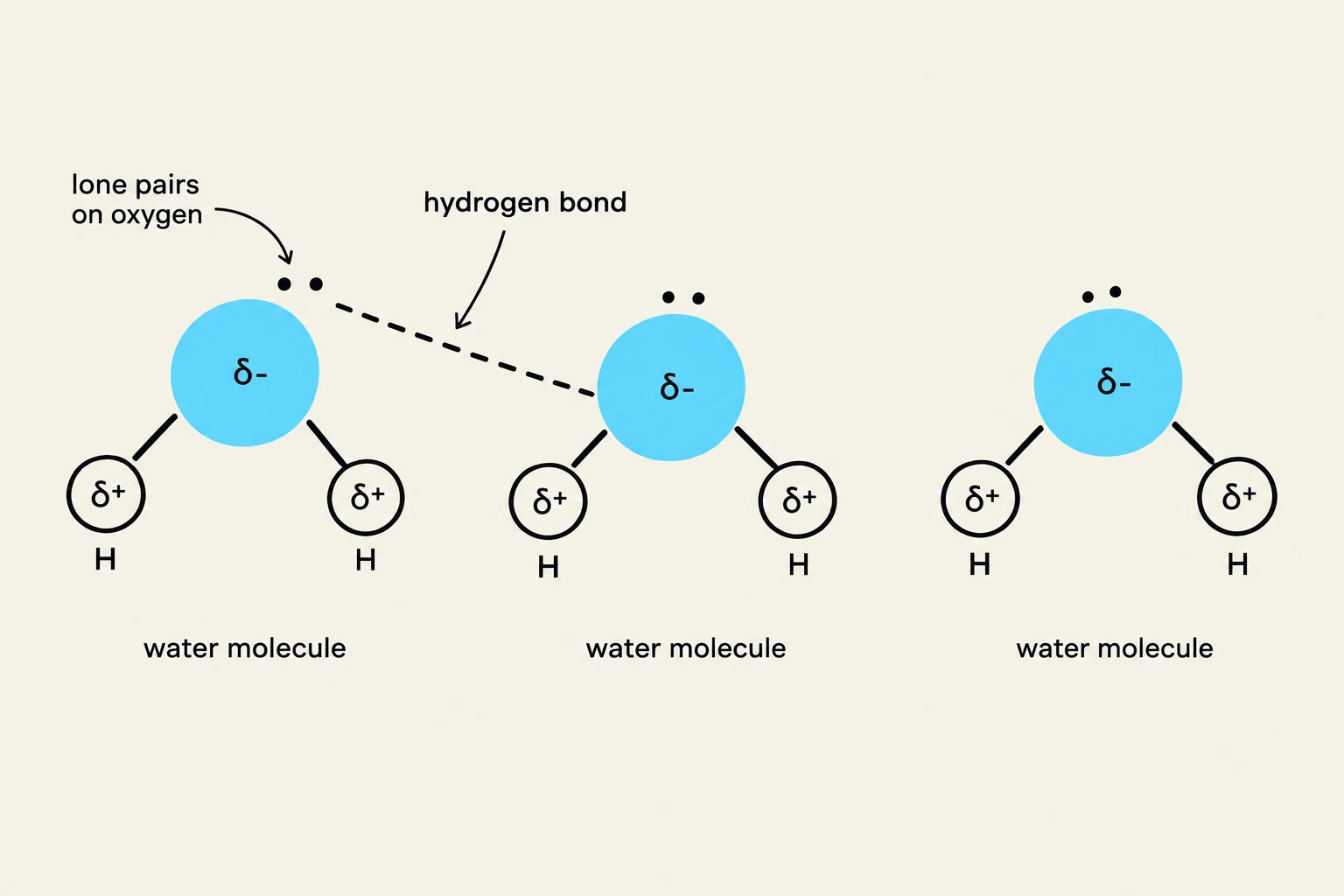
Diagram illustrating hydrogen bonding between water molecules, showing partial positive charges on hydrogen atoms and partial negative charges on the oxygen atom, along with lone pairs on oxygen.
Among all intermolecular forces, hydrogen bonding is particularly powerful. This is not a "bond" in the sense of a covalent bond, but rather a very strong type of dipole-dipole interaction.
Hydrogen bonding occurs when a hydrogen atom is covalently bonded to a highly electronegative atom—specifically Nitrogen (N), Oxygen (O), or Fluorine (F)—and is then attracted to a lone pair of electrons on a neighboring N, O, or F atom.
Two factors contribute to this extreme strength:
High Polarity: The large difference in electronegativity creates a very strong dipole.
Small Atomic Size: Because the hydrogen atom is so small, the dipoles can approach each other very closely, intensifying the attraction.
Comparison Note: To understand the scale of energy involved, consider that converting 18 g of water to vapor requires only 44 kJ (overcoming intermolecular forces), whereas breaking the actual O-H covalent bonds in that same amount of water would require 940 kJ.
How Interactions Shape Liquid Properties
The strength of these intermolecular attractions directly influences the physical characteristics of a substance.
Boiling Point
The boiling point of a substance is a direct measure of the strength of the attractive forces between its molecules. To turn a liquid into a gas, enough energy must be provided to overcome these attractions. Because hydrogen bonding is so strong, water has a much higher boiling point than non-polar molecules of similar size.
Viscosity
Viscosity is a liquid's resistance to flow. Molecules that are more strongly attracted to one another "stick" together more effectively, making it harder for them to slide past each other.
Worked Example:
Consider two molecules:
HO–CH2CH2–OH (Ethylene glycol)
HO–CH2CH2–CH3 (Propanol)
Ethylene glycol has two hydroxyl (-OH) groups capable of forming multiple hydrogen bonds, whereas propanol has only one. Consequently, ethylene glycol has much stronger intermolecular attractions and a significantly higher viscosity.
Surface Tension
Water exhibits a phenomenon where its surface behaves like an "elastic" skin, allowing certain insects to walk on it. This is due to surface tension. In the bulk of a liquid, a molecule is pulled equally in all directions by its neighbors. However, a molecule at the surface has no neighbors above it, resulting in a net inward force that pulls the surface molecules more tightly together.
Density and the Unique Behavior of Ice
In most substances, the solid state is denser than the liquid state. However, water is a notable exception due to its hydrogen bonding.
At warm temperatures, water molecules have enough kinetic energy to move around despite their attractions. As water cools, kinetic energy decreases and hydrogen bonding begins to dominate. Instead of crowding together, the molecules arrange themselves into an ordered crystalline structure that actually spaces the molecules farther apart than they were in the liquid state. Because the same mass of water occupies more volume as ice, ice is less dense than liquid water and floats.
Cohesion, Adhesion, and the Meniscus
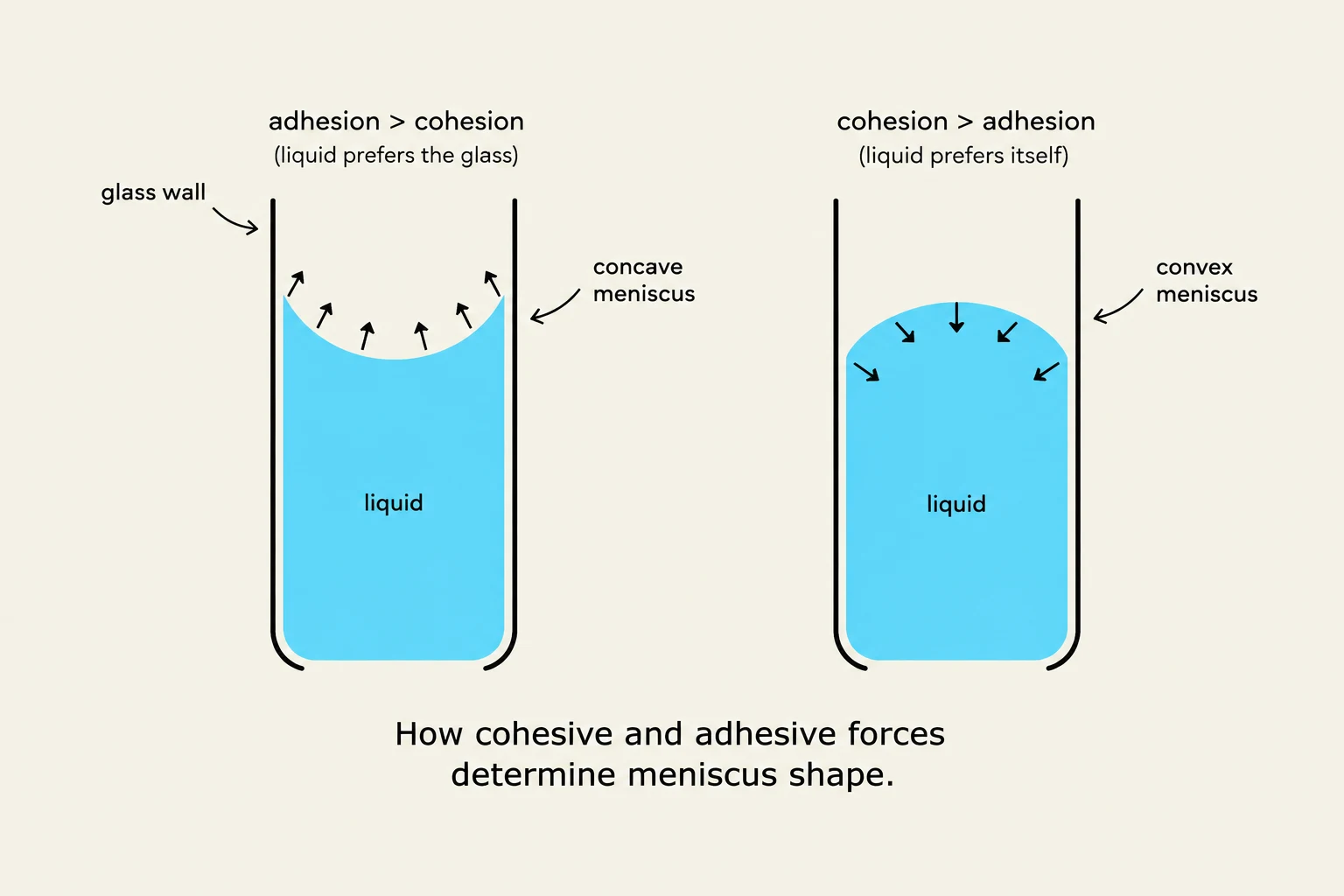
This diagram illustrates how cohesive and adhesive forces influence the shape of a liquid's meniscus in a container. When adhesion is greater than cohesion, the liquid forms a concave meniscus, as seen with water in glass. Conversely, when cohesion is greater than adhesion, the liquid forms a convex meniscus, as seen with mercury in glass.
When a liquid is placed in a container, the shape of its surface—the meniscus—is determined by the competition between two types of forces:
Cohesive forces: The attraction between like molecules (liquid-liquid).
Adhesive forces: The attraction between different molecules (liquid-container).
Depending on which force is stronger, the meniscus will take one of two shapes:
Concave Meniscus: If adhesive forces are stronger than cohesive forces, the liquid will "climb" the walls of the container. An example is water in a glass container.
Convex Meniscus: If cohesive forces are stronger than adhesive forces, the liquid will pull away from the walls and bulge inward to maximize its internal interactions. An example is mercury in a glass container.
Exam Tip: When asked to predict the shape of a meniscus, always compare the strength of the liquid's internal attraction (cohesion) against its attraction to the surface (adhesion). If the liquid "likes" the container more than itself, it will be concave!
Keep reading for free.
Create an account to finish this reading and make it part of your study routine.