Explores the complex relationship between humans and microorganisms, covering the human microbiome, microbial antagonism, and factors influencing host susceptibility to infection.
The relationship between humans and microorganisms is complex, ranging from essential symbiotic partnerships to life-threatening battles. Understanding this relationship requires a clear distinction between the microbes themselves and the broader biological context in which they live. By studying the human microbiome, the mechanisms of microbial antagonism, and the factors that influence host susceptibility, we can better understand how infections arise and how diseases progress.
The Human Microbiome and Resident Microbiota
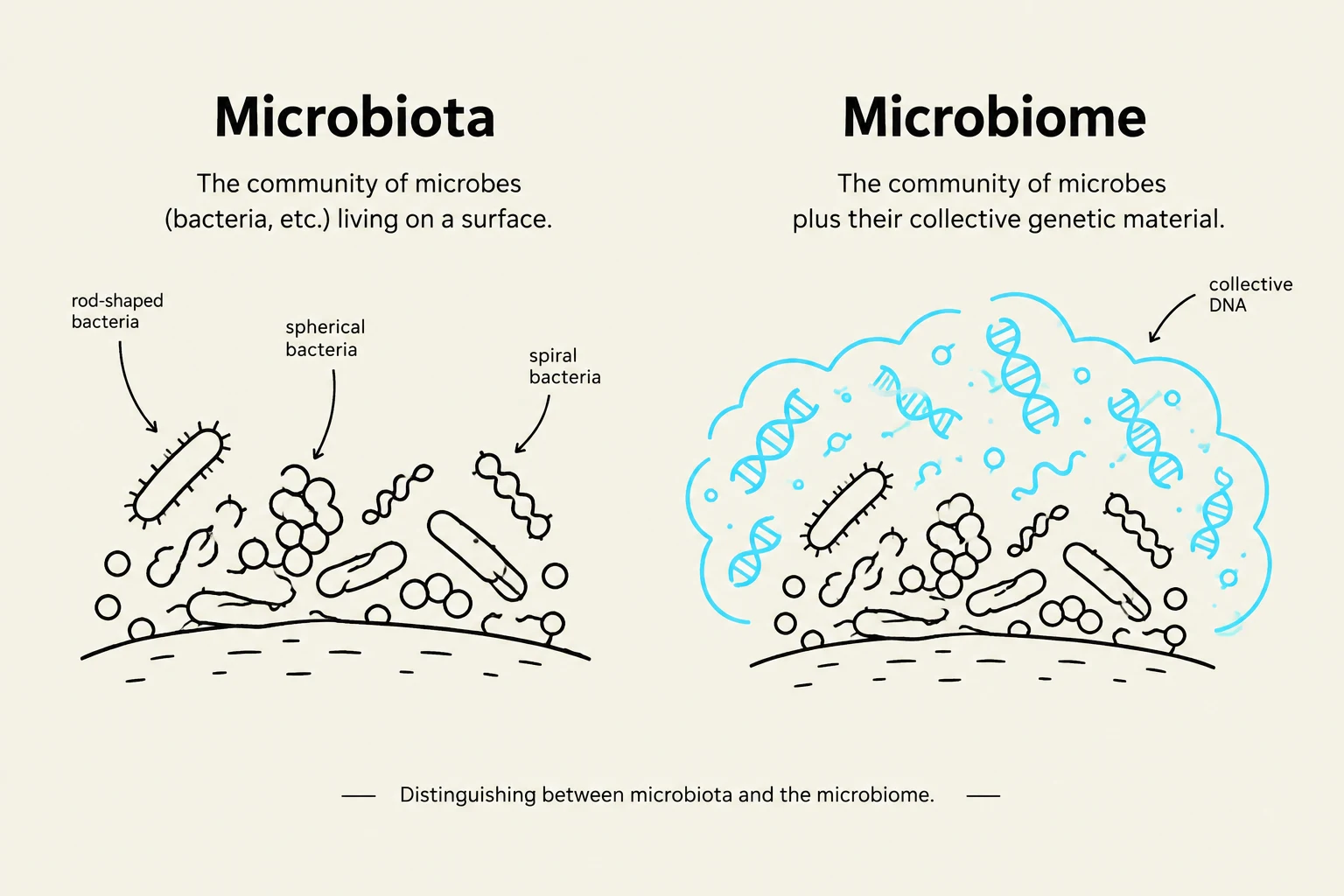
This illustration distinguishes between microbiota, which is the community of microbes living on a surface, and microbiome, which includes the microbes plus their collective genetic material.
To understand these interactions, we must first define our terms. While the terms are often used interchangeably in casual conversation, they have distinct scientific meanings. The microbiota refers to the actual microbes living on or in a human host, whereas the microbiome represents the sum total of all those microbes plus their collective genetic material.
Most of these microbes are resident microbiota—long-term colonizers that generally do not cause disease. These organisms are critical to human health and functioning. For example, during birth, newborns acquire microbiota via vaginal delivery; species such as Lactobacillus help with digestion and provide skin protection. Even human milk contains approximately 600 species of bacteria that assist the infant's gut health.
Historically, many body sites were believed to be sterile. However, the Human Microbiome Project (HMP), which began in 2007, used genome sequencing to reveal that microbes exist in diverse habitats, including the lungs, bladder, breast milk, and even the bloodstream. The HMP demonstrated that our microbes possess millions of protein-encoding genes, far outnumbering the ~21,000 genes in the human genome.
Exam Tip: The composition of the microbiome varies significantly between individuals and even between different parts of the same person's body. For instance, your left-hand and right-hand microbiota are significantly different!
From Colonization to Disease
The presence of a microbe does not always equate to illness. We must distinguish between several key stages of microbial interaction:
Colonization: The establishment of microbes in a habitat.
Infection: The process where microbes enter the body, pass through host defenses, and multiply.
Disease: A deviation from health caused by microbial damage to tissues or organs.
Infectious Disease: A specific pathologic state caused directly by microbes or their products.
The transition from colonization to disease depends on the nature of the microbe and the state of the host. A pathogen is a parasitic microbe that causes infection and disease. True pathogens can cause disease in healthy individuals with normal immunity (e.g., influenza), while opportunistic pathogens only cause disease when host defenses are compromised or when the microbe enters a non-typical body site (e.g., Candida albicans).
The severity of a disease is described as its virulence, which is determined by the microbe's ability to establish itself and cause damage. A virulence factor is any specific characteristic or structure (like a toxin or capsule) that helps the microbe achieve this.
Microbial Antagonism: The Body's Natural Defense
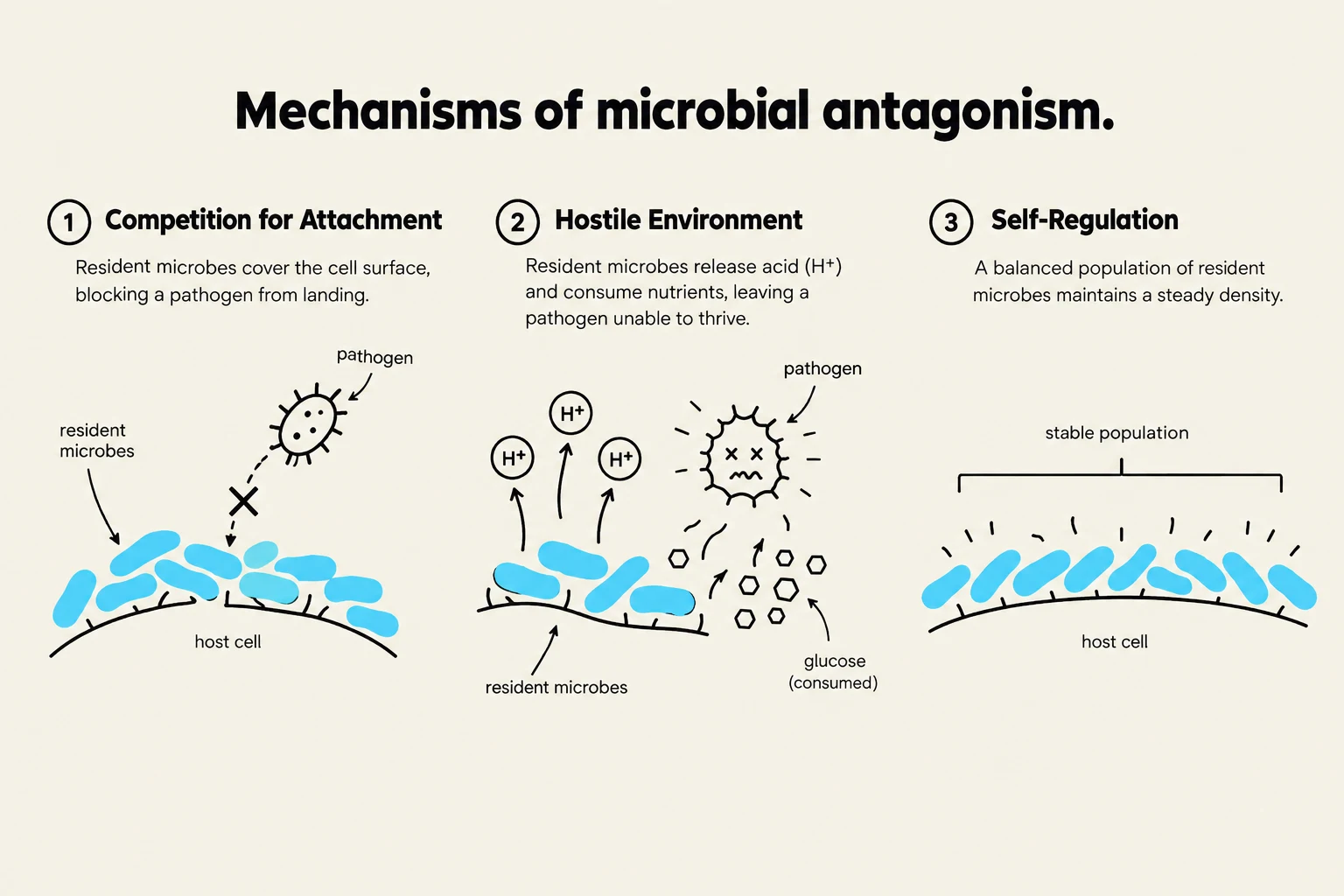
This diagram illustrates three mechanisms by which resident microbes can antagonize pathogens: competition for attachment sites, creation of a hostile environment through acid production and nutrient consumption, and self-regulation of microbial population density.
One of the most important ways the body protects itself is through microbial antagonism. This is the process by which the normal resident microbiota prevents the colonization of harmful, incoming microbes. This protection occurs through several mechanisms:
Competition for Attachment Sites: The resident microbes occupy the available space, leaving no room for invaders to latch on.
Creation of a Hostile Environment: Resident microbes may compete for limited nutrients or change the local chemistry (such as pH) to make the environment unsuitable for pathogens.
Self-Regulation: The resident microbiota prevents its own overgrowth to maintain homeostasis within the host.
Factors That Weaken Host Defenses
Even a highly virulent pathogen may fail to cause disease if the host's defenses are robust. However, several factors can increase susceptibility and allow an infection to progress into a full-blown disease:
Age: Extreme youth (infancy or prematurity) and old age are both periods of increased vulnerability.
Immune Status: Genetic defects, acquired conditions like AIDS, or the use of immunosuppressive drugs and chemotherapy.
Underlying Conditions: Chronic illnesses such as diabetes, cancer, or liver malfunction, as well as the stress of surgery or organ transplants.
Stress: Both physical and mental stressors can compromise the body's ability to fight infection.
Exam Trap: While many things can weaken the immune system, moderate exercise is generally NOT considered a factor that weakens host defenses in a clinical context.
Summary of Disease Progression
This graph illustrates the typical progression of clinical disease stages over time, showing symptom severity from incubation through convalescence.
The journey from initial contact to clinical disease can be summarized by the following progression:
Gone→Colonized→Infection→Disease
Whether a person reaches the "Disease" stage depends on a combination of "sliders": the microbe's virulence, the correct portal of entry, the host's previous exposure (immunity), and the host's general level of health.
Stage
Description
Incubation
Time from first contact to first symptoms; microbe is multiplying but no symptoms are felt
Prodromal
1–2 days of vague, early symptoms like fatigue or muscle aches
Acute
Microbe multiplies at high levels; greatest virulence and specific signs/symptoms appear
Convalescent
Symptoms decline and health returns as the immune response takes over
Keep reading for free.
Create an account to finish this reading and make it part of your study routine.