Integumentary System: Structure, Function, and Pathologies
Explore the anatomy and physiology of the integumentary system, including the skin, hair, and nails. Learn about its role in homeostasis, wound healing, and common pathologies like skin cancer and burns, as well as Vitamin D synthesis.
The integumentary system is much more than just a covering for the body; it is a dynamic, multi-functional organ system that serves as the primary interface between our internal environment and the outside world. Comprising the skin (the cutaneous membrane), hair, nails, and various glands, this system plays a critical role in maintaining homeostasis, providing sensory input, and acting as a vital defense mechanism against environmental threats.
Anatomy and Physiological Functions
The skin is organized into several distinct layers. The most superficial is the epidermis, a keratinized stratified squamous epithelium. Beneath this lies the dermis, a thick layer of dense irregular connective tissue containing blood vessels, nerves, hair follicles, and glands. Deep to the dermis is the subcutaneous layer (hypodermis), which consists of adipose and areolar connective tissue that anchors the skin to underlying muscles and bones.
Epidermal Composition and Color
The epidermis is composed of four main cell types:
Keratinocytes: The primary structural cells.
Langerhans cells: Intraepidermal macrophages that assist in immune responses.
Merkel cells: Tactile epithelial cells responsible for sensation.
Melanocytes: Cells that produce melanin, the pigment responsible for skin and hair color.
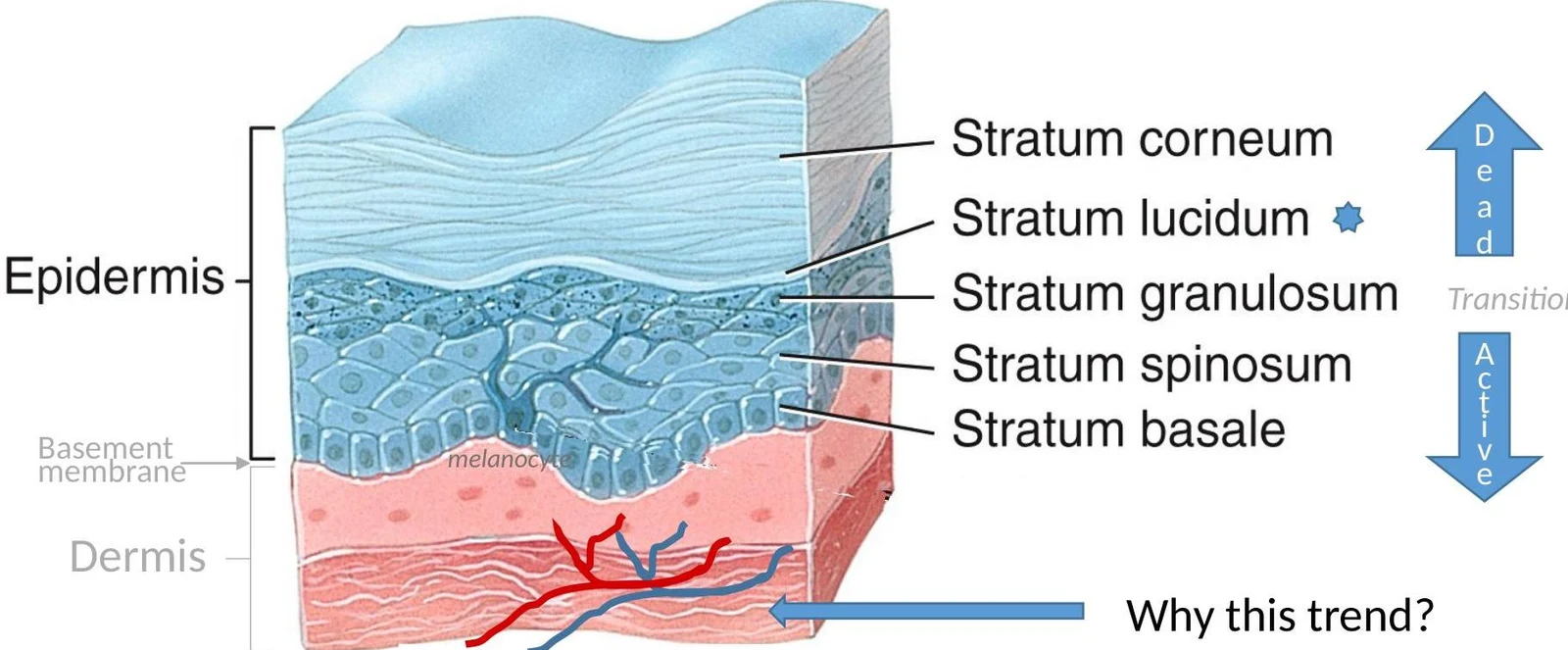
The epidermis is organized into "strata" or layers. Thick skin (found on palms and soles) contains five layers, including the stratum lucidum, while thin skin contains only four.
Diagram illustrating the layers of the epidermis and dermis, including the stratum corneum, stratum lucidum, stratum granulosum, stratum spinosum, and stratum basale, along with the basement membrane and melanocytes.
Systemic Interactions and Homeostasis
The integumentary system interacts with almost every other major body system to maintain homeostasis:
Skeletal & Digestive Systems: The skin facilitates the synthesis of Vitamin D, which is essential for calcium and phosphorus absorption in the intestines to build bone.
Muscular System: By aiding calcium absorption, the skin indirectly supports muscle contraction.
Nervous System: Sensory receptors in the skin provide the brain with vital information regarding touch, pressure, temperature, and pain.
Cardiovascular System: The dermis can adjust blood vessel diameter (vasoconstriction and vasodilation) to regulate body temperature and blood flow.
Immunity: The skin acts as a mechanical barrier and utilizes macrophages (Langerhans cells) to recognize and process foreign antigens.
Wound Healing Processes
When the skin is injured, the body initiates complex repair mechanisms. The type of healing depends on the depth of the wound.
Epidermal vs. Deep Wound Healing
Epidermal wound healing occurs when the injury is superficial and only affects the epidermis. In contrast, deep wound healing is required when the injury extends into the dermis and the subcutaneous layer.
Stages of Deep Wound Healing
Deep wound repair follows a specific sequence of stages:
Bleeding/Inflammation: Blood vessels are damaged, leading to clotting. Macrophages arrive to clean the area, and fibroblasts begin to appear.
Proliferation: Fibroblasts proliferate rapidly to create new tissue.
Remodeling: The newly formed epithelium thickens, and the dermis matures and contracts, often resulting in the formation of scar tissue.
Pathologies: Cancer and Burns
Skin Cancer and the Cell Cycle
Cancer is characterized by uncontrolled cell growth resulting from failures in the cell cycle "checkpoints". These checkpoints (Cell Growth, DNA Synthesis, and Mitosis) are regulated by proteins like cyclins and tumor suppressor genes. If a cell bypasses these controls and avoids apoptosis (programmed cell death), it can form a tumor (neoplasm).
Benign tumors: Do not cause disease or damage.
Malignant tumors: Cause damage and can undergo metastasis, spreading to other body parts via the lymphatic or vascular systems.
Common skin cancers include:
Carcinoma: The most common type, involving keratinocytes. This includes Squamous cell carcinoma (starting in the stratum spinosum) and Basal cell carcinoma (starting in the stratum basale).
Melanoma: A rarer but much more dangerous cancer arising from melanocytes.
Exam Tip: The ABCDE Method for Melanoma Detection
To identify potential melanoma, look for:
Asymmetry: One half does not match the other.
Border: Irregular, notched, or blurred edges.
Color: Uneven or multiple colors.
Diameter: Larger than 6mm (about the size of a pencil eraser).
Evolving: Changes in size, shape, or color.
Burns and Assessment
Burns cause tissue damage and cell death due to heat, electricity, UV radiation, or chemicals. They are classified by severity:
1st Degree: Superficial; affects only the epidermis.
2nd Degree: Affects the epidermis and the superficial dermis; can often heal without scarring.
3rd Degree: Extends through the epidermis and dermis into the subcutaneous layer; often painless because nerves are destroyed.
4th Degree: Deep injury extending to muscle, bone, or tendons.
To estimate the extent of a burn, medical professionals use the Rule of Nines, which divides the body into areas that represent approximately 9% of the total body surface area.
Vitamin D Activation Pathway
The skin plays a fundamental role in the metabolic pathway of Vitamin D, which is essential for bone health.
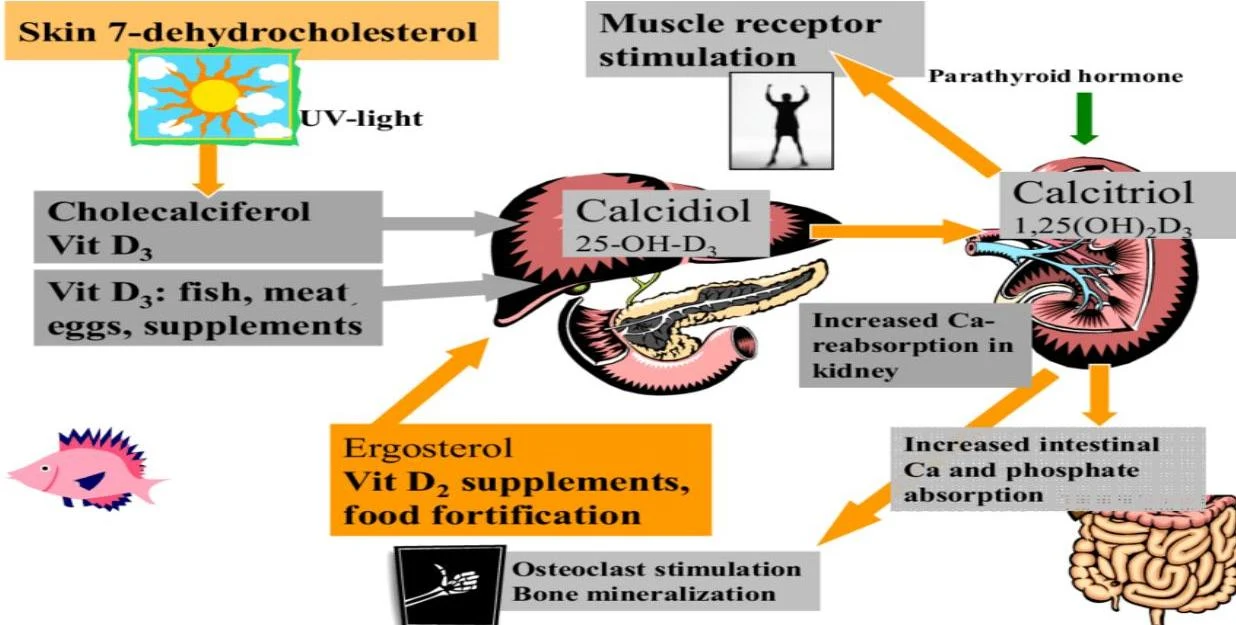
Synthesis: When skin is exposed to UV light, it produces cholecalciferol (the inactive form of Vitamin D).
Activation: Cholecalciferol travels to the liver and then to the kidneys. The kidneys convert it into calcitriol.
Function: Calcitriol acts as a hormone. It signals the epithelial cells in the small intestine to increase the number of calcium transporters, thereby promoting the absorption of dietary calcium into the bloodstream.
This diagram illustrates the synthesis and function of Vitamin D in the human body, starting from skin exposure to UV light and its conversion through various stages in the liver and kidneys, ultimately affecting calcium and phosphate absorption and bone mineralization.
Keep reading for free.
Create an account to finish this reading and make it part of your study routine.