Integral and Peripheral Membrane Proteins: Cellular Functions
Explore the essential roles of integral and peripheral proteins within the plasma membrane, including their functions as ion channels, carriers, receptors, enzymes, linkers, and cell-identity markers.
The plasma membrane is far more than just a simple barrier between the inside and outside of a cell. While the phospholipid bilayer provides the fundamental structure, it is the proteins embedded within or attached to this bilayer that perform the actual "work" of the cell. These proteins act as gates, messengers, workers, and even identification tags. To understand how a cell interacts with its environment, we must categorize these proteins into two primary groups: integral proteins and peripheral proteins.
Integral Membrane Proteins
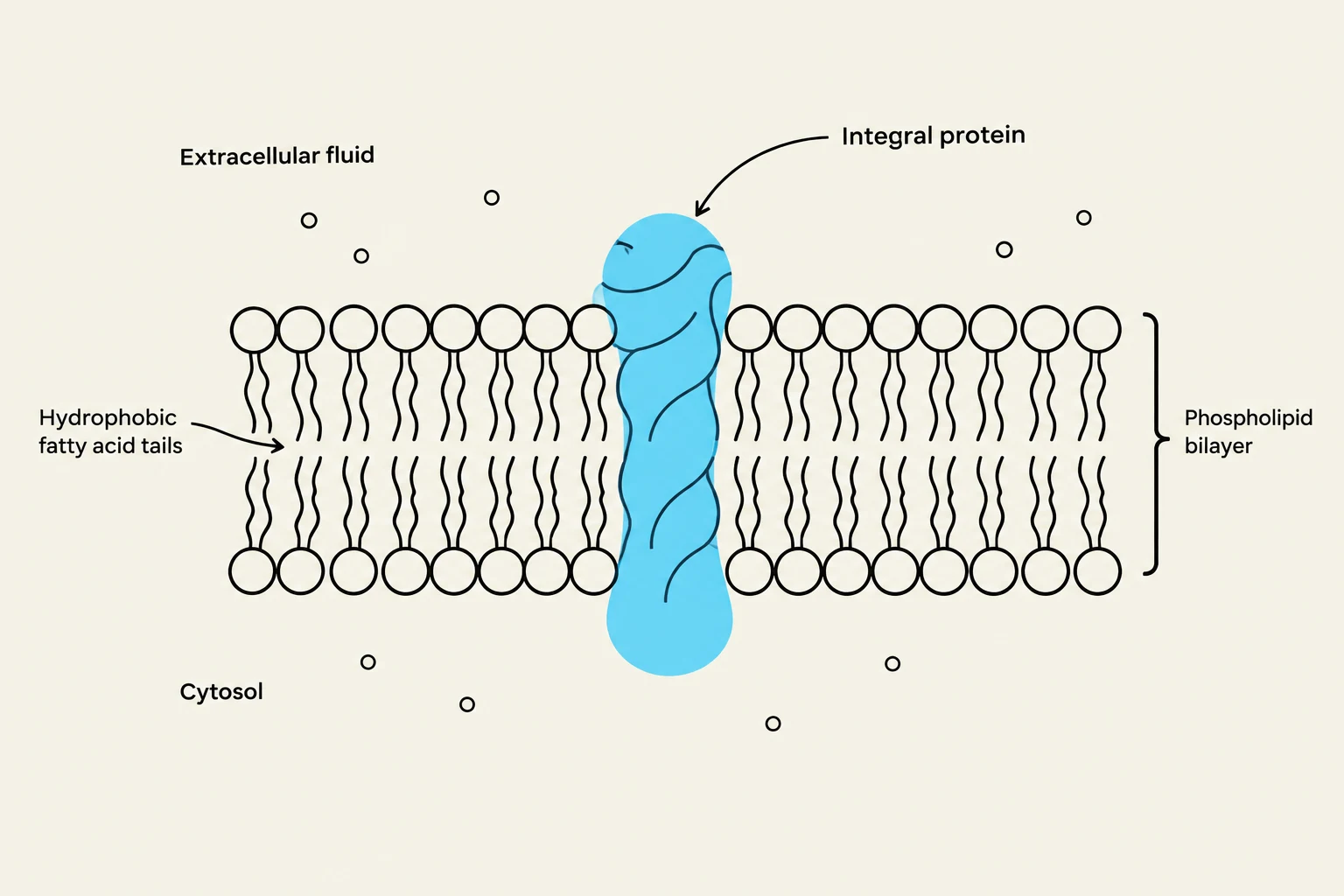
Diagram of a cell membrane showing the phospholipid bilayer, integral protein, extracellular fluid, and cytosol.
Integral proteins are characterized by their relationship to the hydrophobic core of the phospholipid bilayer. Unlike other molecules that might simply sit on the surface, integral proteins are embedded within the membrane. Because they penetrate the membrane, they are uniquely positioned to bridge the gap between the extracellular fluid and the cytosol, allowing them to perform several specialized roles.
1. Ion Channels
One of the most critical functions of an integral protein is to facilitate the movement of ions. Since ions are charged, they cannot easily pass through the fatty acid tails of the phospholipid bilayer. Ion channels solve this problem by forming a pore—a hollow, water-filled tunnel—that runs through the membrane. This pore allows specific ions to flow down their concentration gradient from the extracellular fluid into the cytosol.
2. Carrier Proteins (Transporters)
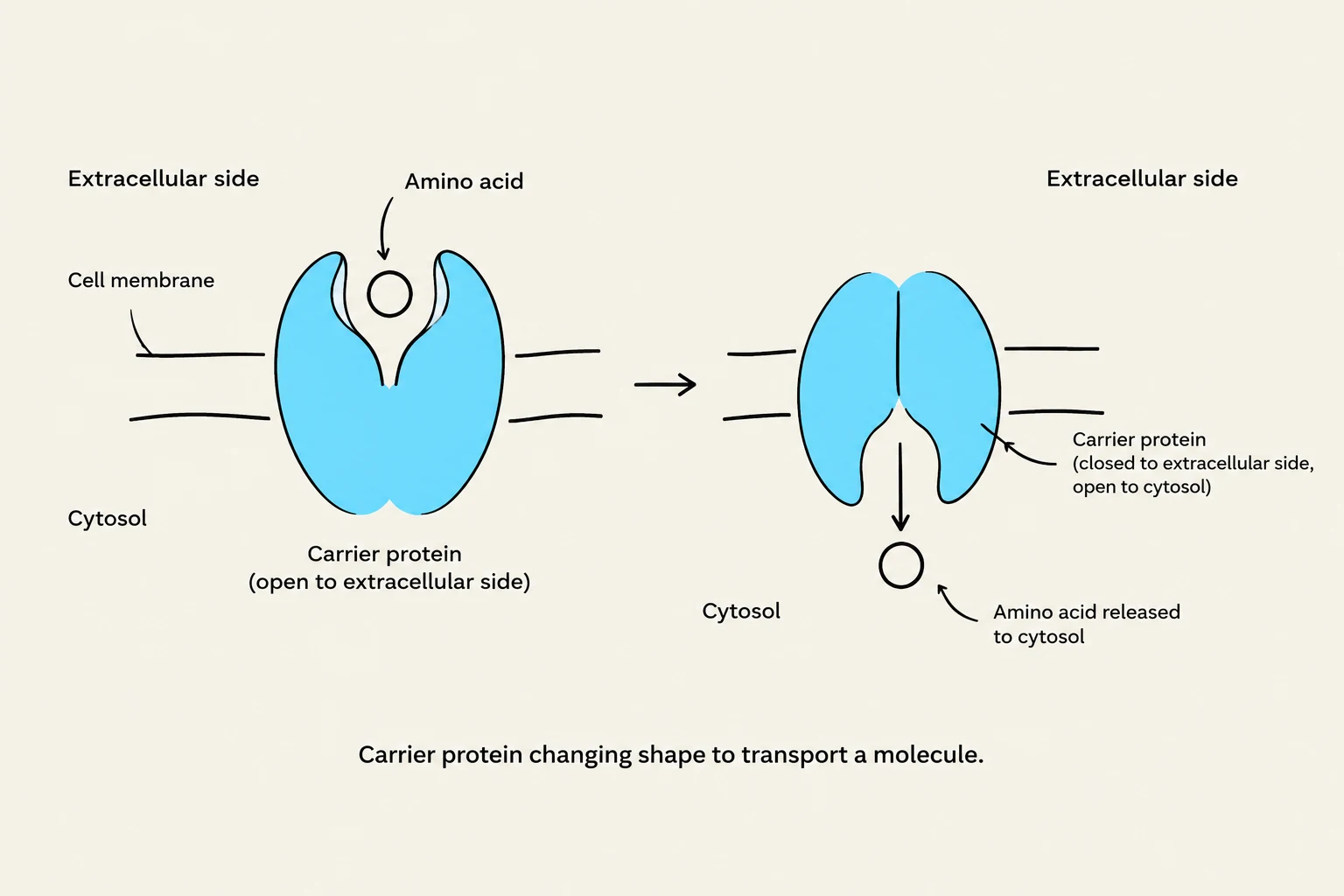
Diagram illustrating how a carrier protein changes shape to transport an amino acid across a cell membrane from the extracellular side to the cytosol.
While ion channels act like open tunnels, carrier proteins (also known as transporters) act more like revolving doors. Instead of providing a constant open path, a carrier protein binds to a specific substance—such as an amino acid—and undergoes a conformational change (a change in its physical shape) to move the molecule from one side of the membrane to the other. This mechanism is essential for bringing necessary nutrients, like those needed for protein synthesis, into the cell.
3. Receptors and Ligands
Cells must constantly respond to signals from the body, such as hormones. This communication is handled by receptors. A receptor is an integral protein that recognizes and binds to a specific molecule called a ligand.
When the correct ligand docks into the receptor, it triggers a change in the cell's function. For example, the hormone insulin binds to insulin receptors to regulate glucose uptake, and antidiuretic hormone binds to receptors in the kidneys to change the water permeability of the plasma membrane.
4. Enzymes and Linkers
Beyond transport and signaling, integral proteins serve as biological "workers" and "anchors":
Enzymes: Some integral proteins act as catalysts, speeding up specific chemical reactions at the membrane surface.
Linkers: These proteins serve as structural bridges, anchoring proteins in the membranes of neighboring cells to one another, or attaching the membrane to protein filaments both inside and outside the cell.
Peripheral Membrane Proteins
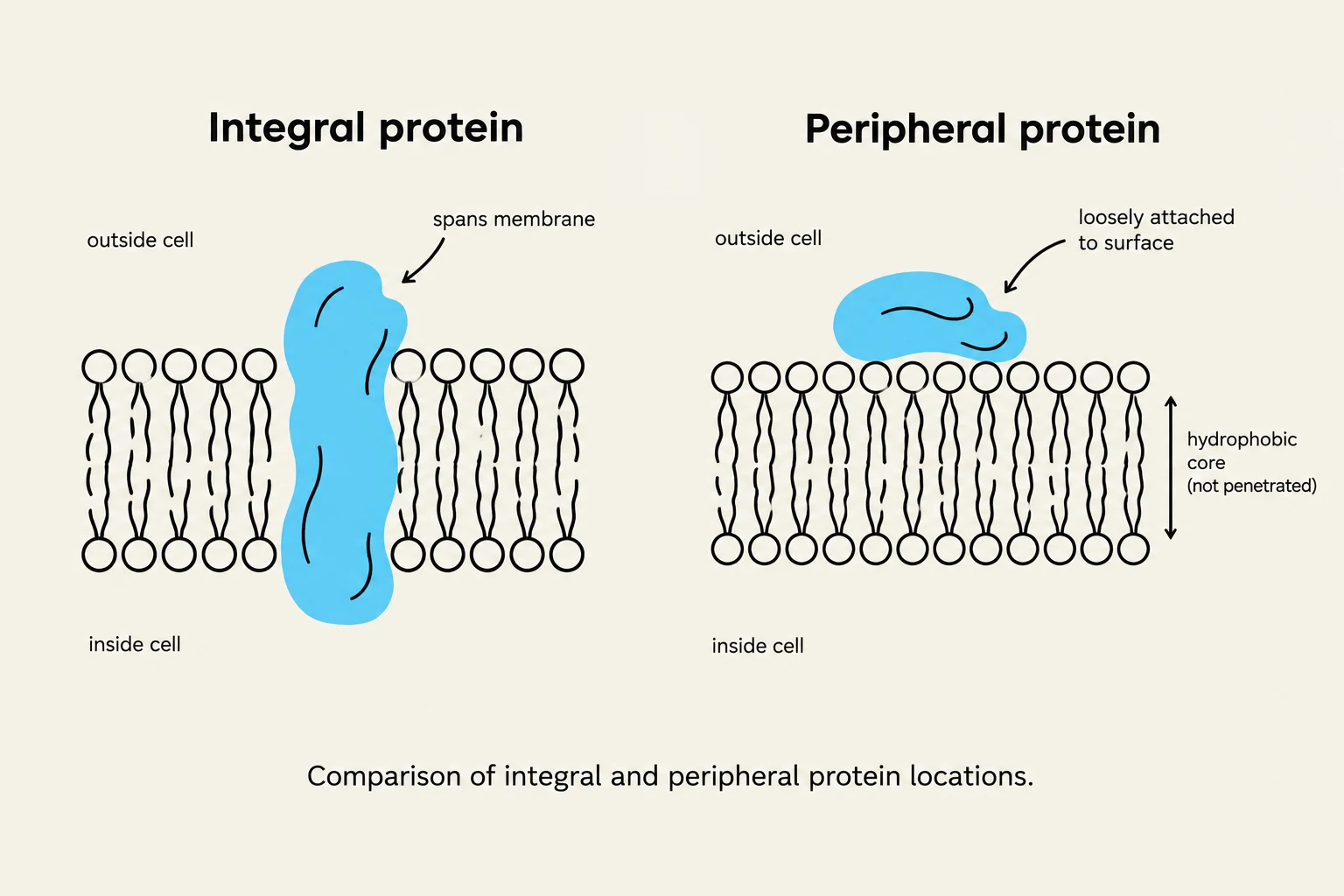
Comparison of integral and peripheral protein locations within a cell membrane.
Unlike integral proteins, peripheral proteins do not embed themselves within the hydrophobic core of the membrane. Instead, they are associated with the membrane surfaces (either the extracellular side or the cytosolic side).
Their roles are primarily structural and mechanical:
Support and Anchoring: They help support the plasma membrane and serve to anchor integral proteins in their proper positions.
Mechanical Activities: They are involved in moving materials and organelles within the cell, changing cell shape during muscle contraction or cell division, and helping cells attach to one another.
Dual Roles: Similar to integral proteins, peripheral proteins can also function as enzymes and linkers.
Cell-Identity Markers: Glycoproteins and Glycolipids
The final layer of membrane complexity comes from carbohydrate-containing molecules. Glycoproteins (proteins with carbohydrate chains attached) and glycolipids (lipids with carbohydrate chains attached) extend from the cell surface to act as cell-identity markers.
These markers are vital for two main reasons:
Tissue Formation: They allow cells to recognize and bond with other cells of the same type to form tissues.
Immune Response: They allow the immune system to distinguish between "self" and "non-self" (foreign) cells.
Clinical Example: Blood Types
The ABO blood type markers are a classic example of cell-identity markers. When receiving a blood transfusion, the blood type must be compatible with your own; if the identity markers do not match, your immune system may recognize the new red blood cells as foreign, causing them to clump together.
Protein Type
Location
Primary Functions
Integral
Embedded in bilayer
Ion channels, Carriers, Receptors, Enzymes, Linkers