An overview of the human immune system, detailing the two main defense systems: the innate (nonspecific) and adaptive (specific) immunity. It covers their respective lines of defense, components, and mechanisms.
The human immune system is a sophisticated, multi-layered defense network designed to provide resistance to disease. Rather than acting as a single unit, it functions through two highly integrated, intrinsic systems: the innate (nonspecific) defense system and the adaptive (specific) defense system. While the innate system provides immediate, broad protection, the adaptive system offers a specialized, long-lasting response to specific invaders. These two systems are intertwined; for instance, innate responses release proteins that alert the adaptive system to the presence of foreign molecules.
The Innate Immune System: The First and Second Lines of Defense
The innate immune system is the body's immediate responder. It does not target specific pathogens but instead reacts to general patterns common to many invaders. It is divided into two distinct stages: the first line of defense (surface barriers) and the second line of defense (internal non-specific responses).
The First Line of Defense: Surface Barriers
The first line of defense consists of physical and chemical barriers designed to prevent pathogens from entering the body's internal environment.
Physical Barriers: Skin and Mucosae
Skin: The skin acts as a primary physical barrier. It utilizes keratin, a protein that is highly resistant to bacterial enzymes, toxins, and weak acids or bases.
Mucosae: These mucous membranes provide mechanical barriers in the digestive and respiratory tracts.
Respiratory Modifications: In the respiratory system, mucus-coated hairs in the nose trap inhaled particles, while cilia in the upper respiratory tract work to sweep dust- and bacteria-laden mucus toward the mouth to be swallowed or expelled.
Chemical Barriers
The body also employs a variety of chemical secretions to inhibit or destroy microorganisms:
Acid Mantle: The acidity of the skin and certain mucous secretions inhibits microbial growth.
Lysozyme: An enzyme found in saliva, tears, and respiratory mucus that kills many microorganisms.
Mucin: A sticky substance that lines the digestive and respiratory tracts to trap invaders.
Defensins: Antimicrobial peptides that inhibit microbial growth.
Other Substances: Lipids in sebum and dermicidin in sweat are toxic to certain bacteria.
The Second Line of Defense: Internal Non-Specific Responses
If a pathogen breaches the surface barriers, the second line of defense is activated. This stage involves internal cellular and chemical responses.
Phagocytes and Natural Killer Cells
Phagocytes: These are white blood cells that ingest and digest (eat) foreign invaders. Neutrophils are the most abundant phagocytes, while macrophages (which develop from monocytes) are the most robust, acting as chief phagocytic cells.
Natural Killer (NK) Cells: These are large granular lymphocytes that "police" the blood and lymph. They can kill cancer and virus-infected cells by inducing apoptosis (programmed cell death) before the adaptive system is even activated.
Inflammation
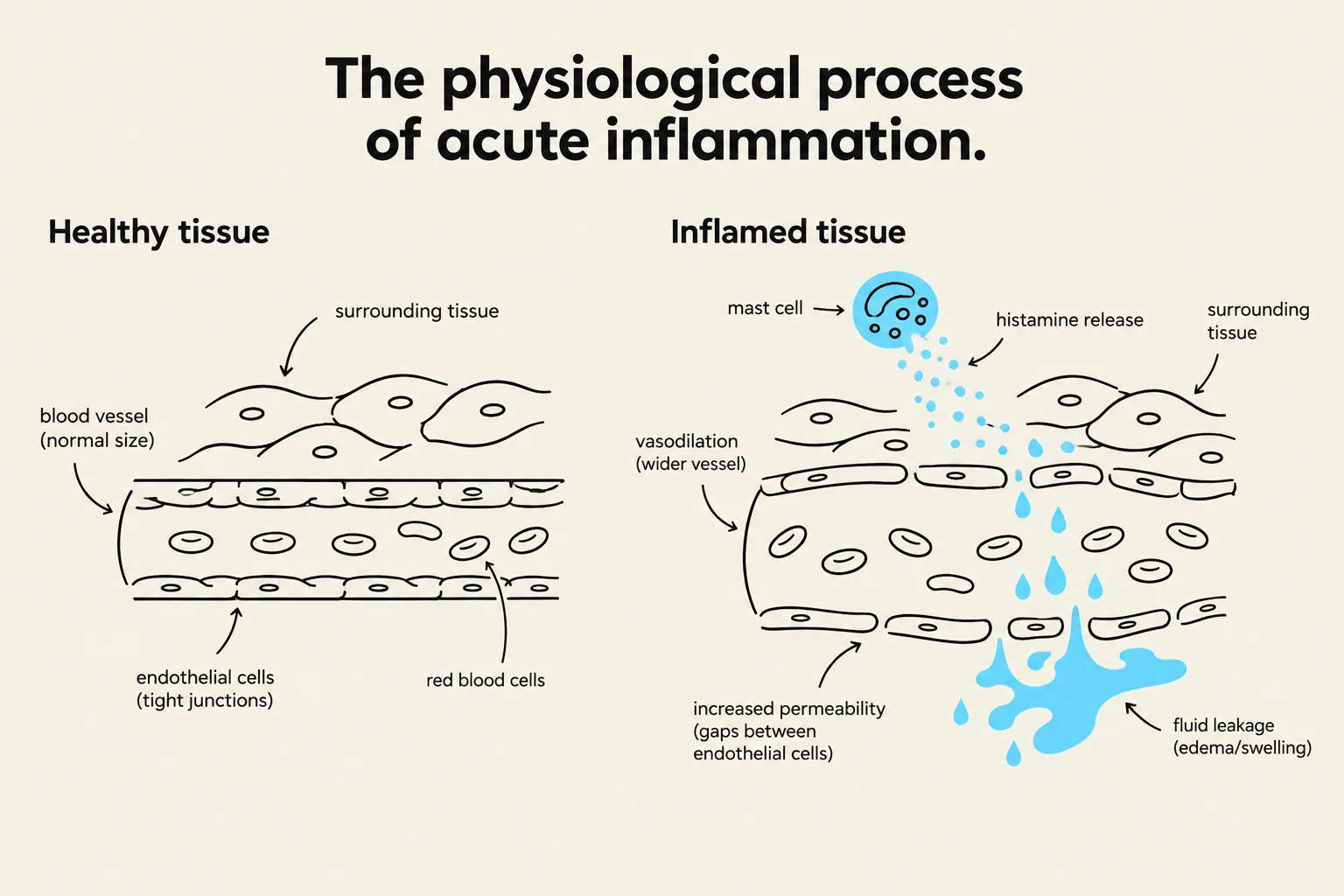
Inflammation is perhaps the most critical mechanism of the second line of defense. It is a tissue response to injury (trauma, heat, or infection) that serves to prevent the spread of damaging agents, dispose of debris, and alert the adaptive immune system.
The four cardinal signs of acute inflammation are redness, heat, swelling, and pain. This process is driven by inflammatory chemicals like histamine (released by mast cells), kinins, and prostaglandins. These chemicals cause vasodilation (leading to redness and heat) and increased capillary permeability (leading to edema or swelling).
Antimicrobial Proteins
The innate system also utilizes specific proteins to hinder invaders:
Interferons (IFNs): These proteins are secreted by virus-infected cells to "warn" neighboring cells, stimulating them to produce proteins that block viral reproduction.
Complement System: A group of about 20 blood proteins that, when activated, can enhance inflammation, promote phagocytosis, and cause direct cell lysis (bursting) of bacteria via the membrane attack complex (MAC).
Exam Tip: Remember that inflammation is a non-specific response. While it is highly effective at containing an infection, it does not distinguish between a splinter and a bacterium; it responds to the tissue damage itself.
The Adaptive Immune System: The Third Line of Defense
The adaptive immune system constitutes the third line of defense. Unlike the innate system, it is highly specific, meaning it recognizes and targets particular antigens (foreign substances). While it takes longer to react initially, it possesses immunological memory, allowing it to mount a much faster and stronger attack upon subsequent exposures to the same pathogen.
Two Branches of Adaptive Immunity
The adaptive system is divided into two main functional branches:
Humoral (Antibody-Mediated) Immunity: This branch targets extracellular pathogens. It involves B lymphocytes (B cells), which differentiate into plasma cells that secrete antibodies (immunoglobulins) into the blood and lymph. These antibodies bind to antigens to neutralize them, clump them together (agglutination), or mark them for destruction by innate cells.
Cellular (Cell-Mediated) Immunity: This branch targets intracellular pathogens, such as viruses hiding inside cells, or abnormal cells like cancer cells. It is driven by T lymphocytes (T cells), specifically cytotoxic T cells (CD8+), which directly kill infected or abnormal cells.
The Role of Antigen Presentation
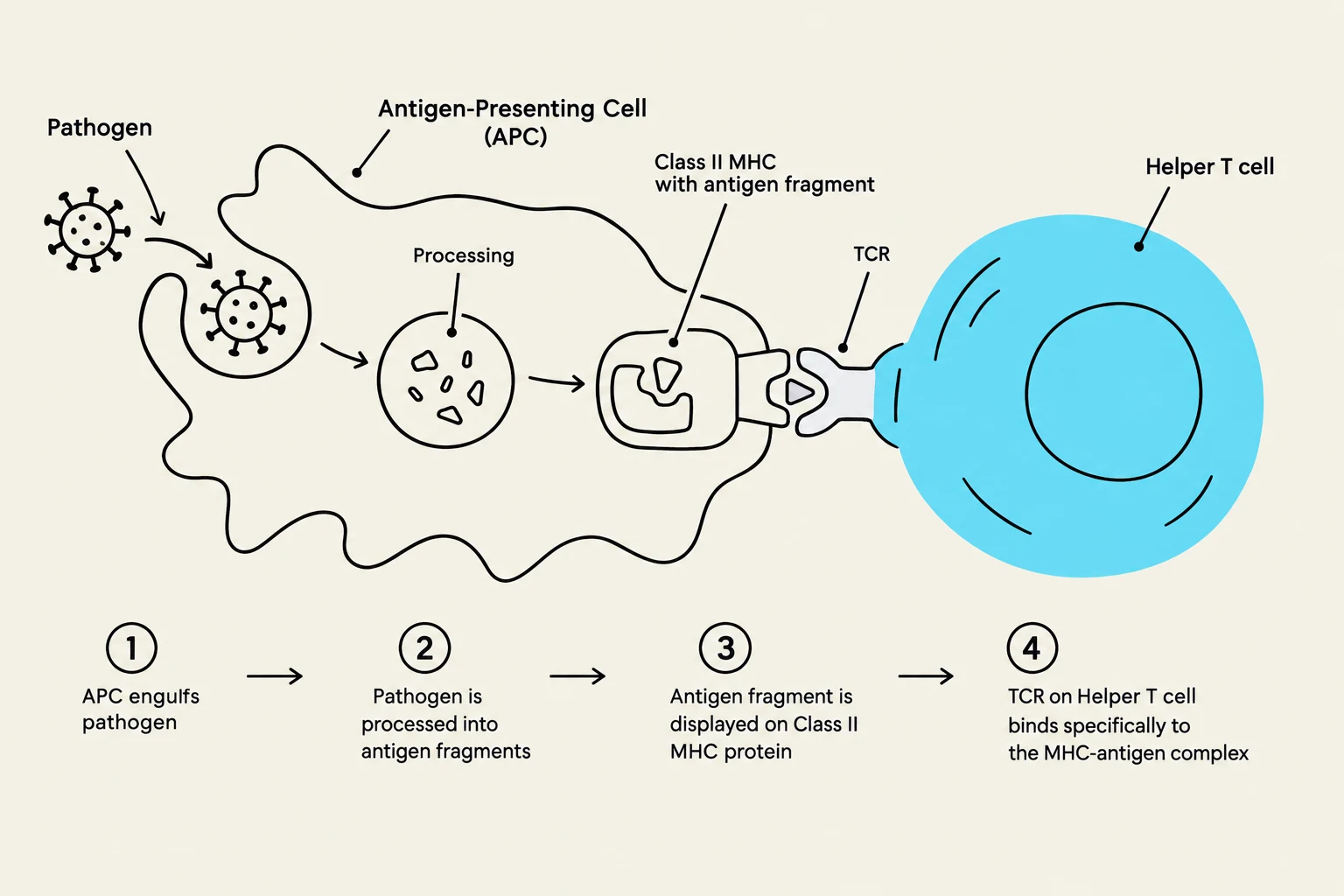
This diagram illustrates the process of antigen presentation by an antigen-presenting cell (APC) to a helper T cell. The APC engulfs a pathogen, processes it into antigen fragments, and displays these fragments on its surface via Class II MHC proteins. The T cell receptor (TCR) on the helper T cell then binds specifically to this MHC-antigen complex, initiating an immune response.
For the adaptive system to function, it must "see" the enemy. This is facilitated by Antigen-Presenting Cells (APCs), such as dendritic cells, macrophages, and B cells. These cells engulf pathogens and display fragments of the antigen on their surface using Major Histocompatibility Complex (MHC) proteins.
Class I MHC: Found on all nucleated cells; they present endogenous antigens (proteins from inside the cell) to CD8+ cytotoxic T cells.
Class II MHC: Found only on APCs; they present exogenous antigens (pathogens engulfed from outside) to CD4+ helper T cells.
Helper T cells (CD4+) are the central coordinators of the entire immune response. Without them, the body cannot effectively activate either B cells or cytotoxic T cells.
Diagram illustrating the physiological process of acute inflammation, comparing healthy tissue with inflamed tissue, showing changes in blood vessels, endothelial cells, and fluid leakage.
Summary Table: Innate vs. Adaptive Defense
Feature
Innate Defense
Adaptive Defense
Line of Defense
1st and 2nd
3rd
Response Time
Immediate
Delayed (days)
Specificity
Non-specific (general)
Highly specific to antigens
Memory
None
Strong immunological memory
Key Components
Skin, Phagocytes, Inflammation, Complement
B cells, T cells, Antibodies
Keep reading for free.
Create an account to finish this reading and make it part of your study routine.