An overview of fundamental genetics concepts, including genotype vs. phenotype, alleles, and hereditary diseases. It details pedigree analysis as a tool for pattern recognition and explains major inheritance patterns such as autosomal dominant, autosomal recessive, X-linked (recessive and dominant), and mitochondrial i
Understanding how genetic traits and disorders move through families is a fundamental skill in clinical practice. By mastering specific terminology and learning to recognize patterns within a family tree, healthcare providers can perform effective genetic risk assessments and provide essential patient education. This article explores the core concepts of genetics, the various modes of inheritance, and the clinical tools used to track these patterns.
Foundations of Genetics
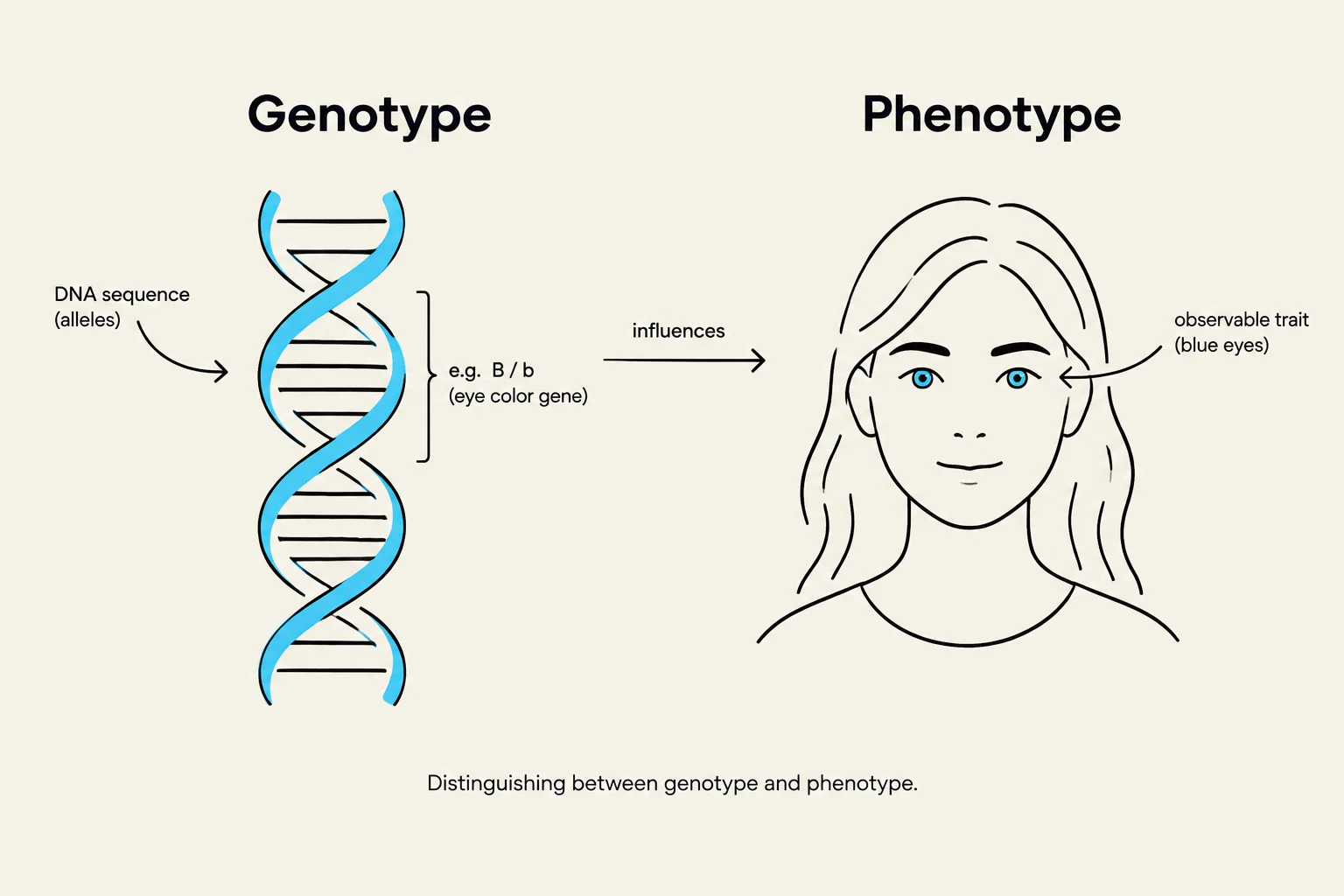
This illustration distinguishes between genotype, the genetic makeup of an organism (e.g., DNA sequence or alleles like B/b for eye color gene), and phenotype, the observable traits resulting from the genotype (e.g., blue eyes).
Before analyzing complex pedigrees, it is essential to establish a common vocabulary. Genetics begins at the molecular level, where DNA provides the instructions for building proteins that drive cellular function.
Genotype vs. Phenotype: An individual's genotype is their specific genetic makeup, including all the alleles they possess. In contrast, the phenotype refers to the observable characteristics or traits that result from the interaction between that genotype and the environment.
Alleles and Genes: A gene is a unit of heredity, while an allele is a specific version of that gene.
Hereditary Disease: This refers to a disorder caused by genetic alterations that can be passed from one generation to the next.
Clinical Tip: When performing a genetic risk assessment, remember that a "variant" (a change in the DNA) does not always equal a clinical diagnosis. Factors like penetrance and variable expressivity can influence whether a person actually shows symptoms.
The Pedigree: A Tool for Pattern Recognition
A pedigree is a diagram or family tree used to track the occurrence of genetic traits and disorders across multiple generations. To identify an inheritance pattern, clinicians often use pattern recognition—the process of identifying characteristic clues within the pedigree.
When analyzing a pedigree, clinicians should ask four critical questions:
Does the condition appear in every generation?
Does it skip generations?
Are males and females equally affected?
Is father-to-son transmission present?
Major Patterns of Inheritance
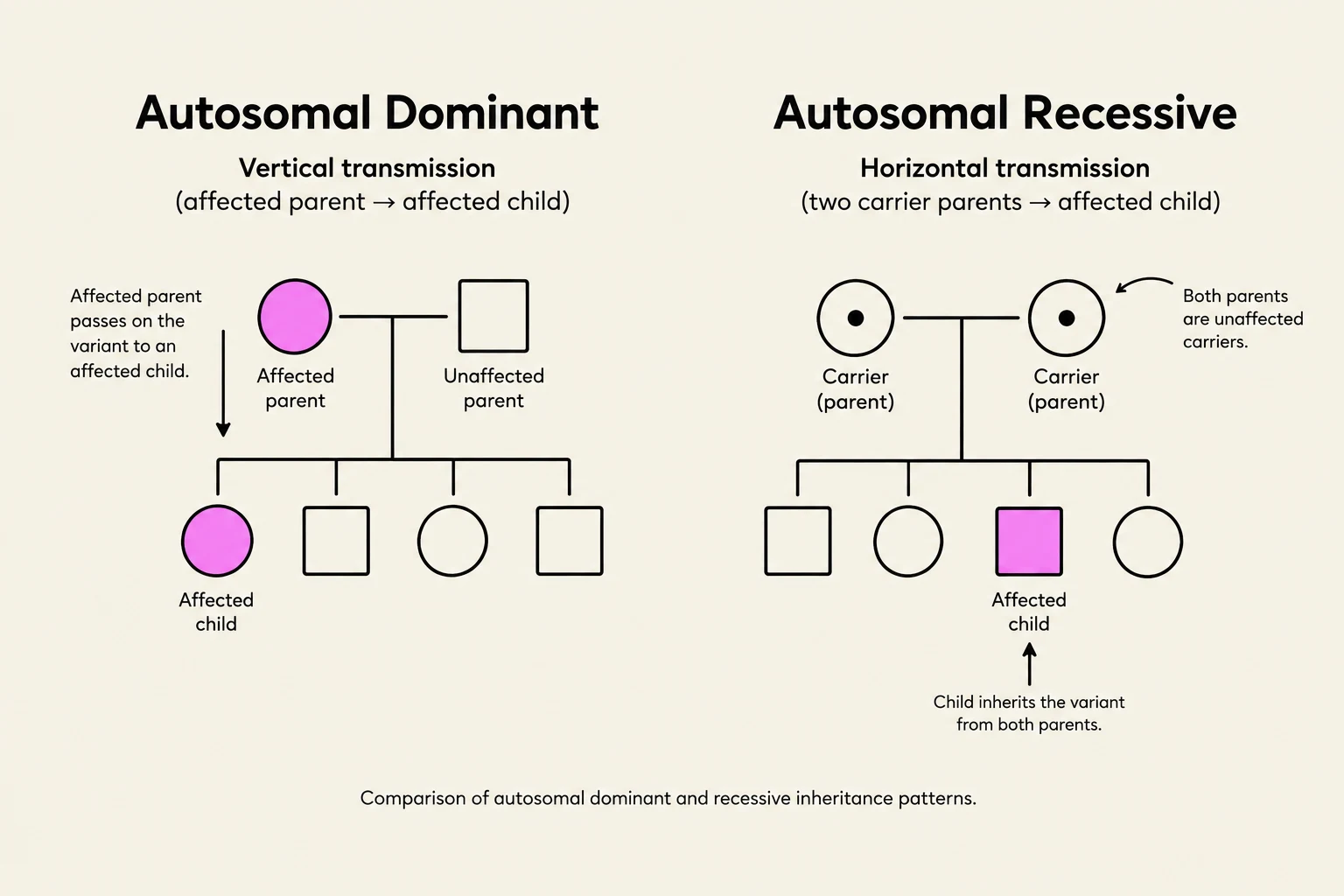
Comparison of autosomal dominant and recessive inheritance patterns.
Genetic disorders are categorized based on how they are transmitted through the chromosomes.
Autosomal Inheritance
Autosomal inheritance involves genes located on the autosomes (chromosomes 1–22), which means the condition affects males and females equally.
Autosomal Dominant
In this pattern, only one abnormal copy of a gene is required for the disorder to be expressed.
Hallmark Features: It typically shows vertical transmission, appearing in every generation. Affected individuals usually have at least one affected parent, and male-to-male transmission is common.
Examples: Huntington disease, Marfan syndrome, Familial hypercholesterolemia, and Neurofibromatosis.
Autosomal Recessive
This pattern requires two abnormal copies of a gene for the disorder to be expressed.
Hallmark Features: The condition often "skips" generations, appearing in children of healthy parents. In these cases, the parents are often carriers—individuals who possess one normal allele and one abnormal allele but do not show symptoms.
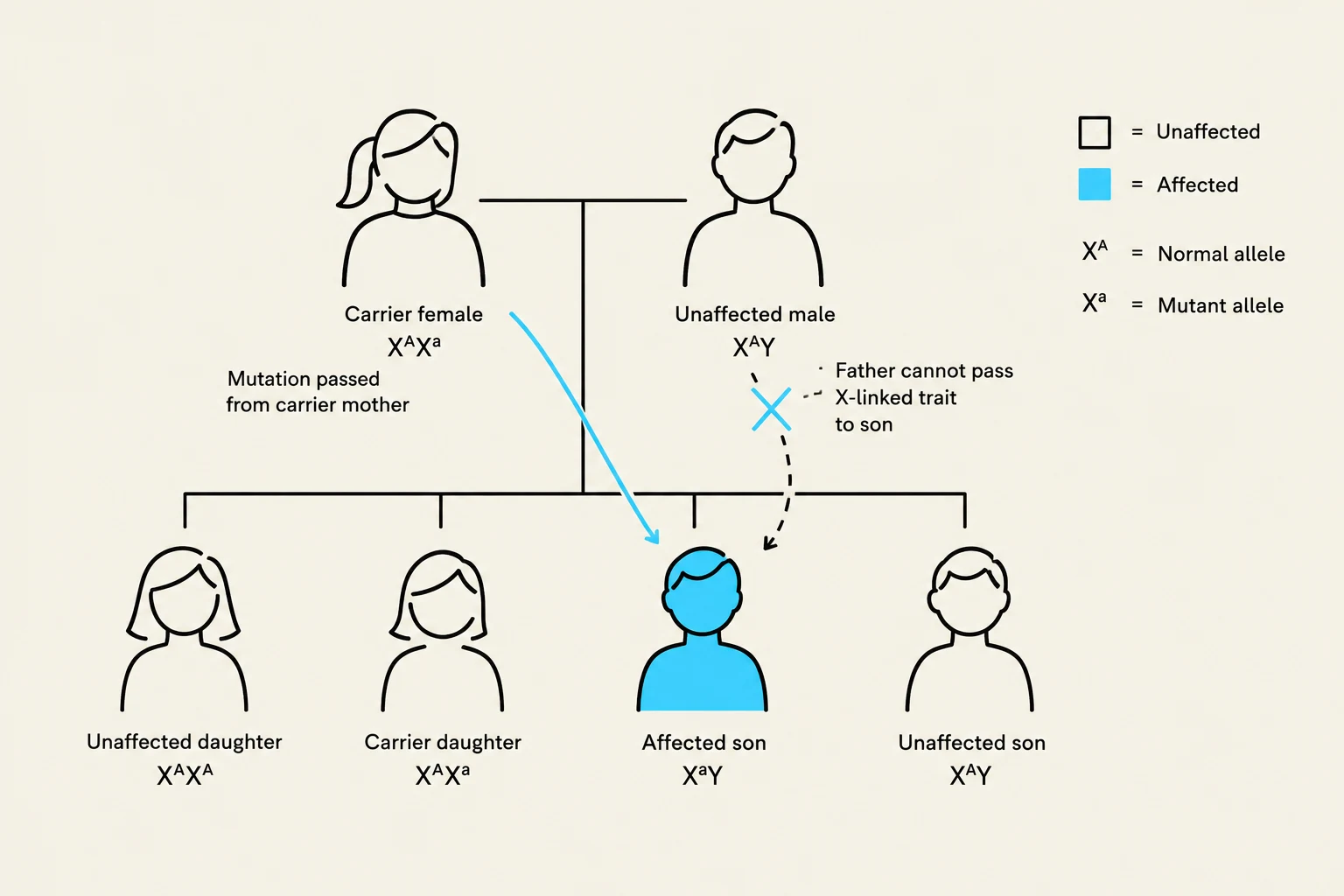
This diagram illustrates X-linked inheritance, showing how a carrier female and an unaffected male can have affected and carrier offspring. It also highlights that fathers cannot pass X-linked traits to their sons.
X-linked inheritance involves genes located on the X chromosome. Because males have only one X chromosome, they are often more severely affected by these disorders.
X-Linked Recessive: These are passed through carrier mothers. Because males lack a second X chromosome to mask the mutation, they are more commonly affected, while females are usually carriers. Notably, father-to-son transmission is impossible in X-linked patterns because fathers pass a Y chromosome to their sons.
Examples: Hemophilia A, Duchenne muscular dystrophy, G6PD deficiency, and Red-green color blindness.
X-Linked Dominant: A single abnormal gene on the X chromosome causes the disease. A key clue is that affected fathers will pass the trait to all of their daughters but none of their sons.
Mitochondrial Inheritance
Mitochondrial inheritance (also called maternal inheritance) occurs because mitochondria are inherited exclusively from the ovum.
Hallmark Features: An affected mother may pass the trait to all of her children, but only her daughters can pass the trait to the next generation.
Summary Table of Inheritance Patterns
Pattern
Generation Pattern
Sex Distribution
Key Clue
Autosomal Dominant
Every generation (Vertical)
Males = Females
Affected parent present
Autosomal Recessive
Skips generations
Males = Females
"Surprise" affected child from healthy parents
X-Linked Recessive
Often skips generations
Mostly Males
No father-to-son transmission
Mitochondrial
Maternal line
Both (from mother)
Only daughters pass it on
Clinical Application: Genetic Risk Assessment
A primary goal for healthcare providers is to use family history to identify risks for cancer predisposition syndromes, hereditary cardiac disorders, and neurologic disorders.
When collecting family history, it is recommended to include at least three generations. "Red flags" that may necessitate a genetic counseling referral include:
Early onset of disease
Clusters of similar disorders in a family
Sudden cardiac death
Recurrent miscarriages
By combining pedigree analysis with an understanding of these fundamental patterns, clinicians can move from simple observation to sophisticated genetic risk assessment and patient education.
Keep reading for free.
Create an account to finish this reading and make it part of your study routine.