This content explains the fundamental process of informed consent in mental health, emphasizing client autonomy, shared decision-making, and the essential components of disclosure and free consent. It addresses common myths and considerations for diversity and crisis situations.
In the field of mental health, the relationship between a practitioner and a client is not merely a transaction of services; it is a profound human encounter governed by ethical and legal standards. At the heart of this relationship lies informed consent. Far from being a simple administrative hurdle, informed consent is a fundamental process that affirms a client's freedom of choice and protects their dignity. It serves as the cornerstone of a therapeutic alliance built on transparency, respect, and mutual empowerment.
The Core Principles: Autonomy and Collaboration
The primary ethical driver of informed consent is client autonomy—the principle that every competent individual has the right to self-determination and the right to decide what shall be done with their own body and mind. Historically, the mental health profession moved away from a "paternalistic" model, where the practitioner's judgment superseded the client's, toward a model that recognizes the client as an active participant in their own care.
This shift has transformed the therapeutic model into one of empowered collaboration. In this framework, the professional and the client engage in shared decision-making. The therapist provides clinical expertise, while the client provides essential knowledge regarding their own life, values, and goals.
Comparison of the Paternalistic Model (Expert → Passive Client) and the Empowered Collaborative Model (Shared Decision-Making) in a therapeutic or client-provider relationship.
Exam Tip: If asked about the fundamental ethical principle of informed consent, always identify respect for autonomy as the primary driver.
The Two Essential Components
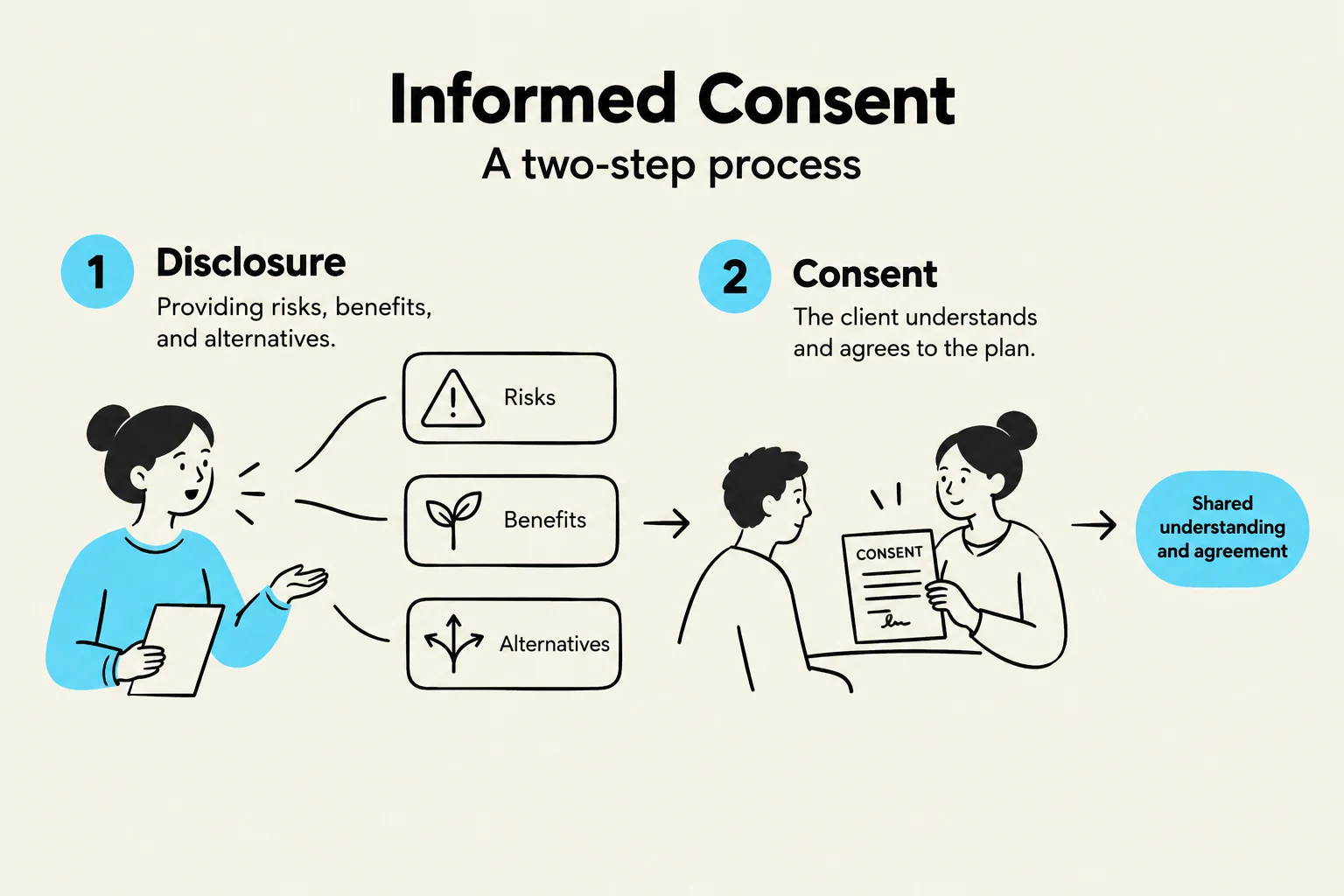
To be ethically and legally valid, the informed consent process must consist of two distinct but interrelated elements:
Disclosure of Relevant Information: The professional must provide the necessary details regarding the nature, risks, and potential benefits of the services. This includes discussing the anticipated course of therapy, fees, limits of confidentiality, and available alternatives. A critical aspect of this is adhering to the "law of no surprises". This principle ensures that clients are not blindsided by the potential side effects of treatment, such as temporary emotional distress or shifts in social relationships that may occur as a result of therapeutic progress.
Free Consent: The client's decision to proceed must be made voluntarily, without any form of coercion or undue pressure.
A diagram illustrating the two-step process of informed consent, involving disclosure of risks, benefits, and alternatives, followed by the client's consent and resulting in shared understanding and agreement.
Dispelling Common Myths
Many practitioners mistakenly view informed consent through a narrow lens. To practice effectively, one must move past these common misconceptions:
Myth: It is a one-time administrative task. In reality, informed consent is an ongoing process, not a static event. It should be revisited as new treatment options emerge or as the therapeutic relationship evolves.
Myth: It is just about confidentiality. While discussing the limits of confidentiality is vital, it is only one part of a much broader disclosure requirement.
Myth: It is purely for risk management. While documentation helps protect against legal liability, treating consent solely as a way to avoid lawsuits ignores the therapeutic value of transparency.
Myth: It is a "notice" of what will happen. There is a significant difference between "notice" (telling someone what is about to happen) and "informed consent" (obtaining an agreement based on understanding).
Clinical and Diversity Considerations
Applying informed consent requires sophisticated clinical judgment. For example, in a crisis situation—such as a client presenting with immediate suicidal ideation—a therapist may need to prioritize safety and stabilize the client before conducting a lengthy, formal consent discussion. In such cases, the professional's duty to protect the client's life may temporarily supersede the standard procedural timeline.
Furthermore, practitioners must be sensitive to diversity and literacy. Many standard consent forms are written at a graduate-school reading level, which is far above the average literacy rate of the general population. To ensure true understanding, professionals should:
Use language that is "reasonably understandable".
Reduce the number of syllables and complex words per sentence.
Provide both verbal and written components to accommodate different learning and processing needs.
This illustration compares an expert-driven (paternalistic) approach to decision-making with a client-centered (informed consent) approach, highlighting differences in decision-making, information sharing, focus, client autonomy, and outcomes.
Summary Table: Components of Disclosure
Category
Examples of Information to Disclose
Logistics
Fees, appointment procedures, emergency contact, length of sessions
Clinical Nature
Nature of treatment, risks, benefits, and potential "indirect effects"
Rights & Limits
Limits of confidentiality, grievance procedures, right to refuse
Alternatives
Other therapeutic options, medication, or self-help groups
Ultimately, when conducted with respect and clarity, informed consent is not an obstacle to the therapeutic bond. Instead, it serves as a symbol of respect for the client's dignity and an invitation to work together as partners in the healing process.
Keep reading for free.
Create an account to finish this reading and make it part of your study routine.