Explains the three stages of information processing in motor control: stimulus identification, response selection, and response programming. Discusses reaction time, anticipation, and the speed-accuracy tradeoff.
Have you ever wondered how a professional goalkeeper can dive in the correct direction before a striker has even finished their kick? Or how you can instinctively hit the brakes when you see red lights ahead in traffic? The answer lies in the complex mental architecture of motor control. To understand how we move, we must first understand how we process information.
The information-processing model provides a framework for understanding how individuals manage motor control and learning across various fields, including sport, psychology, and everyday life. This model suggests that human performance is not just a matter of muscle strength or speed, but a sequence of mental stages that transform environmental stimuli into physical movement.
The Three Stages of Information Processing
The model is broken down into three primary, sequential stages: stimulus identification, response selection, and response programming.
1. Stimulus Identification
The process begins with stimulus identification, which involves detecting and recognizing what is happening in the environment using sensory input—primarily vision, but also hearing, touch, and proprioception. This stage is about recognizing patterns. For example, a driver notices brake lights turning on, or a rugby player reads the unpredictable movement of a defense.
A key distinction in this stage is that experts are often better than novices not because they have faster reflexes, but because they can detect meaningful patterns earlier through years of deliberate exposure.
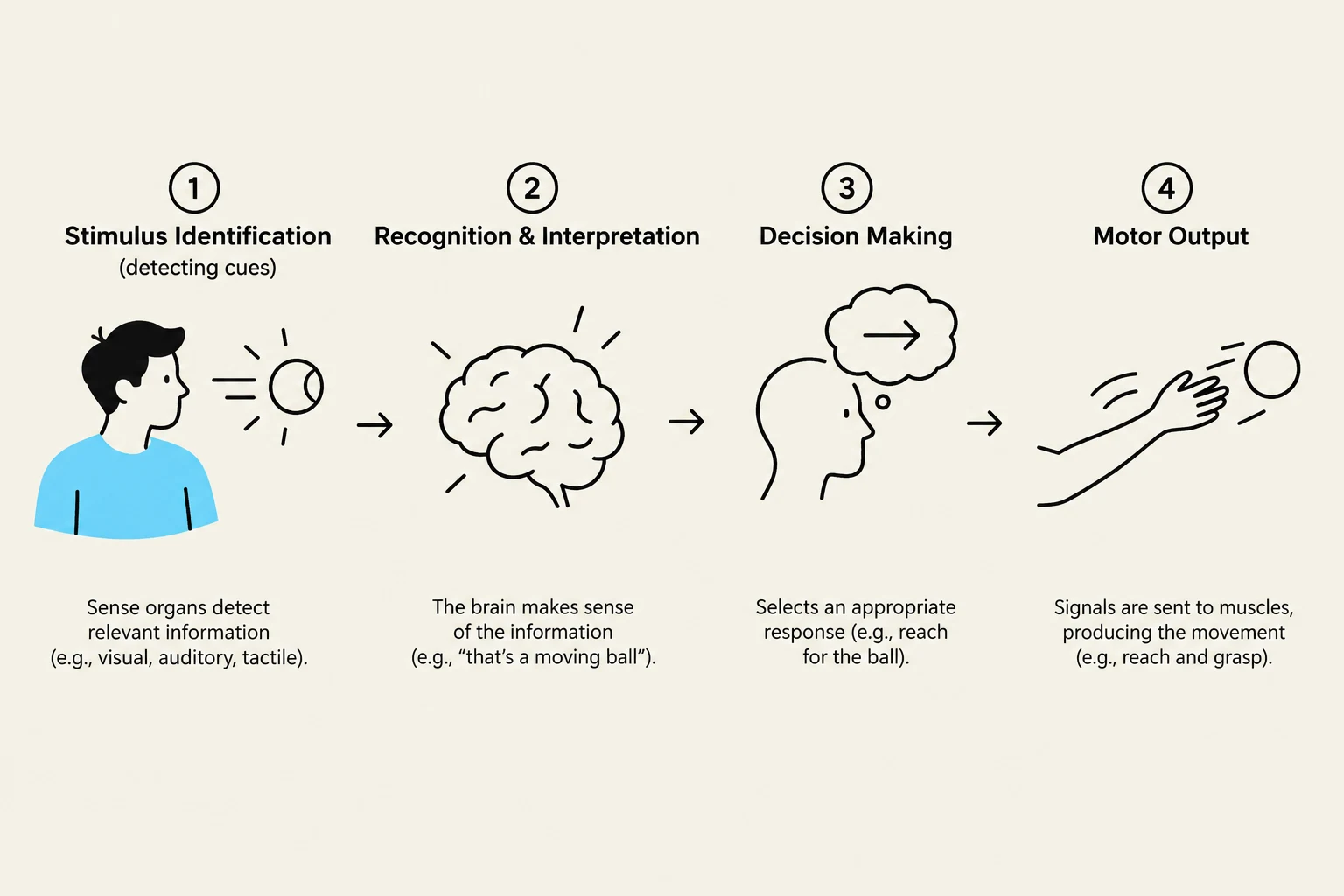
This diagram illustrates the four stages of information processing in response to a stimulus: stimulus identification, recognition and interpretation, decision making, and motor output. It shows how sensory input is processed by the brain to generate an appropriate motor response.
2. Response Selection
Once the stimulus is identified, the individual moves to response selection. This is the decision-making phase where you choose a specific action from a set of available options. In a basketball game, this might mean deciding whether to pass, shoot, or dribble.
Two factors significantly influence how fast this stage occurs:
Stimulus-Response (S-R) Compatibility: This refers to how "natural" the link is between a stimulus and the required response. For example, turning a bicycle handlebar left to turn left is highly compatible, which speeds up selection. If the link is arbitrary, selection slows down.
Hick's Law: This principle states that as the number of stimulus-response alternatives increases, the time required to make a decision also increases.
3. Response Programming
The final stage is response programming, where the brain organizes the motor system to execute the chosen action. This involves retrieving and assembling the specific muscular commands needed for the movement.
The complexity of the movement dictates how long this stage takes. A simple task, like tapping a single finger, is programmed almost instantly. However, a complex task, such as a full golf swing or a gymnastics tumbling pass, requires significantly more time to organize the precise sequence of muscle activations.
Understanding Reaction Time (RT)
In the study of motor control, it is vital to distinguish between Reaction Time and Movement Time.
Reaction Time (RT): The interval from the onset of the stimulus to the very beginning of the movement. This represents the time spent in the identification and selection stages.
Movement Time: The interval from the start of the movement to its completion.
The total Response Time is the sum of these two:
Response Time=Reaction Time+Movement Time
Exam Tip: If a coach observes a player reacting slowly to a signal, they must determine if the bottleneck is in the decision-making (slow RT) or the physical execution (slow movement time). These require different training interventions.
The Power of Anticipation
To overcome the inherent delays in processing, high-level performers use anticipation. Anticipation is the ability to predict what will happen in the environment and when it will occur. This allows information processing to begin before the stimulus actually arrives.
Anticipation can be categorized into three types:
Event Anticipation: "What will happen?"
Spatial Anticipation: "Where will it happen?"
Temporal Anticipation: "When will it happen?"
While anticipation can decrease reaction time and help minimize injury in sports, it carries a "high cost to correct". If an athlete anticipates the wrong direction or timing, they may be completely out of position when the actual event occurs.
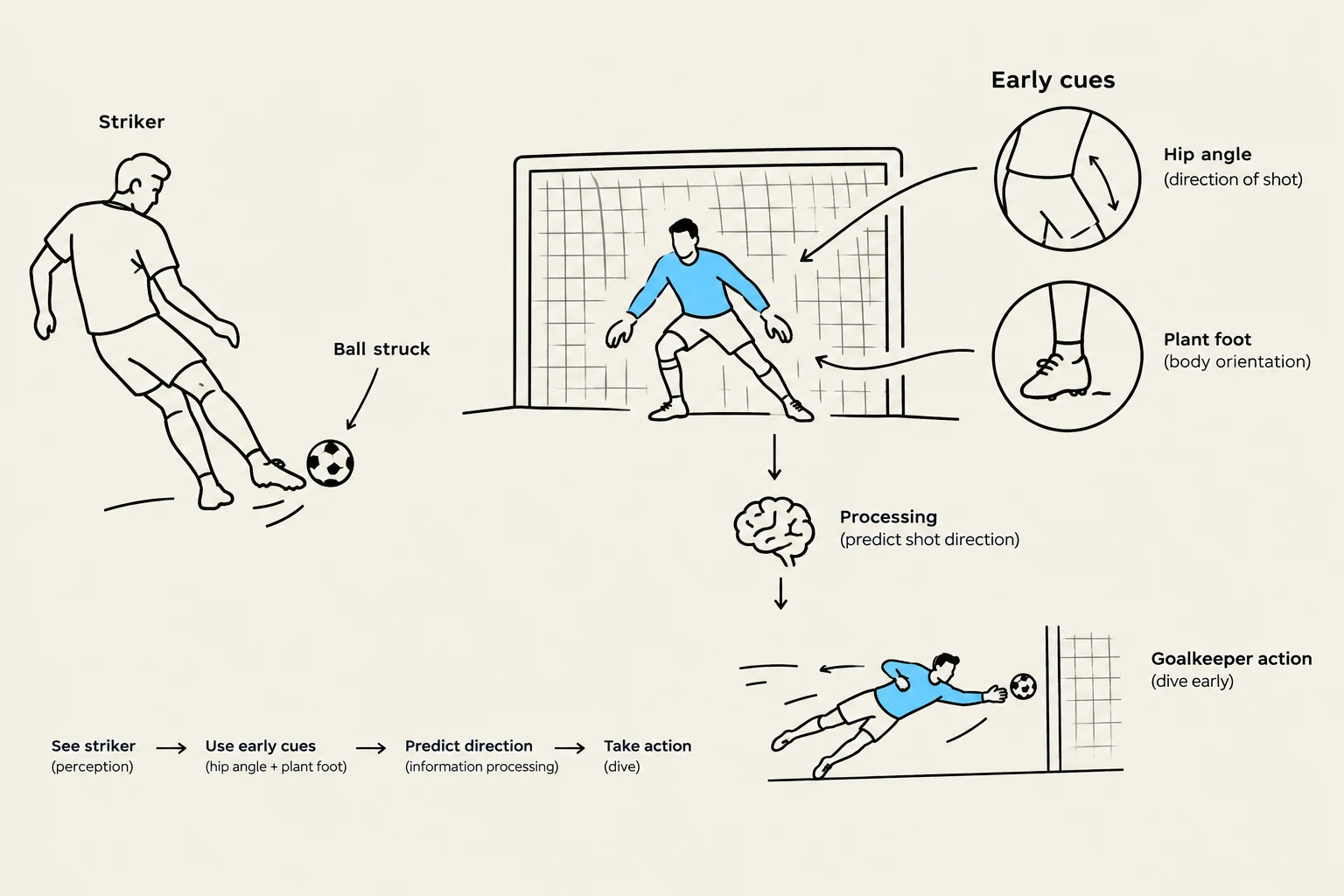
This diagram illustrates the process by which a goalkeeper anticipates and reacts to a penalty kick, using visual cues from the striker's body language and the ball's trajectory to predict the shot's direction and take action.
Practical Application: The Penalty Save
A goalkeeper facing a penalty kick provides a perfect real-world application of this model. The keeper has a very narrow window—approximately 400–600ms—from the moment the ball is struck to make a decision and complete a dive.
Stimulus ID: The keeper reads early cues such as the striker's hip angle, plant-foot position, and backswing.
Response Selection: The keeper decides whether to dive left, dive right, or stay central.
Response Programming: The keeper organizes the explosive muscular sequence required for the dive.
Elite goalkeepers often use these early cues to commit to a direction before the ball is even struck. This is a strategic way to "buy back" response-programming time, illustrating the delicate balance between speed and accuracy in high-pressure motor tasks.
The Speed-Accuracy Tradeoff
As we move toward more advanced motor learning, we encounter the speed-accuracy tradeoff. While it is tempting to assume that moving as fast as possible is always superior, increasing speed often comes at the expense of precision. In the context of information processing, rushing through the identification or selection stages can lead to errors in decision-making, while rushing the programming stage can lead to uncoordinated movements.
Summary Checklist for Analysis:
When analyzing a motor skill, ask yourself:
Stimulus ID: What specific environmental cues is the performer reading?
Response Selection: How many options are they choosing from? Is the stimulus-response compatible?
Response Programming: Is the movement a simple action or a complex, multi-step sequence?
Keep reading for free.
Create an account to finish this reading and make it part of your study routine.