Information Processing and Decision Making in Human Performance
Explores the information-processing model of human performance, detailing the three stages: stimulus identification, response selection, and response programming. Discusses factors influencing reaction time, Hick's Law, and the difference between reaction time and movement time.
When we watch an elite athlete react to a split-second cue, we are witnessing more than just physical speed; we are seeing the culmination of complex mental processing. Whether it is a goalkeeper diving toward a corner or a driver slamming on the brakes, the human brain must transform environmental stimuli into precise muscular actions. To understand how this happens, we use the information-processing model, which breaks down human performance into three distinct mental stages.
The Three Stages of Information Processing
The information-processing model describes the "mental side" of performance by outlining how we perceive, decide, and act. This process is cyclical: once an action is completed, feedback about the outcome loops back into the first stage, serving as the foundation for all learning.
Stage 1: Stimulus Identification
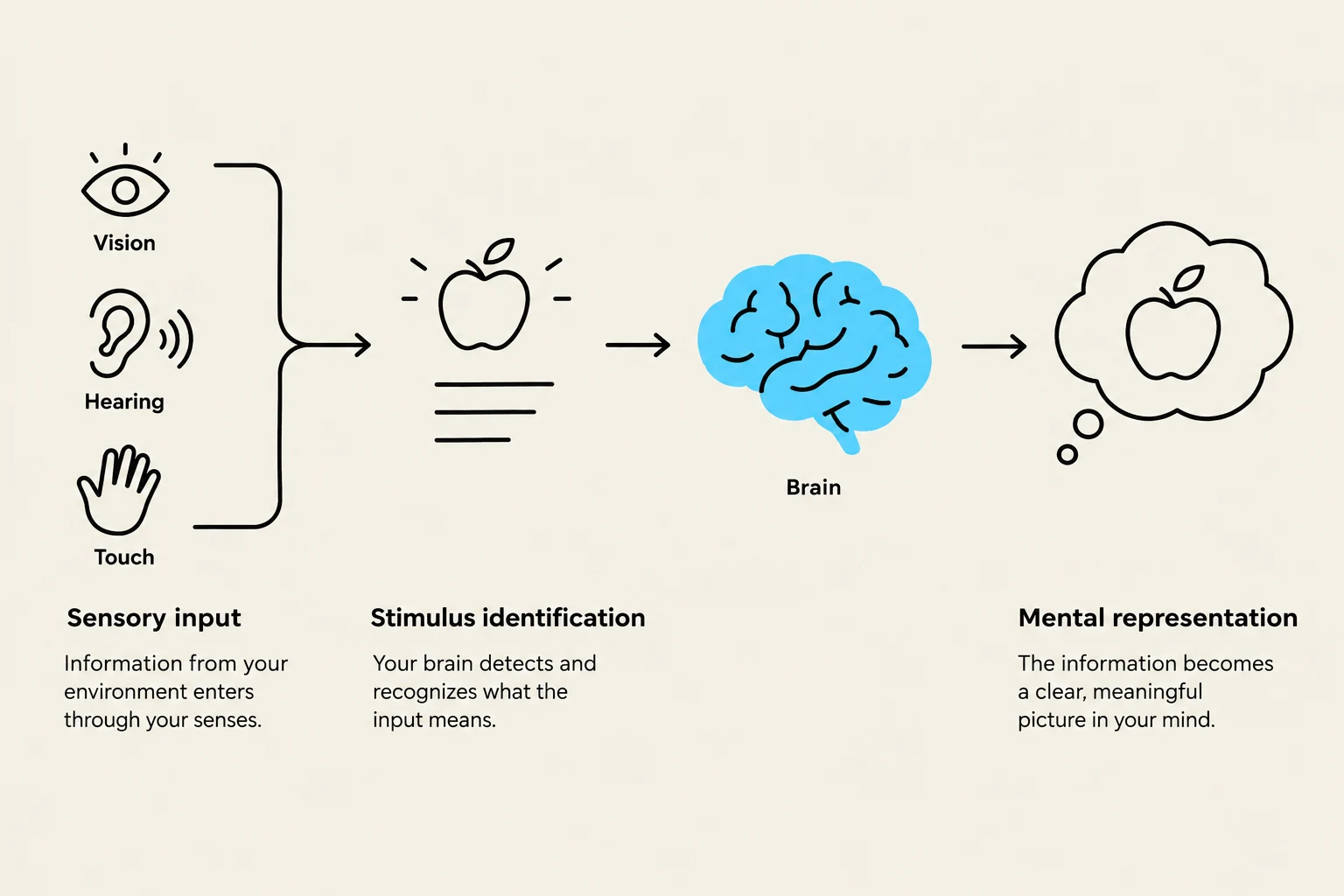
The first step is detecting a stimulus and recognizing a pattern within it. This relies on sensory input, primarily vision, but also includes hearing, touch, and proprioception. For example, a driver notices the red glow of brake lights ahead, or a rugby player reads the subtle shift in a defender's stance.
A critical distinction in this stage is the difference between experts and novices. Experts are often able to detect meaningful patterns much earlier than beginners through deliberate exposure and training. This ability to "read" a situation is what allows elite performers to anticipate events before they fully unfold.
This diagram illustrates the process of sensory input, stimulus identification, and mental representation, showing how information from the environment is processed by the brain to form a meaningful mental picture.
Stage 2: Response Selection
Once the stimulus is identified, the brain must decide what to do. This is the decision-making phase, where the performer chooses one action from several available options. In sports, this might mean deciding whether to pass, shoot, or dribble under intense pressure.
Several factors influence how quickly we can make this selection:
Stimulus-Response (S-R) Compatibility: This refers to how "natural" the link is between a stimulus and its required response. If a light on the left requires a left-hand response (spatial compatibility), selection is fast. If the link is arbitrary, the process slows down.
Population Stereotypes: These are learned cultural behaviors that influence decision speed. For instance, we instinctively know that red means "stop" and turning a dial clockwise increases volume.
Amount of Practice: As practice increases, reactions become faster. At very high levels, performers achieve "automatic processing," where the number of available choices has little to no impact on reaction speed.
Stage 3: Response Programming
The final stage involves organizing the motor system. The brain must retrieve and assemble the specific muscular commands required to execute the chosen response.
The complexity of the movement dictates the time required for this stage. A simple task, like a single-finger tap, requires almost instant programming. In contrast, a complex movement like a full golf swing or a gymnastics tumbling pass requires significantly more time to organize the many muscle groups and precise sequences involved.
A diagram illustrating the process of decision making, starting with environmental input, followed by stimulus identification, interpretation, and finally decision making.
Measuring Performance: Reaction Time vs. Movement Time
To analyze performance effectively, we must distinguish between how fast we think and how fast we move.
Reaction Time (RT): The interval from the onset of the stimulus to the very beginning of the movement. This is primarily a measure of the first two stages (identification and selection).
Movement Time (MT): The interval from the start of the movement to its completion. This is a measure of the third stage (programming and execution).
Total Response Time: The sum of both components:
Total Response Time=Reaction Time+Movement Time
Exam Tip: If a coach observes a slow response in an athlete, they must diagnose the bottleneck. Is the athlete slow at making the decision (slow RT), or are they slow at executing the physical movement (slow MT)? Each requires a different training intervention.
The Impact of Choice: Hick's Law
The complexity of a decision is often defined by the number of stimulus-response (S-R) alternatives available. We categorize these into two types:
Simple Reaction Time: One stimulus and one response. This is the fastest possible situation.
Choice Reaction Time: Choosing one response from multiple predetermined movements.
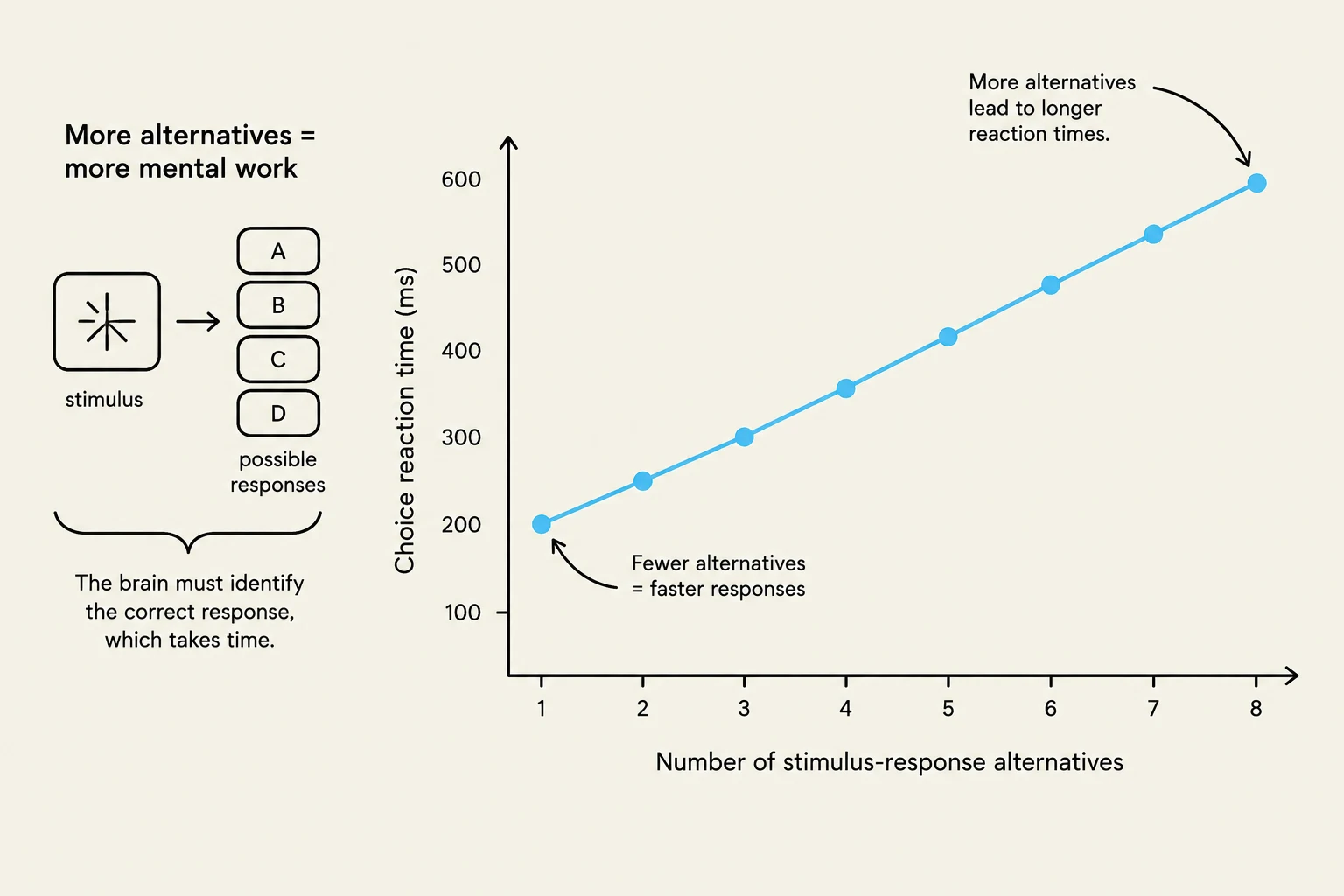
As the number of choices increases, the time required to make a decision also increases. This relationship is described by Hick's Law, which states that reaction time increases in proportion to the logarithm of the number of stimulus-response alternatives.
This graph illustrates the relationship between the number of stimulus-response alternatives and choice reaction time, showing that more alternatives lead to longer reaction times due to increased mental work required to identify the correct response.
While doubling the options does not double the decision time, it consistently slows the process down. This is a vital concept in coaching: by simplifying the decisions available to a performer under pressure (reducing the number of viable choices), you can effectively decrease their reaction time.
Summary Table: Applying the Model
Stage
Process
Sport Example (Goalkeeper)
Everyday Example (Driving)
Stimulus ID
Detecting/Recognizing
Reading hip angle and plant foot
Noticing brake lights
Response Selection
Deciding
Choosing to dive left, right, or stay central
Choosing which pedal to press
Response Programming
Organizing Muscles
Organizing the explosive dive
Executing the braking sequence
Keep reading for free.
Create an account to finish this reading and make it part of your study routine.