Explore cognitive psychology and the information-processing approach, covering sensation, perception, attention, memory, and decision-making processes.
Have you ever wondered why you don't constantly see your own nose, even though it is always in your field of vision? The answer lies in the incredible efficiency of your brain. To prevent being overwhelmed by a constant flood of sensory data, your brain employs "unconscious selective attention," filtering out "useless" information so you can focus on what truly matters. This ability to manage information is the core focus of cognitive psychology.
Understanding Cognitive Psychology
Cognitive psychology is the scientific study of the mind and its mental processes. Unlike behaviorism, which focused primarily on observable actions, cognitive psychology seeks to understand the internal mechanisms of the mind, including perception, attention, memory, reasoning, and decision-making.
In the mid-20th century, the field was transformed by the emergence of computer science. Psychologists began using a computer metaphor to describe how the human mind functions. Just as a computer takes in data, processes it through various circuits, and produces an output, the human mind is viewed as an information processor that transforms input into meaningful behavior.
The Information-Processing Approach
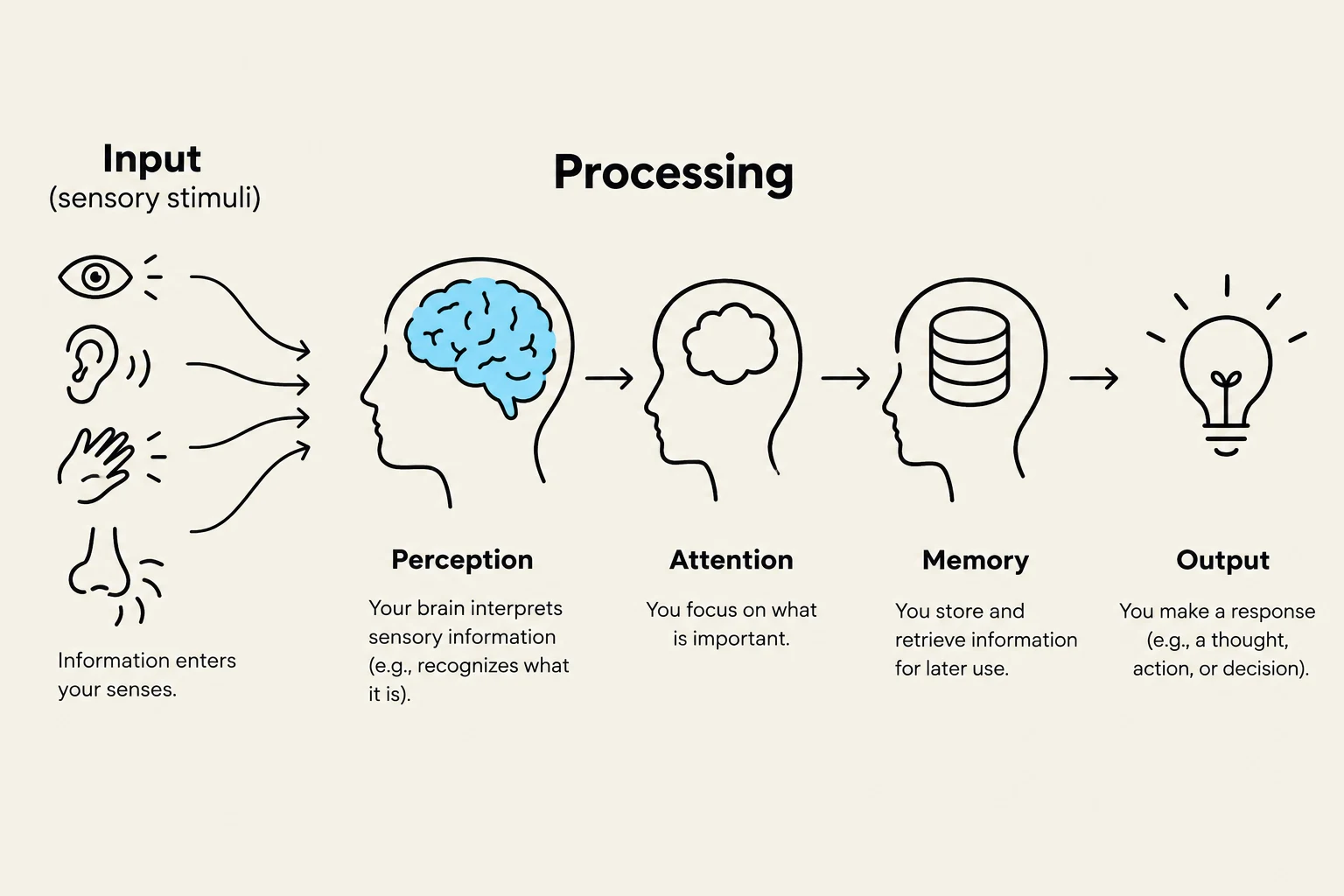
The information-processing approach views cognition as a sequence of distinct stages. To understand how we move from seeing a stimulus to making a decision, we can break the process down into five key stages:
Input: The reception of sensory stimuli from the environment.
Processing: The active engagement of perception, attention, and encoding.
Storage: The retention of information within different memory systems (sensory, short-term, working, and long-term).
Retrieval: The process of recalling stored information when needed.
Output: The final result, manifesting as decision-making or behavior.
This diagram illustrates the cognitive process of how information is received, processed, and acted upon, encompassing input, perception, attention, memory, and output.
Sensation and Perception: Making Sense of the World
Before we can think about information, we must first receive it. This begins with sensation, the process of detecting stimuli from the environment through our sensory organs—such as the eyes, ears, or skin—and transmitting that data to the brain.
However, sensation alone is not enough. We need perception, the cognitive process where the brain interprets and organizes that sensory input to make sense of our environment. Perception is not a passive recording; it involves activating our pre-existing beliefs and knowledge to categorize what we see or hear.
The Mechanics of Perception
Perception relies on two complementary processes:
Bottom-up processing: Perception is driven by the physical characteristics of the stimulus itself.
Top-down processing: Our knowledge, expectations, goals, and previous experiences influence how we interpret those physical signals.
A fascinating result of these processes is perceptual constancy. This is our tendency to perceive objects as stable and unchanging, even when the sensory image on our retina changes. For example, you perceive a door as a rectangle even when it is partially open and the image hitting your retina looks like a trapezoid. Once we have successfully processed these inputs, we achieve object recognition, allowing us to identify a stimulus as belonging to a familiar category.
Attention: The Mental Filter
Because our environment provides more data than our brains can handle, we rely on attention—the process of selectively concentrating on specific information while ignoring other stimuli. This is often referred to as selective attention.
Attention can be categorized into two types:
Voluntary (Controlled) Attention: Actively directing your focus toward a specific task, such as solving a difficult math problem.
Involuntary (Automatic) Attention: Being captured by sudden or prominent stimuli, such as turning your head toward a loud bang.
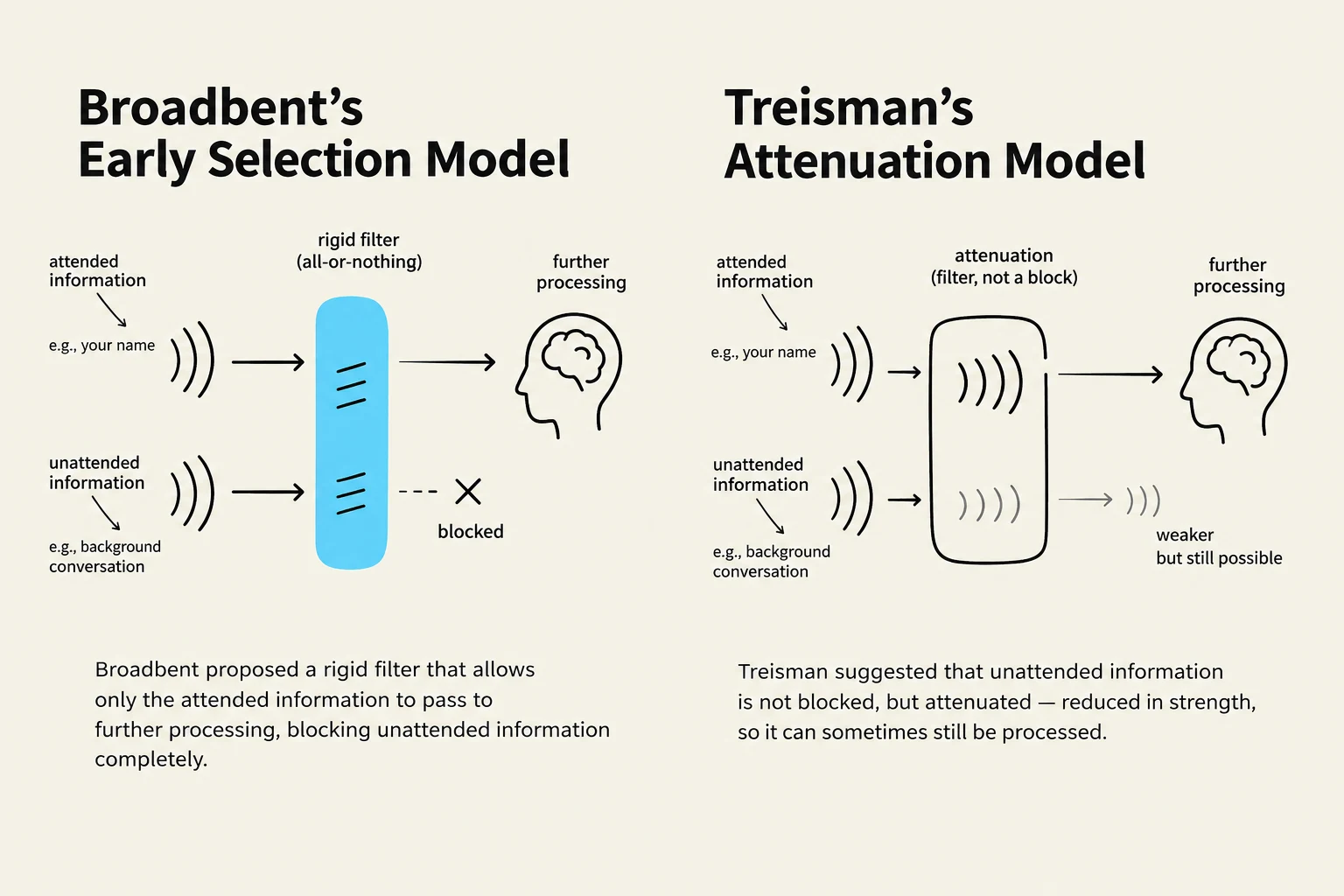
Exam Tip: Remember the difference between Broadbent's Filter Model and Treisman's Attenuation Model. Broadbent suggested a "bottleneck" where unattended info is completely blocked. Treisman argued that unattended info is merely "turned down" (attenuated), allowing highly relevant information—like hearing your own name—to still break through.
This image illustrates two models of auditory attention: Broadbent's Early Selection Model, which proposes a rigid filter, and Treisman's Attenuation Model, which suggests unattended information is attenuated rather than completely blocked.
Dual-Process Theory: Fast vs. Slow Thinking
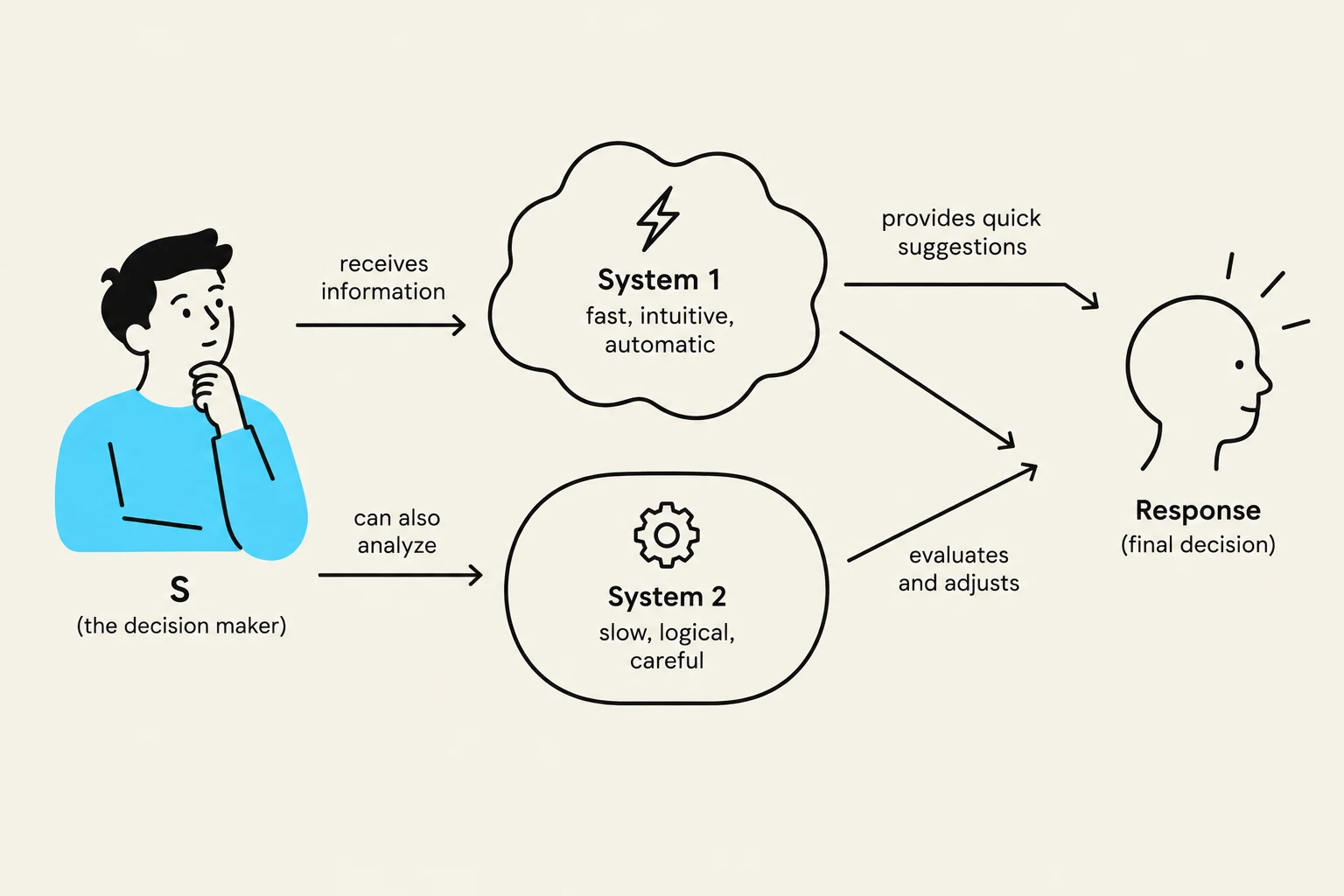
When it comes to making decisions, cognitive psychology suggests we use two distinct types of processing, often called System 1 and System 2:
Feature
System 1 (The Automatic System)
System 2 (The Thinking System)
Speed
Fast and rapid
Slow and deliberate
Effort
Effortless/Low-effort
Requires high effort
Consciousness
Unconscious/Implicit
Conscious/Explicit
Function
Intuitive, associative, habitual
Analytical, rule-based, logical
While System 1 is incredibly useful for quick reactions (like recognizing a face or avoiding danger), it is prone to cognitive biases—systematic patterns of judgment that lead to errors. These errors often stem from heuristics, which are mental shortcuts or "rules of thumb" used to make quick decisions.
For example, the availability heuristic causes us to judge an event as more probable simply because examples of it come to mind easily. Similarly, the representativeness heuristic leads us to judge things based on how much they resemble a typical "model" or stereotype, often causing us to ignore actual statistical probabilities.
This diagram illustrates a decision-making model with two systems: System 1, which is fast and intuitive, and System 2, which is slow and logical. The decision maker receives information that System 1 processes to provide quick suggestions. The decision maker can also analyze this information using System 2, which evaluates and adjusts the suggestions, leading to a final decision or response.
Summary of Cognitive Flow
From the moment a stimulus hits your senses to the moment you act, your mind is performing a complex dance of filtering, interpreting, storing, and retrieving. By understanding these processes, we gain insight into why we make certain decisions and how we navigate a world filled with endless information.
Keep reading for free.
Create an account to finish this reading and make it part of your study routine.