This content explains the chain of infection, types of infections (HAI, exogenous, endogenous), medical asepsis, hand hygiene, personal protective equipment (PPE), and transmission-based precautions (contact, droplet, airborne) to prevent the spread of organisms in healthcare settings.
In a healthcare environment, safety is a shared responsibility. Because patients often have lower resistance to disease, increased exposure to microorganisms, and undergo invasive procedures, they are at a significantly higher risk for infection. Infection prevention and control (IPAC) involves a systematic approach to reducing the transfer of organisms through medical asepsis, hand hygiene, personal protective equipment (PPE), and specific transmission-based precautions.
Understanding Infection Types
To control infection, we must first understand how it occurs and where it comes from. Infections can be categorized by their source and their setting.
Health Care–Associated Infections (HAI)
Also known as nosocomial infections, these are infections that patients acquire while receiving treatment in a healthcare facility. A common example is a Clostridium difficile infection.
Exogenous vs. Endogenous Infection
Infections are further classified by the origin of the pathogen:
Exogenous infection: These are caused by organisms acquired from the external environment, such as from other people, contaminated surfaces, or medical equipment.
Endogenous infection: These occur when a patient's own resident flora (microorganisms that normally live on or in the body) cause an infection, often after an invasive procedure or surgery.
Exam Tip: Remember that "resident flora" are usually nonpathogenic but can become dangerous if they enter a sterile area of the body during surgery.
Diagram illustrating exogenous and endogenous pathogens and their modes of entry or spread within the human body.
The Chain of Infection
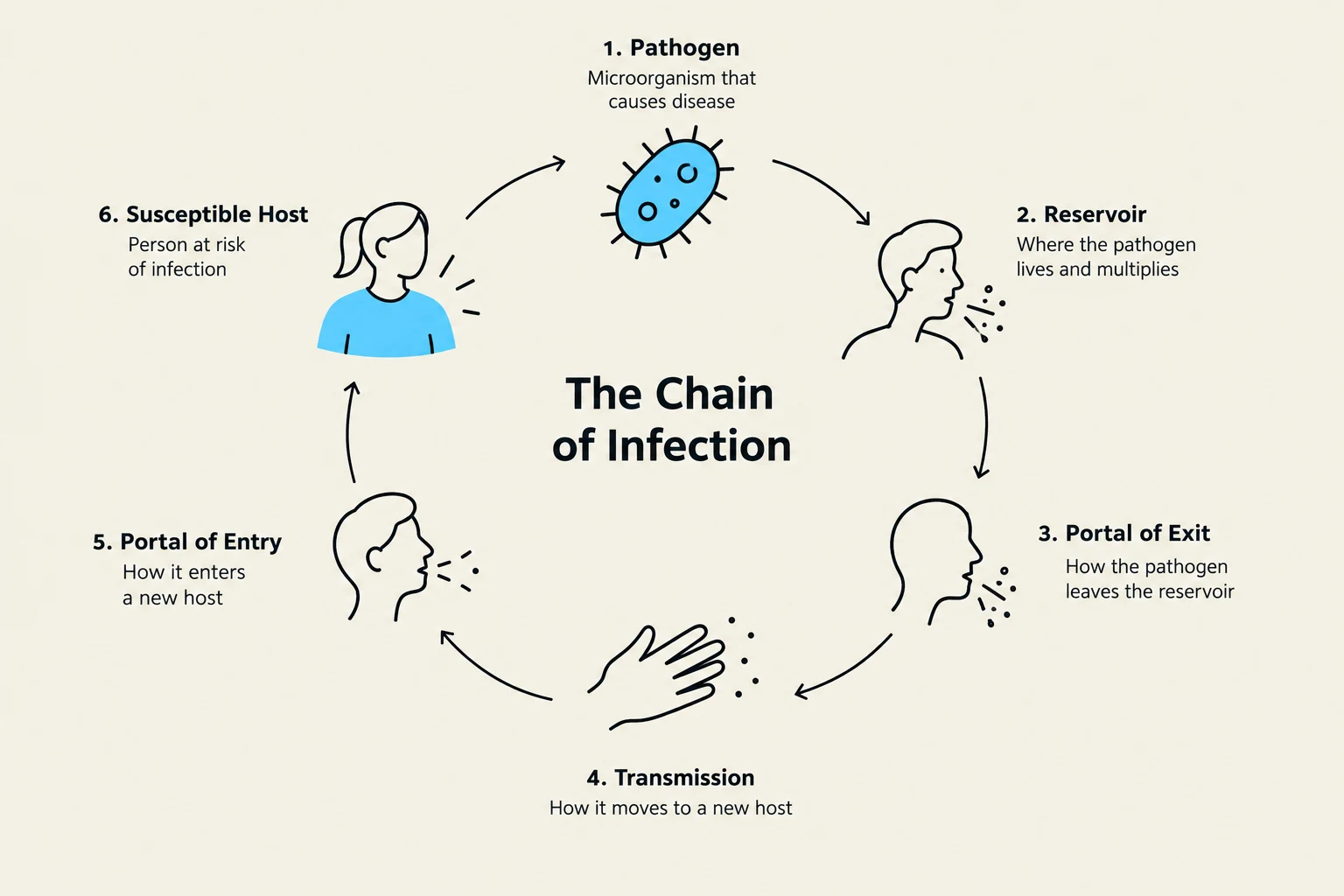
The "Chain of Infection" is a fundamental concept in IPAC. For an infection to spread, a specific sequence of events must occur. If you break even one link in this chain, the transmission is stopped.
The links include:
Infectious Agent: The pathogen (bacteria, virus, fungi, or protozoa).
Reservoir: The place where the pathogen lives and multiplies (humans, animals, or the environment).
Portal of Exit: The way the pathogen leaves the reservoir (e.g., through the mouth, nose, or a wound).
Mode of Transmission: How the agent moves (e.g., direct contact, droplets, or airborne).
Portal of Entry: How the pathogen enters the new host (e.g., mucous membranes or broken skin).
Susceptible Host: The person at risk, whose susceptibility depends on genetics and immune strength.
The chain of infection illustrates the six steps involved in the transmission of infectious agents: pathogen, reservoir, portal of exit, transmission, portal of entry, and susceptible host.
Asepsis and Hand Hygiene
To break the chain, healthcare workers use Medical Asepsis, also known as "clean technique". The goal of medical asepsis is to reduce the number of organisms and prevent their transfer.
Hand Hygiene
Hand hygiene is the single most important technique for infection control and prevention. It includes several methods:
Handwashing with soap and water.
Antiseptic hand wash.
Antiseptic hand rub.
Surgical hand asepsis.
Precautions and Personal Protective Equipment (PPE)
In clinical practice, precautions are divided into two main categories: Routine Practices and Transmission-Based Precautions.
Routine Practices
These are the primary strategies for preventing infection and must be applied to all patient interactions, regardless of whether the patient's infection status is known or suspected.
Transmission-Based Precautions
When a patient is known or suspected to be infected with a specific pathogen, additional precautions are required to prevent cross-contamination.
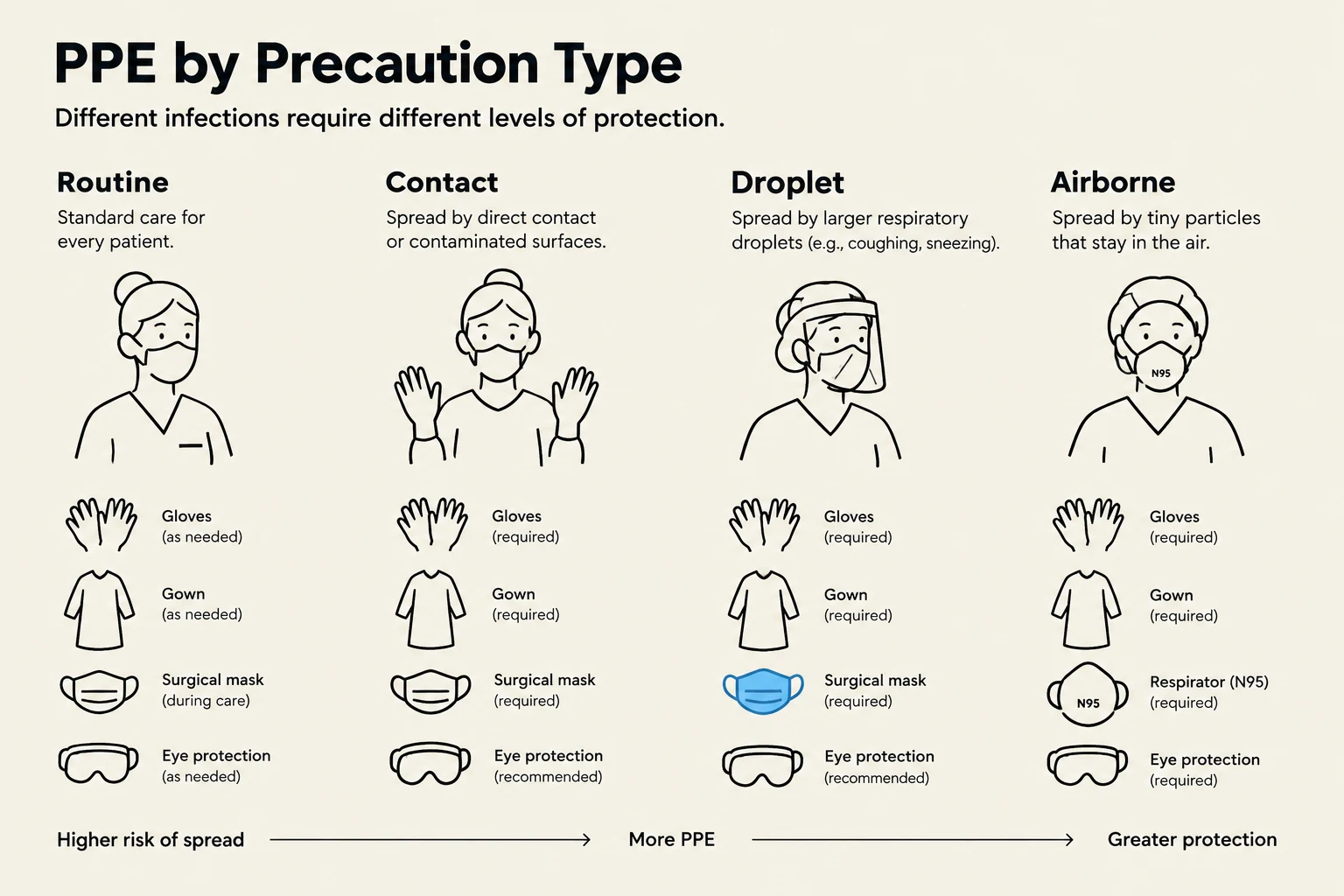
Contact Precautions: Used for organisms transmitted by direct or indirect contact with the patient or their environment.
Droplet Precautions: Used for pathogens transmitted by large respiratory droplets that typically travel only a short distance (within 1 meter) from the patient.
Airborne Precautions: Used for tiny particles (droplet nuclei) that remain suspended in the air for long periods.
Using PPE
Personal Protective Equipment (PPE) includes items such as caps, masks, protective eyewear, and gloves.
Assessment: Before applying a mask, assess the patient's potential for infection and the risk of splashes.
Maintenance: Change masks immediately if they become moist or soiled.
Procedure: It is critical to follow consistent "donning" (putting on) and "doffing" (taking off) procedures to avoid self-contamination.
This diagram illustrates the different types of Personal Protective Equipment (PPE) recommended for various precaution types, including Routine, Contact, Droplet, and Airborne, based on the risk of infection spread.
Key Environmental and Safety Control Measures
Beyond personal protection, several environmental measures are essential to maintain a safe healthcare setting:
Environmental Cleaning and Disinfection: Regularly cleaning high-touch surfaces and medical equipment to remove germs.
Equipment Reprocessing: Ensuring reusable medical devices are properly cleaned, disinfected, or sterilized between patients.
Respiratory Hygiene and Cough Etiquette: Encouraging patients and staff to cover coughs/sneezes with tissues or elbows and using no-touch bins.
Safe Injection Practices and Sharps Safety: Using sterile, single-use needles and syringes for every injection, and disposing of all sharps in rigid, puncture-proof containers.
Waste and Linen Management: Safely disposing of biomedical waste and handling soiled linens carefully to prevent the spread of microorganisms.
Summary Note: Effective infection control is a multi-layered approach. While hand hygiene and routine practices form the foundation, transmission-based precautions and environmental management provide the necessary barriers to stop specific outbreaks.
Keep reading for free.
Create an account to finish this reading and make it part of your study routine.