Infection, Infectious Diseases, and Epidemiology: A Comprehensive Overview
This overview covers the fundamental concepts of infection, disease, and epidemiology, including pathogenesis, the human biome, disease transmission dynamics, and public health strategies like herd immunity.
Understanding how diseases emerge, spread, and impact populations is a cornerstone of modern medicine and public health. While we often use the terms "infection" and "disease" interchangeably in casual conversation, they represent distinct biological processes. An infection occurs when pathogenic organisms invade or colonize the body, but a disease only manifests when that infection causes a measurable change from a healthy state. To study these phenomena, scientists rely on three interconnected disciplines: pathology (the study of disease), etiology (the study of causes), and pathogenesis (the study of how a disease develops within the body).
Pathogenesis and the Mechanics of Infection
When a pathogen enters a host, its ability to cause harm is determined by its virulence—the range or severity of the disease it can produce. This severity is driven by virulence factors, which are specific structures or molecules that allow the microbe to adhere to cells, invade tissues, colonize the host, or cause direct damage.
The impact of a pathogen is often quantified by two critical metrics:
Infectious Dose (ID50): The dose required to infect 50% of a test population.
Lethal Dose (LD50): The dose required to kill 50% of a test population.
For example, the amount of a pathogen needed to cause illness varies wildly; while cholera requires a high dose of approximately 108 cells, the botulinum toxin is lethal at a microscopic level of just 0.03 nanograms per kilogram of body weight.
To prove that a specific microbe is responsible for a specific disease, scientists historically relied on Koch's Postulates. These foundational rules require isolating the organism from a diseased host, growing it in a pure culture, reproducing the disease in a healthy animal, and then re-isolating the identical organism from the newly infected host.
The Human Biome: Symbiosis and Microbiota
Three types of symbiotic relationships: Mutualism (both host and microbe benefit), Commensalism (host is unaffected, microbe benefits), and Parasitism (host is harmed, microbe benefits).
Humans are not solitary organisms; we are walking ecosystems known as the human biome. We host a vast array of microorganisms that can be categorized into two groups: resident microbiota, which are permanent colonizers of specific body sites, and transient microbiota, which may only stay for days or weeks.
The relationship between these microbes and our bodies is called symbiosis, which manifests in three primary ways:
Mutualism: Both the host and the microbe benefit (e.g., E. coli in the small intestine).
Commensalism: The microbe benefits, while the host remains unharmed (e.g., bacteria living in a sweat gland pore).
Parasitism: The microbe benefits at the expense of the host (e.g., Streptococcus mutans on tooth surfaces).
A vital defense mechanism is microbial antagonism, where healthy resident microbes inhibit the growth of harmful transient organisms. However, this balance can be disrupted. Opportunistic microorganisms are normally harmless residents that can cause disease if the host's immune system is weakened by factors like chemotherapy, radiotherapy, or the use of broad-spectrum antibiotics.
Exam Tip: Remember that "morbidity" refers to the state of being diseased or the total number of cases, while "mortality" refers specifically to deaths caused by the disease. Mortality is a subset of morbidity.
Epidemiology: Tracking Disease in Populations
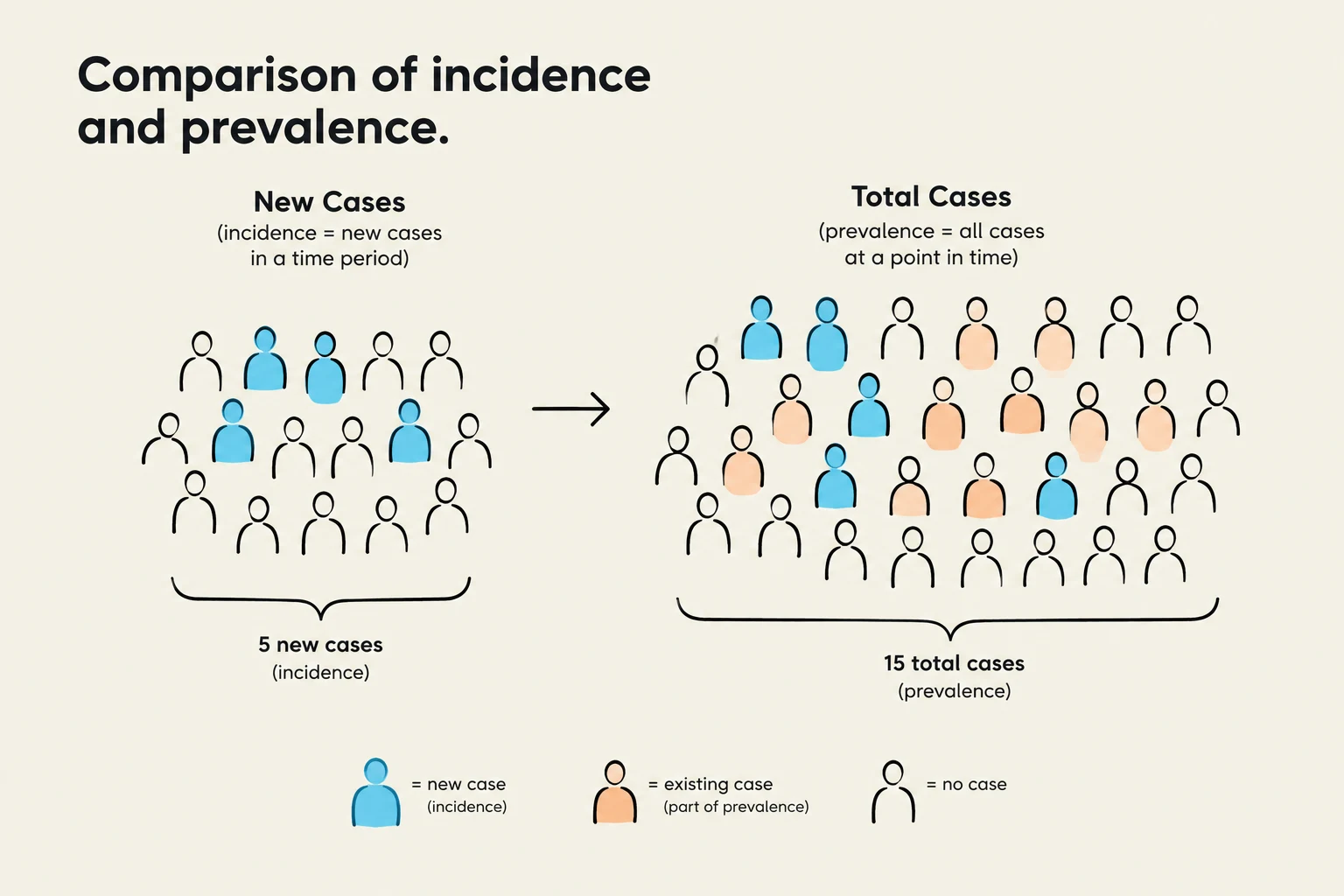
This graphic illustrates the difference between incidence and prevalence. Incidence, shown on the left, represents new cases over a period, while prevalence, on the right, shows all existing cases at a specific point in time.Epidemiology is the scientific study of how diseases occur, distribute, and spread through populations. Epidemiologists use several key metrics to track these patterns:
Incidence: The number of new cases appearing in a specific area during a set time period.
Prevalence: The total number of cases (both new and existing) in a population during a specific period.
Case Fatality Ratio (CFR): The proportion of infected people who die from a disease.
Infection Fatality Rate (IFR): A more accurate measure of lethality that includes both diagnosed and undiagnosed infections.
Epidemiologists also track the Basic Reproduction Number (R0), which represents the average number of people one infected individual will infect in a completely susceptible population. If R0<1, the disease will eventually decline and disappear.
Disease Distribution Patterns
Diseases are classified by how they are distributed geographically and temporally:
Sporadic: Occasional, irregular cases.
Endemic: A disease that is consistently present in a specific region.
Epidemic: An unusual, sudden increase in cases within a country or region.
Pandemic: An epidemic that has spread across multiple continents or globally.
Transmission Dynamics: How Pathogens Move
All pathogen transmission follows three stages: escape from the host, travel through an environment or via a vector, and entry into a new host.
Direct Transmission
This occurs through immediate contact between an infected and a susceptible individual:
Contact Transmission: Physical touch, such as kissing or sexual contact.
Droplet Transmission: Large respiratory droplets (greater than 5 micrometers) expelled during coughing or sneezing. These travel short distances, typically less than 6 feet.
Indirect Transmission
This involves an intermediary between the source and the host:
Fomites: Inanimate objects (like doorknobs or medical tools) that become contaminated and transfer pathogens when touched.
Vectors: Living organisms, often insects like mosquitoes or flies, that carry pathogens from one host to another.
Reservoirs and Zoonosis
A reservoir is the natural environment (living or non-living) where a pathogen lives and multiplies long-term. While many reservoirs are living hosts, they can also be soil or water.
When a disease that primarily infects animals is transmitted to humans, it is called a zoonosis. This often occurs through spillover events, where a pathogen acquires the genetic changes necessary to jump from an animal species to humans. For example, the 2014 Ebola epidemic in West Africa was likely the result of a spillover event from bats.
Clinical Progression and Public Health
Infectious diseases typically progress through predictable stages: the incubation period (between infection and symptoms), the prodromal period (vague, general symptoms), the illness period (severe signs/symptoms), the decline period (diminishing symptoms), and convalescence (recovery).
To protect populations, public health officials aim for herd immunity. This occurs when a high enough proportion of the population is immune (through vaccination or prior infection) that the pathogen cannot find enough susceptible hosts to spread effectively. For highly contagious diseases like measles, which has an R0 of 12–18, approximately 95% vaccination coverage is required to maintain herd immunity.
Finally, clinicians must remain vigilant against nosocomial infections—infections acquired specifically within healthcare facilities. These are often preventable through strict adherence to hygiene protocols, such as proper hand washing and sterilization.
Keep reading for free.
Create an account to finish this reading and make it part of your study routine.