


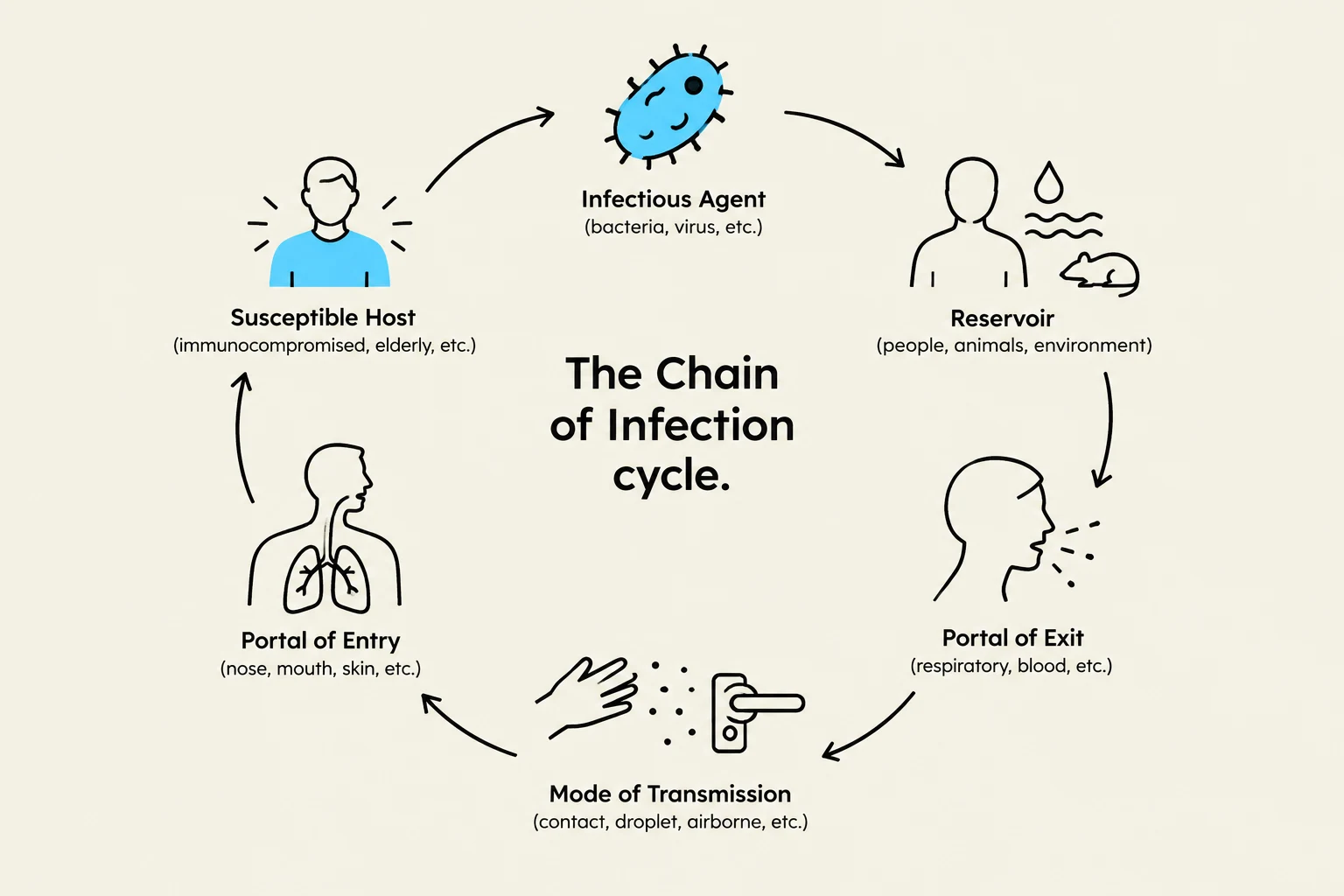
In the healthcare environment, the primary goal of infection control is to break the chain of infection to prevent the spread of pathogens and reduce the incidence of healthcare-associated infections (HAIs). Healthcare-associated infections are infections that clients acquire while receiving treatment for other conditions within a healthcare facility. To achieve effective control, healthcare professionals utilize a tiered system of precautions: Standard Precautions (Tier 1) and Transmission-Based Precautions (Tier 2).
Standard Precautions (Tier 1)
Standard Precautions are the foundation of infection control and must be applied to all clients, regardless of their medical diagnosis or suspected infection status. These precautions are designed to reduce the risk of transmitting blood-borne pathogens (BBP) and other infectious agents found in moist body substances, including blood, all body fluids (except sweat), nonintact skin, and mucous membranes.
Hand Hygiene
Hand hygiene is recognized as the most effective measure to prevent the spread of infection. There are two primary methods:
- Handwashing: This is required when hands are visibly soiled with blood, body fluids, or other contaminants.
- Hand Sanitization: Alcohol-based hand sanitizers serve as an adjunct for hands that are not visibly soiled.
Personal Protective Equipment (PPE)
PPE acts as a barrier between the healthcare worker and infectious materials. The Occupational Safety and Health Administration (OSHA) enforces standards to prevent employee exposure to infectious materials. Key components include:
- Gloves: Used to protect hands from contact with blood, body fluids, secretions, excretions, mucous membranes, and nonintact skin. Note that if a healthcare worker has a latex sensitivity, alternative materials must be used.
- Masks and Eye Protection: Masks protect the mouth and nose, while goggles or face shields protect the eyes from splashes or sprays of infectious material.
- Gowns: Used to protect skin and clothing from contamination.
Keep reading for free.
Create an account to finish this reading and make it part of your study routine.
Continue reading freeAlready have an account? Log in
Updated