Infection Control and Standard Precautions in Healthcare
This guide explains the principles of infection control, including the chain of infection, medical and surgical asepsis, standard precautions, and transmission-based precautions. It details essential practices like hand hygiene and the use of personal protective equipment (PPE) to prevent health care-associated infecti
In the clinical environment, the primary goal of infection control is to implement measures that reduce or eliminate the sources and transmission of infectious agents. By doing so, healthcare providers protect both their patients and themselves from disease. A significant challenge in this field is the prevention of Health Care-Associated Infections (HAIs)—infections that patients acquire specifically while receiving care in healthcare facilities.
To manage these risks effectively, nurses must understand the mechanics of how microorganisms move and how to intervene at various stages of that movement.
The Chain of Infection
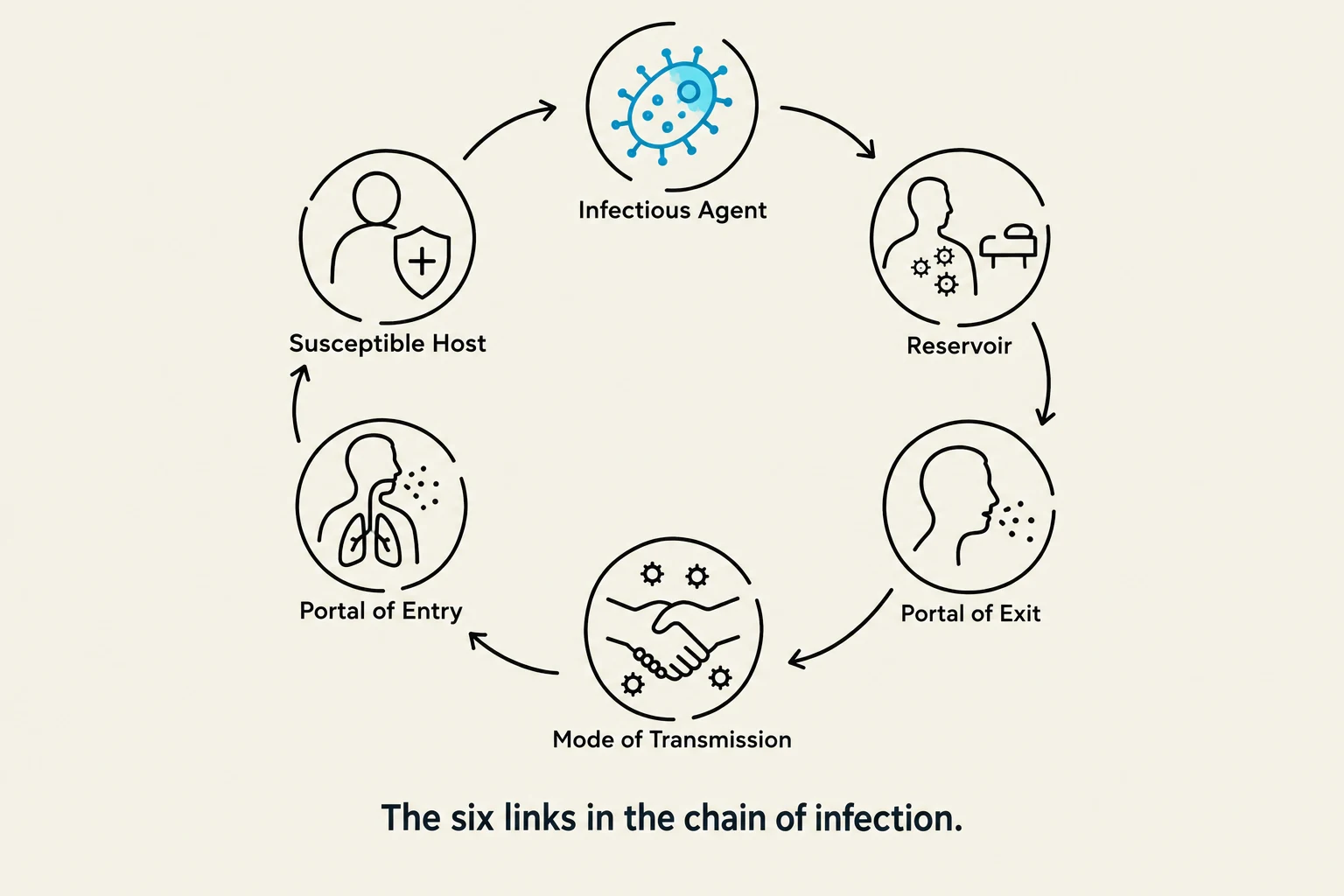
The six links in the chain of infection: Infectious Agent, Reservoir, Portal of Exit, Mode of Transmission, Portal of Entry, and Susceptible Host.
The "chain of infection" represents the process by which an infectious agent moves from one host to another. While the specific links in the chain can vary depending on the pathogen, the nurse's fundamental responsibility is to identify these links and "break" them to stop the spread of disease.
Breaking the chain involves several strategies:
Containment: Using barriers like gloves to prevent contact with body fluids.
Reduction: Applying aseptic techniques to lower the number of organisms present.
Protection: Ensuring proper use and disposal of medical equipment to prevent accidental exposure.
Asepsis: Medical vs. Surgical
Asepsis is defined as the absence of pathogenic (disease-producing) microorganisms. In nursing practice, we categorize aseptic techniques into two distinct levels based on the required intensity of the intervention:
Medical Asepsis (Clean Technique)
Medical asepsis focuses on reducing the number of organisms and preventing their transfer from one place to another. This is the standard approach used in daily patient care to minimize the risk of cross-contamination.
Surgical Asepsis (Sterile Technique)
Surgical asepsis is a much more rigorous standard. It focuses on the total destruction of all microorganisms, including their highly resistant spores. This technique is reserved for invasive procedures where any presence of microbes could lead to severe infection.
Standard Precautions (Tier 1)
Standard precautions are considered "Tier 1" defenses and are the cornerstone of infection prevention. The most critical rule of standard precautions is that they must be applied to all patients, regardless of whether their infection status is known or suspected.
These precautions apply whenever there is potential contact with:
Blood
All body fluids (including urine, feces, and wound drainage)
Secretions and excretions (excluding sweat)
Nonintact skin
Mucous membranes
Hand Hygiene: The Non-Negotiable Essential
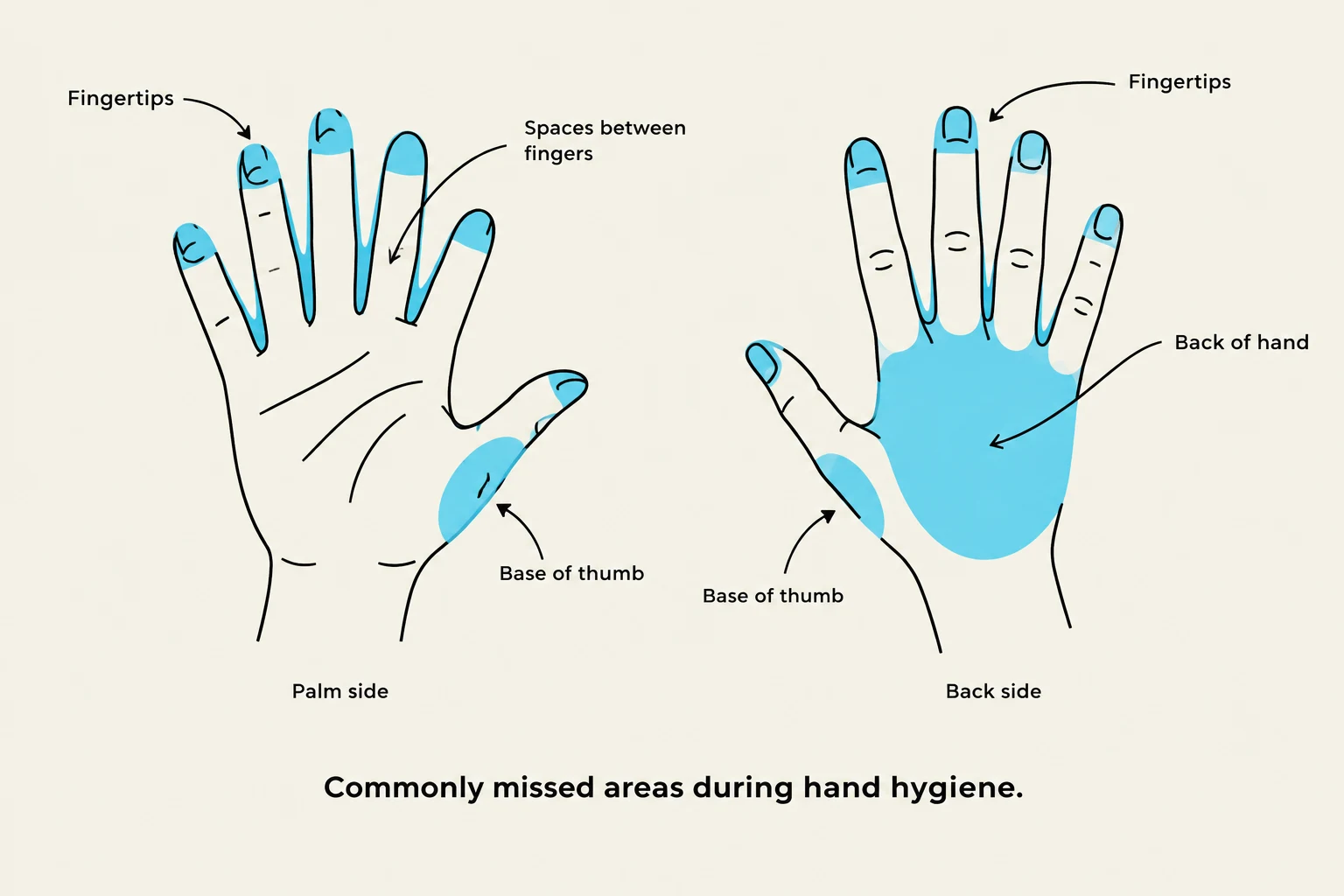
Diagram illustrating commonly missed areas during hand hygiene, including fingertips, spaces between fingers, base of thumb, and back of hand.
Hand hygiene is not optional; it is a fundamental requirement for patient safety. It can be performed using soap and water or an appropriate alcohol-based hand antiseptic.
To be effective, healthcare workers must pay attention to commonly missed areas, such as:
Fingertips
Between the fingers
The backs of the hands
The bases of the thumbs
Clinical Note: Barriers to Effective Hygiene
Certain factors can impede the effectiveness of hand hygiene. Jewelry and artificial nails are difficult to clean and can harbor microorganisms. Additionally, skin conditions like dermatitis (reported in approximately 30% of healthcare workers), cracks, or abrasions can trap bacteria and make thorough cleaning difficult.
Personal Protective Equipment (PPE)
PPE serves as a physical barrier between the provider and infectious agents. The choice of PPE depends on the anticipated level of exposure:
Gloves: Must be worn when anticipating contact with blood, body fluids, nonintact skin, or mucous membranes.
Masks, Eye Protection, and Gowns: These should be used if there is a risk of splashes or sprays occurring during a procedure.
Properly donning (putting on) and doffing (taking off) PPE is vital to prevent self-contamination. For example, the doffing sequence is particularly sensitive because the exterior of the PPE is considered contaminated.
Respiratory Hygiene and Cough Etiquette
To contain infectious agents in the air, nurses must implement and teach respiratory hygiene/cough etiquette. This includes instructing patients to cover their mouth and nose when coughing or sneezing and ensuring that tissues are disposed of properly.
Transmission-Based Precautions (Tier 2)
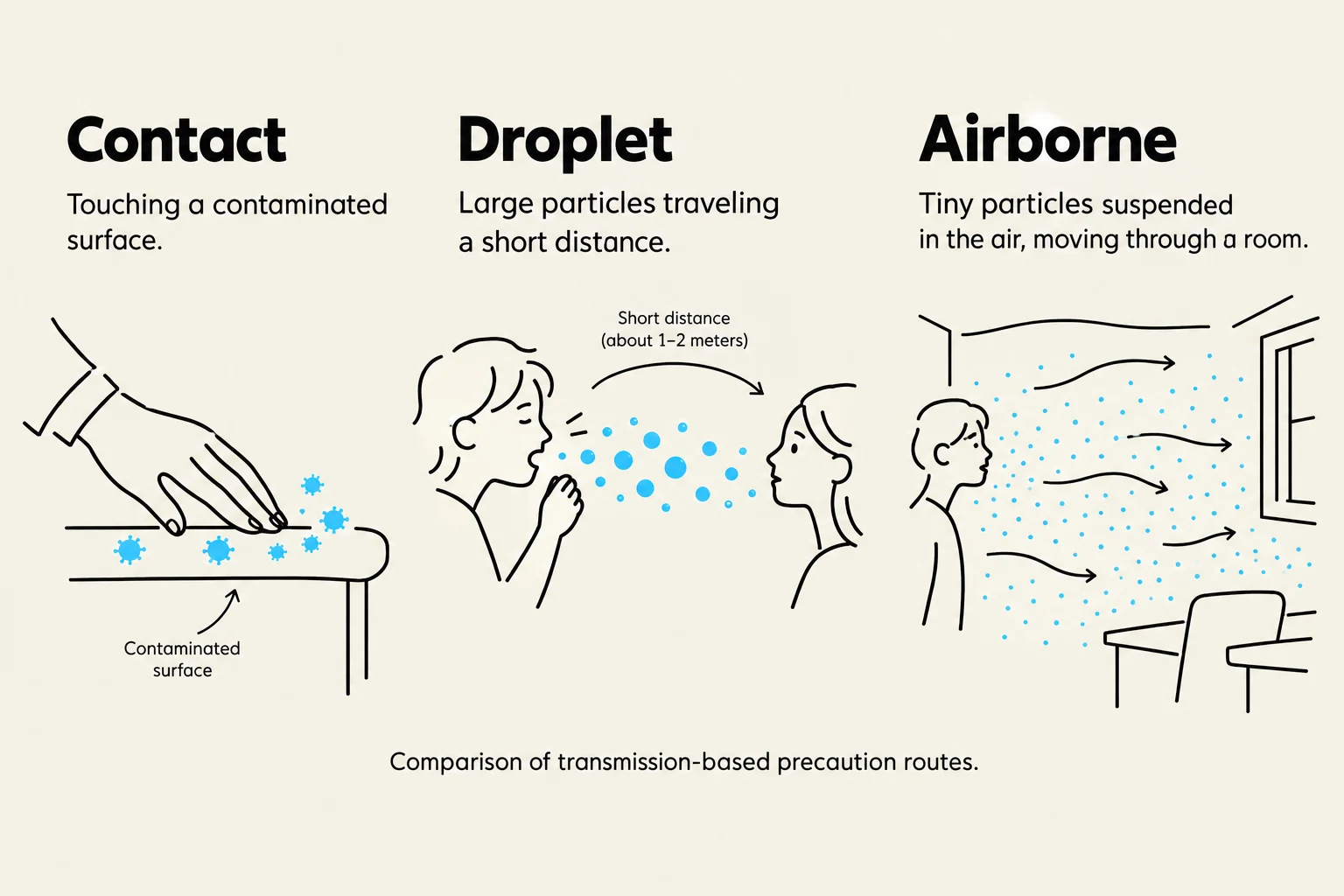
Comparison of transmission-based precaution routes: Contact, Droplet, and Airborne.
When standard precautions are not enough to prevent the spread of a specific pathogen, Transmission-Based Precautions (Tier 2) are implemented. These are used for patients known or suspected to be infected or colonized with specific microorganisms.
These precautions are categorized by the route of transmission:
Contact Precautions: Used for organisms spread by direct or indirect contact.
Droplet Precautions: Used for pathogens transmitted through large respiratory droplets.
Airborne Precautions: Used for tiny particles that remain suspended in the air.
Note: In some clinical scenarios, "Droplet Contact Precautions" may be combined to address multiple risks.
The Nurse's Role in Management
Nurses are the frontline defenders in infection control. Beyond the physical application of techniques, the nurse's role includes:
Assessment: Knowing a patient's susceptibility to infection and identifying body sites prone to HAIs, such as the urinary or respiratory tracts.
Role Modeling: Demonstrating perfect adherence to hygiene and aseptic techniques to set a standard for the team.
Patient Education: Teaching patients and families about cough etiquette, hand hygiene, and the importance of isolation precautions.
Exam Tip: Safety Checks
Before entering a client's environment, always perform safety checks. This includes assessing the necessary level of PPE required for that specific patient and ensuring you have the correct equipment to protect yourself from exposure to infectious agents.
Keep reading for free.
Create an account to finish this reading and make it part of your study routine.