Individual Rights and Incarceration Rates: A Global and Domestic Analysis
This reading examines the relationship between a society's commitment to individual and democratic rights and its incarceration rates. It explores constitutional protections in the U.S., compares global trends using data from organizations like Freedom House, and analyzes domestic variations within the United States.
How a society manages the tension between state authority and personal freedom is often visible in two distinct metrics: the legal protections afforded to its citizens and the number of people held in its prisons. While democratic ideals emphasize the preservation of individual liberties, the practical application of law can lead to vastly different outcomes in terms of incarceration. By examining global trends and domestic variations within the United States, we can begin to see how the strength of a nation's legal framework correlates with its penal practices.
Understanding Individual and Democratic Rights
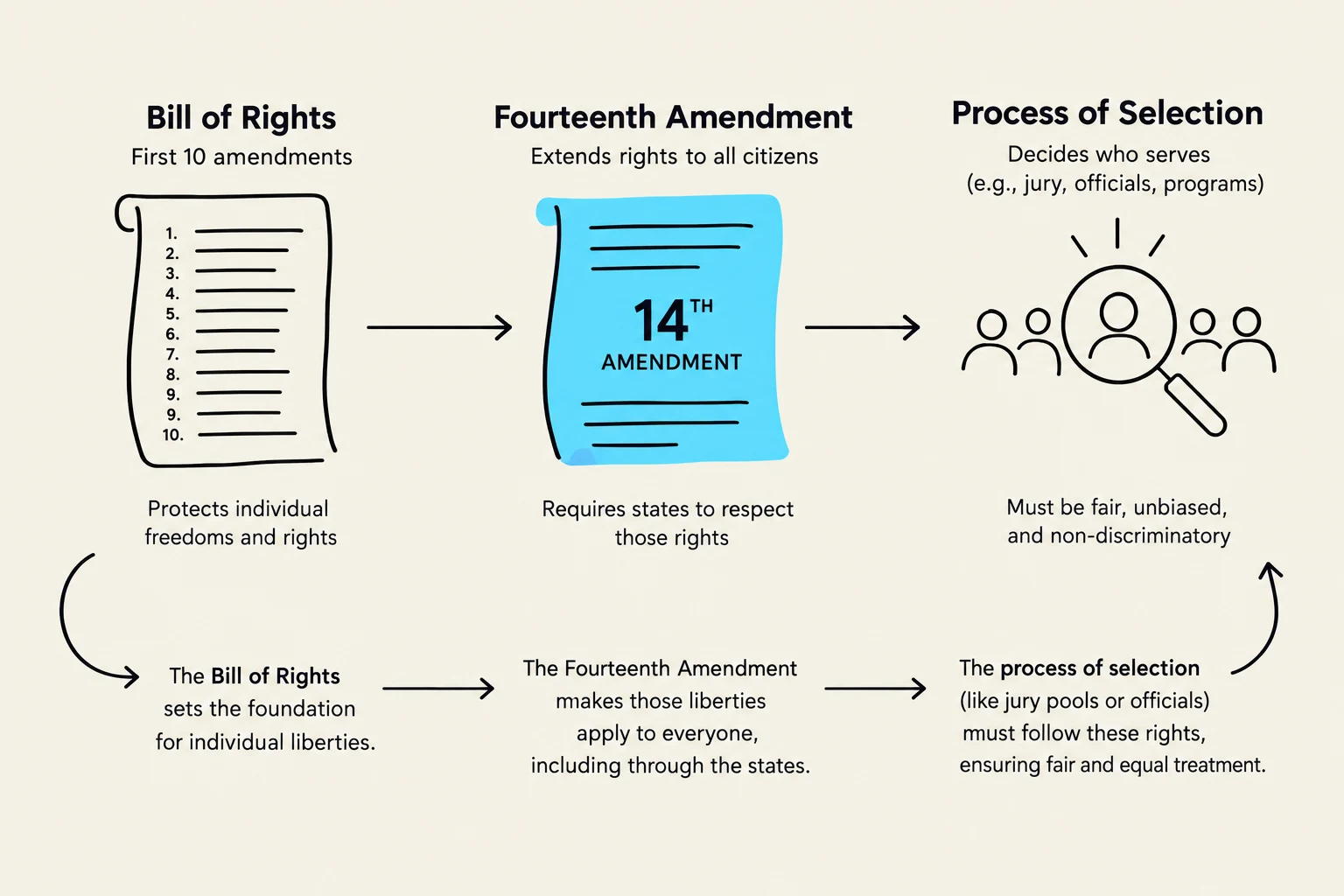
At the core of a free society are civil liberties: specific individual rights, such as the right to a fair trial, that are constitutionally protected against infringement by the government. In the United States, these protections are anchored in the Bill of Rights and the Fourteenth Amendment. A critical legal mechanism is selective incorporation, a process where the Supreme Court uses the Fourteenth Amendment's due process clause to apply the protections of the Bill of Rights to the individual states.
Democratic rights are not absolute; they often exist in a state of constant negotiation with national security and public safety. For example, freedom of expression is a fundamental pillar of democracy, yet it can be limited if it incites "imminent lawless action" or endangers national security. Similarly, the government may regulate the "time, place, and conditions" of public assembly to ensure public convenience.
The Pillars of Constitutional Protection
The First Amendment provides several essential protections that define the American democratic experience:
Speech and Press: Freedom to express ideas and publish information, subject to limits regarding libel, slander, and obscenity.
Religion: Protected through the Establishment Clause (preventing the government from favoring one religion) and the Free-Exercise Clause (preventing the government from interfering with religious practice).
Assembly: The right to gather peacefully, provided regulations are applied evenly to all groups.
Exam Tip: When studying the First Amendment, remember the distinction between the Establishment Clause (government cannot start a religion) and the Free-Exercise Clause (government cannot stop you from practicing your religion). The "Lemon Test" is a key judicial tool used to evaluate Establishment Clause cases.
This diagram illustrates the relationship between the Bill of Rights, the Fourteenth Amendment, and the process of selection, emphasizing fairness and equal treatment.
Rights of the Accused and Due Process
A crucial intersection between individual rights and the state occurs during the criminal justice process. Procedural due process refers to the specific steps authorities must follow before a person can be lawfully punished. These safeguards are designed to prevent wrongful arrest, conviction, and punishment.
The legal process is divided into distinct phases, each with specific constitutional protections:
Suspicion and Arrest: The Fourth Amendment protects against unreasonable searches and seizures, requiring "probable cause" for an arrest.
Interrogation: The Fifth Amendment protects against self-incrimination. Following the landmark Miranda v. Arizona (1966) case, police are required to issue "Miranda warnings" to inform suspects of their right to remain silent and their right to an attorney.
Trial: The Sixth Amendment guarantees the right to legal counsel, a speedy trial, and an impartial jury. Furthermore, the exclusionary rule prevents evidence obtained in violation of a defendant's rights from being used in court.
Sentencing: The Eighth Amendment prohibits "cruel and unusual punishment," ensuring that penalties are not disproportionate to the offense.
The Criminal Justice Process illustrates the stages from suspicion to sentencing.
Global Comparisons: Rights vs. Incarceration
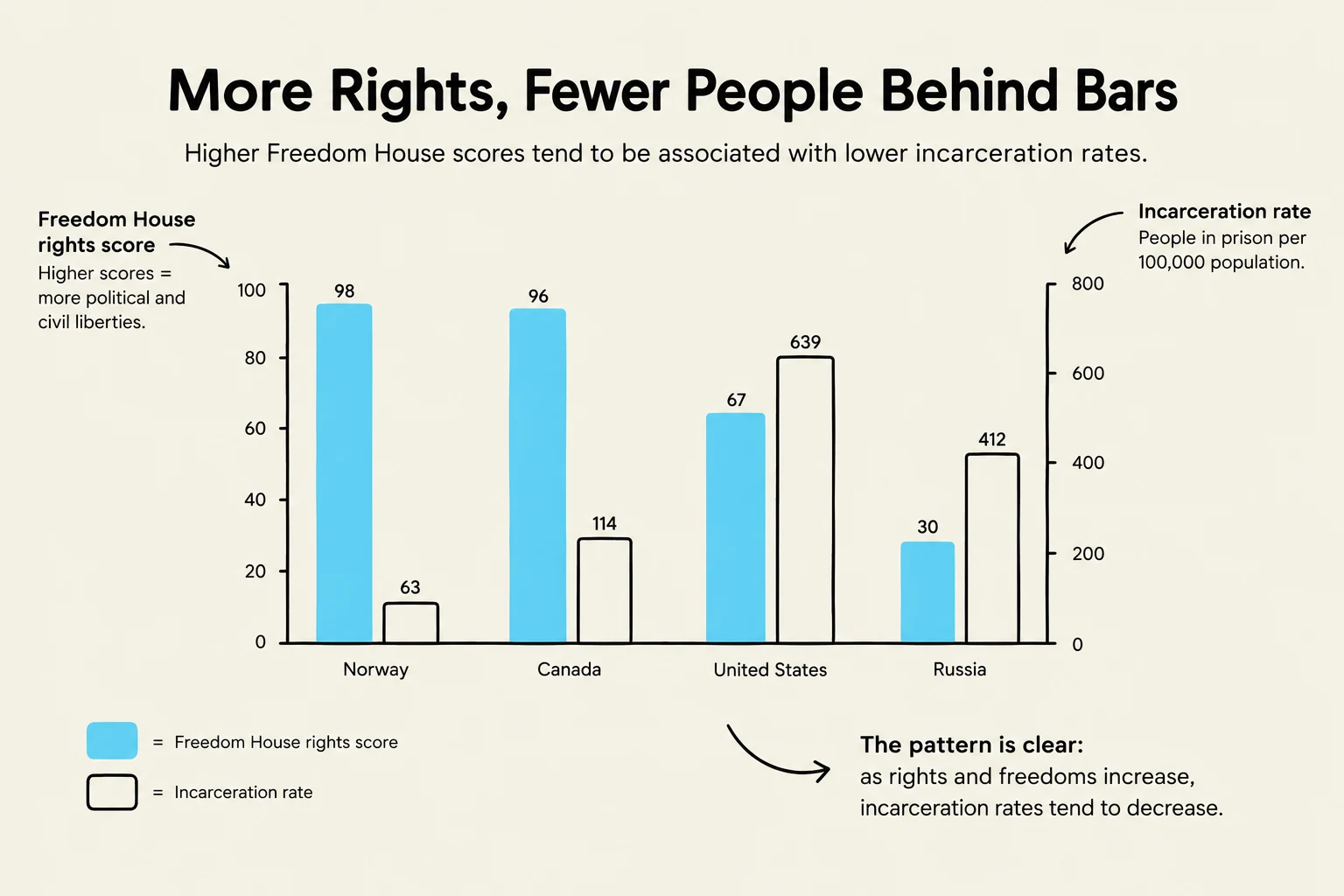
When we look at the world through the lens of Freedom House's 100-point ranking system, a pattern emerges regarding the relationship between democratic rights and imprisonment.
Countries with high scores for individual and democratic rights often maintain lower incarceration rates. For instance, Germany (94), the United Kingdom (94), and France (90) report high levels of protection. In contrast, nations like Russia (20) and China (9) report significantly lower levels of these protections.
This distinction is reflected in the actual number of people incarcerated per 100,000 people:
High Incarceration: The United States leads with a rate of 531 per 100,000. Other notable rates include Russia (300) and Iran (226).
Lower Incarceration: Developed nations with high rights protections often show much lower rates, such as Canada (88), Germany (67), and Japan (36).
Critical Thinking Note: While the U.S. ranks high in individual rights (86 on the Freedom House scale), it remains a global leader in per capita inmates. This suggests that high levels of protected rights do not automatically result in low incarceration rates; other factors like sentencing policy and crime governance play significant roles.
This bar chart illustrates the correlation between higher Freedom House scores (representing political and civil liberties) and lower incarceration rates per 100,000 population across four countries: Norway, Canada, the United States, and Russia. The data suggests that as rights and freedoms increase, incarceration rates tend to decrease.
Domestic Variations: The United States Landscape
Even within the United States, where the Constitution provides a unified framework, incarceration rates vary drastically across the 50 states. Because most crimes are governed by state law rather than federal law, regional differences in sentencing practices and legal policies create a fragmented landscape of imprisonment.
States can be categorized by their incarceration rates per 100,000 people to illustrate this disparity:
Incarceration Rate (per 100k)
Example States
200 or less
Hawaii, Washington, New York, Vermont
201 to 300
California, Illinois, Pennsylvania
301 to 400
Florida, Michigan, Tennessee
More than 400
Texas, Louisiana, Mississippi, Georgia
These variations highlight that the "balance" between state authority and individual rights is not a static national constant, but a shifting reality that depends heavily on local jurisdiction and political climate.
Keep reading for free.
Create an account to finish this reading and make it part of your study routine.