An exploration of Indigenous legal traditions in Canada, their historical context, terminology, sources, and their evolving relationship with the Canadian legal system, emphasizing reconciliation and integration.
The legal landscape of Canada is not a single, monolithic entity. While many people think of "the law" as the statutes passed by Parliament or decisions made by the Supreme Court, there exists a profound and ancient layer of legal authority that predates the arrival of European settlers. Understanding the relationship between Indigenous legal traditions and Canadian law is essential for anyone studying the Canadian legal system, as it touches upon the very foundation of our constitutional framework and the ongoing journey toward reconciliation.
This diagram illustrates the relationship between the broad term "Indigenous" and the specific legal term "Aboriginal" as used in the Canadian Constitution, outlining key groups such as First Nations, Inuit, and Métis.
The Context of Reconciliation
In recent years, the movement to improve the relationship between Indigenous peoples and non-Indigenous Canadians has gained unprecedented momentum. This shift is largely driven by a growing public awareness of Canada's colonial history and the devastating, long-lasting impacts of specific state policies, most notably the Indian residential school system.
As society grapples with these historical truths, there is an increasing recognition that for Canada to move forward, Indigenous law must be viewed not merely as a historical curiosity, but as a meaningful and vital component of the national legal structure.
Navigating Terminology
One of the first challenges for students of law is mastering the specific terminology used to describe the diverse peoples of this land. While these terms are often used interchangeably in casual conversation, they carry distinct legal and social meanings that are critical to navigate correctly.
Indigenous: This is a broad, umbrella term used to describe the original inhabitants of a land. In the Canadian context, it encompasses First Nations, Inuit, and Métis peoples.
Aboriginal: This term is frequently used in a legal context, particularly within the Canadian Constitution (such as Section 35 of the Constitution Act, 1982), to refer to the collective rights of Indigenous peoples.
First Nations: This term refers to the many distinct Indigenous nations across Canada who are neither Inuit nor Métis.
Inuit: The Indigenous people inhabiting the Arctic regions of Canada.
Métis: A distinct Indigenous people with a unique culture and identity, often stemming from the historical unions of Indigenous women and European fur traders.
Indian: While this term is still used in specific legal contexts (such as the Indian Act), it is important to use it with caution and sensitivity, as it is often viewed as a colonial label.
Study Tip: When answering exam questions regarding rights and identity, always check if the question is asking about a specific group (like the Inuit) or the collective rights of "Aboriginal peoples" under the Constitution. Precision in terminology demonstrates a professional understanding of the law.
The Nature of Indigenous Legal Traditions
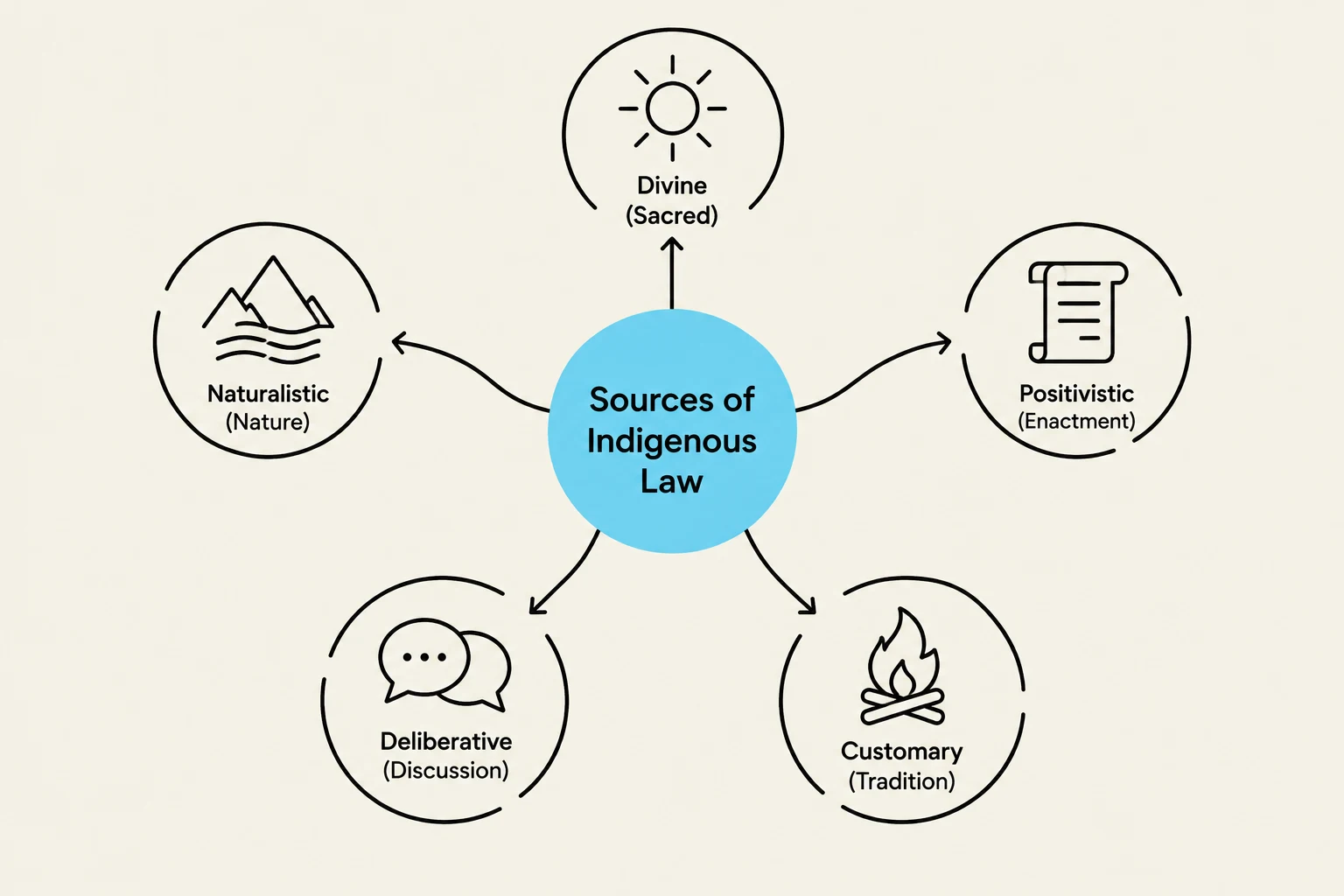
This diagram illustrates the various sources of Indigenous Law, including Divine (Sacred), Naturalistic (Nature), Deliberative (Discussion), Customary (Tradition), and Positivistic (Enactment).
A common misconception is that there is a single "Indigenous law." In reality, because there are hundreds of distinct Indigenous communities across Canada, there is no single, monolithic legal tradition. Instead, there is a vast and diverse array of unique legal systems, each with its own history and application.
Scholar John Borrows provides a framework for understanding these traditions by identifying five primary sources from which Indigenous law can emerge:
Divine (or sacred) law: Laws that are derived from spiritual or religious beliefs and connections to the sacred.
Naturalistic (or natural) law: Laws based on the inherent order of the natural world and the observations of nature.
Positivistic law: Laws that are established through formal human enactment, such as through the authority of a leader or a community council.
Deliberative law: Laws that emerge through collective discussion, debate, and decision-making processes within a community.
Customary law: Laws that are rooted in long-standing traditions, habits, and the repeated practices of a community over generations.
Interconnection and the Future of Canadian Law
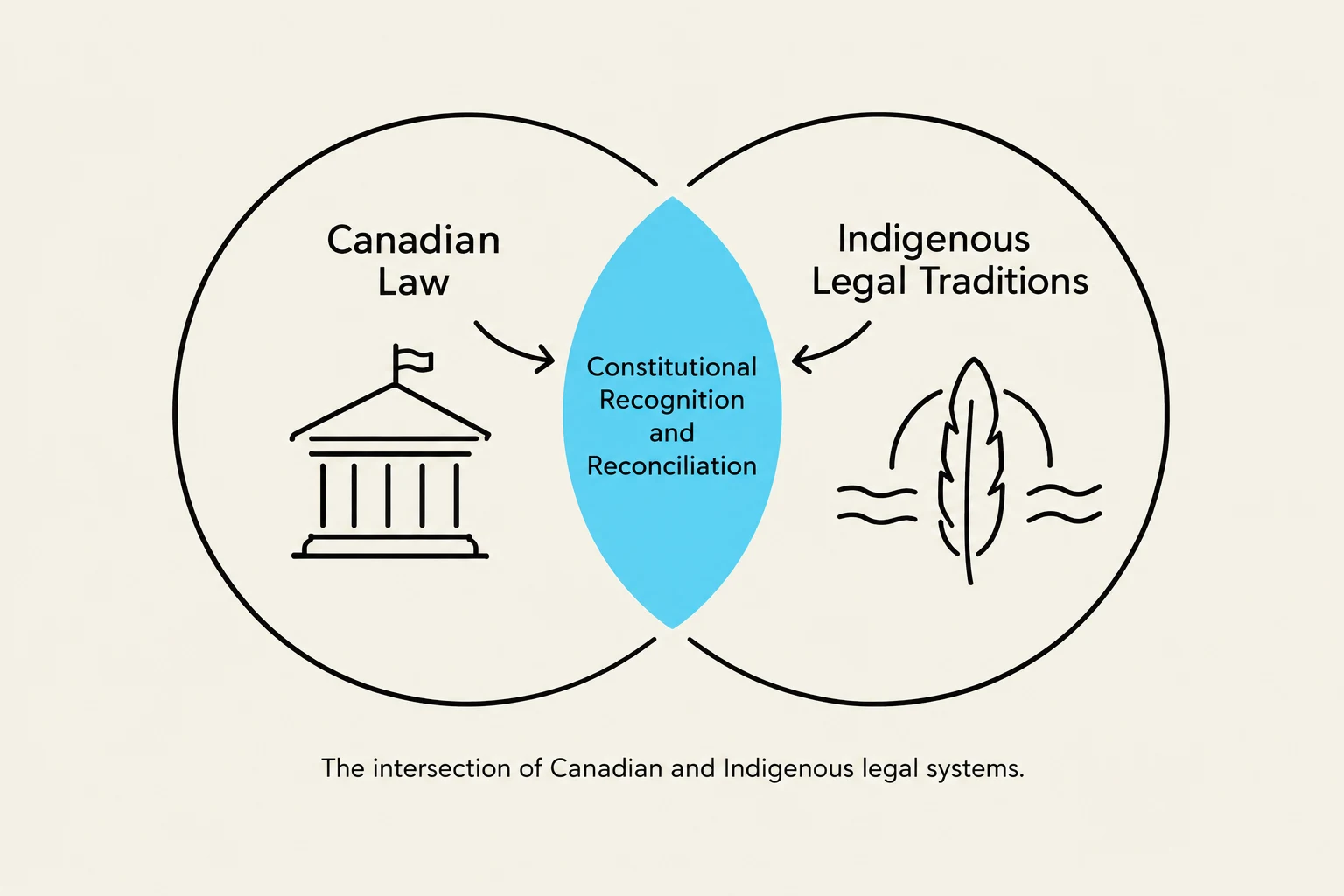
This diagram illustrates the intersection of Canadian law and Indigenous legal traditions, highlighting constitutional recognition and reconciliation.
It is important to understand that Indigenous legal traditions exist separately from Canadian law, but they are not entirely isolated. There is already an established interconnection between these two systems within Canada's current constitutional framework.
While the Canadian legal system has slowly gained greater recognition and protection for Indigenous rights over time, significant obstacles remain on the path toward full integration and respect. The goal of modern legal discourse is to move toward a future where Indigenous law is recognized as a legitimate and meaningful part of the broader Canadian legal landscape, creating a more inclusive and just national structure.
Keep reading for free.
Create an account to finish this reading and make it part of your study routine.