Indigenous History and Legal Doctrines in North America
Examines the complex history of Indigenous relations with European settlers in North America, focusing on missionary activities, Indigenous oral traditions, and legal precedents like the Doctrine of Discovery, particularly in the northeastern regions.
The history of Indigenous relations with European settlers in North America is not merely a series of encounters, but a complex web of military, religious, and legal frameworks. While traditional colonial narratives often frame this history as a sudden "discovery" of empty lands, a closer examination of missionary activity, Indigenous oral traditions, and evolving legal doctrines reveals a much more contested and layered reality. By looking at the northeastern regions of North America, we can see how religious missions and legal precedents like the Doctrine of Discovery shaped the lives and land rights of Indigenous nations for centuries.
Early Contact: French Missions and Algonquian Peoples
In the northeastern regions, particularly around Maine and Quebec, early interactions were heavily influenced by religious activity. French Catholic orders—including the Jesuits, Recollects, and Capuchins—established missions among various Algonquian-speaking peoples. These missions often preceded English strategic interests in the region, creating deep-seated religious and political ties between Indigenous populations and New France.
These interactions were not always peaceful or one-sided. While missionaries sought to convert Indigenous populations, the Algonquian-speaking peoples often engaged with Europeans through sophisticated trade networks. For example, by the 1580s, Penobscot mariners were functioning as middlemen in the fur trade, utilizing European-style vessels to facilitate commerce between French ships and inland hunters.
Study Tip: When analyzing early contact, distinguish between "seasonal contact" (fishing/trading) and "permanent settlement" (colonization). The former often involved more mutual, albeit wary, economic exchange.
This timeline illustrates the progression of European interaction with Indigenous peoples, from seasonal fishing and trading to the establishment of permanent settlements.
The Penobscot Perspective and Oral Tradition
To understand the true nature of early contact, historians must look beyond European written records. The writings of Nicolar, a Penobscot man of significant lineage, offer a vital counter-narrative. In his work, The Life and Traditions of the Red Man, Nicolar blended traditional Indigenous history with Christian elements to ensure his people's story would not "pass away unwritten".
Unlike colonial histories that present "discovery" as a singular, unprecedented event, Penobscot oral traditions provide evidence of long-standing, albeit often suspicious, encounters with Europeans. One such tradition, passed down through generations, describes the sighting of "strange-looking men" in large canoes long before the major colonial settlements were established. These accounts emphasize that Indigenous peoples were not passive observers but active, wary participants who monitored European movements with "matter-of-fact curiosity".
The Doctrine of Discovery and Land Title
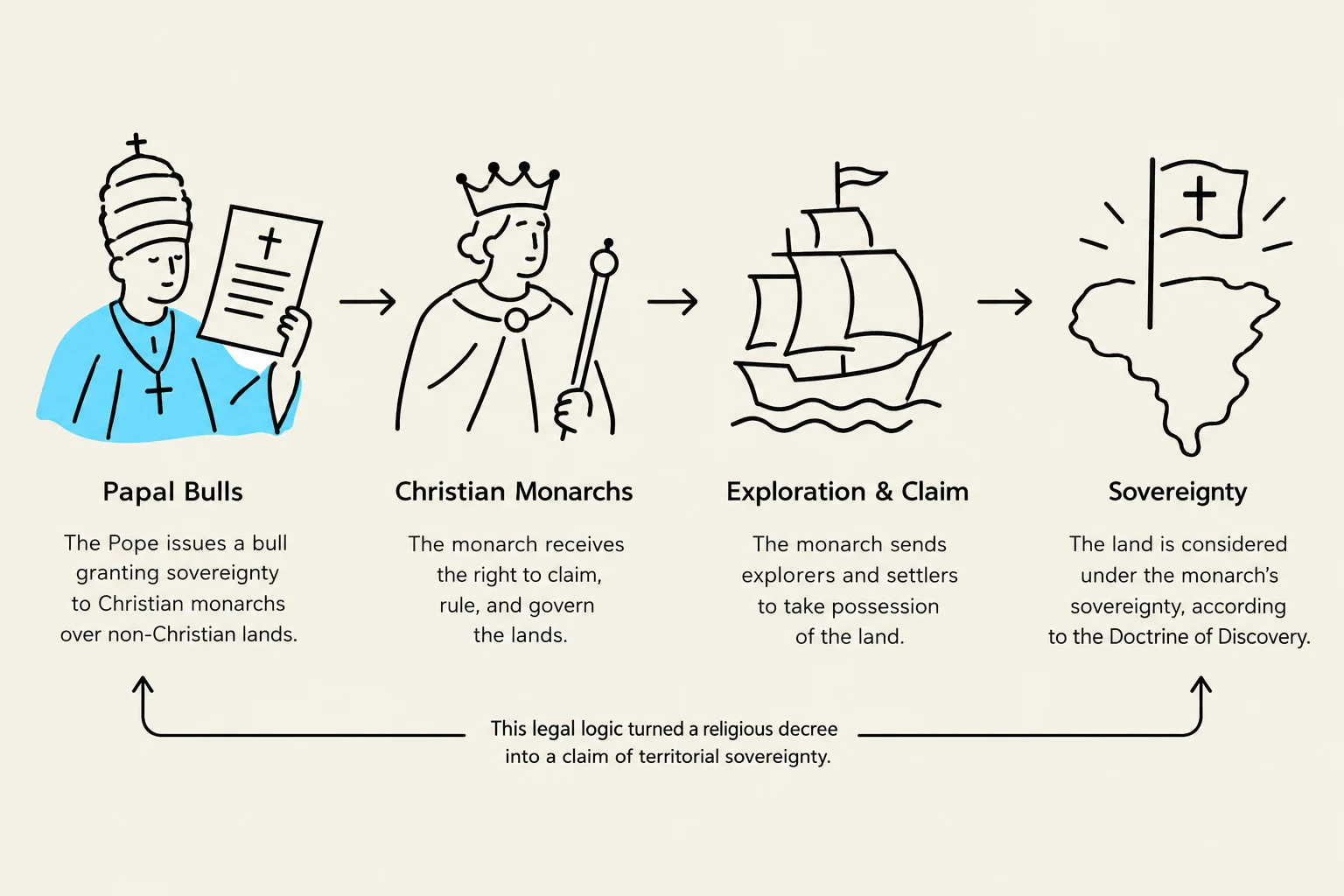
While Indigenous nations maintained their own histories and governance, European powers utilized a legal framework known as the Doctrine of Discovery to justify the seizure of land. This doctrine was rooted in 15th-century Papal Bulls, such as Inter Caetera, which granted Christian monarchs the right to claim "undiscovered" lands that were not under the sovereignty of a Christian prince.
This legal concept fundamentally altered the status of Indian land title. It suggested that European "discovery" granted the discovering nation the exclusive right to extinguish Indigenous land titles and grant the soil to its citizens.
This diagram illustrates the historical concept of the Doctrine of Discovery, showing how papal bulls granted Christian monarchs sovereignty over non-Christian lands, leading to exploration, claim, and eventual sovereignty.
Landmark Legal Battles: Marshall's Jurisprudence
The application of the Doctrine of Discovery was solidified in the United States through the decisions of the Supreme Court, most notably by Chief Justice John Marshall.
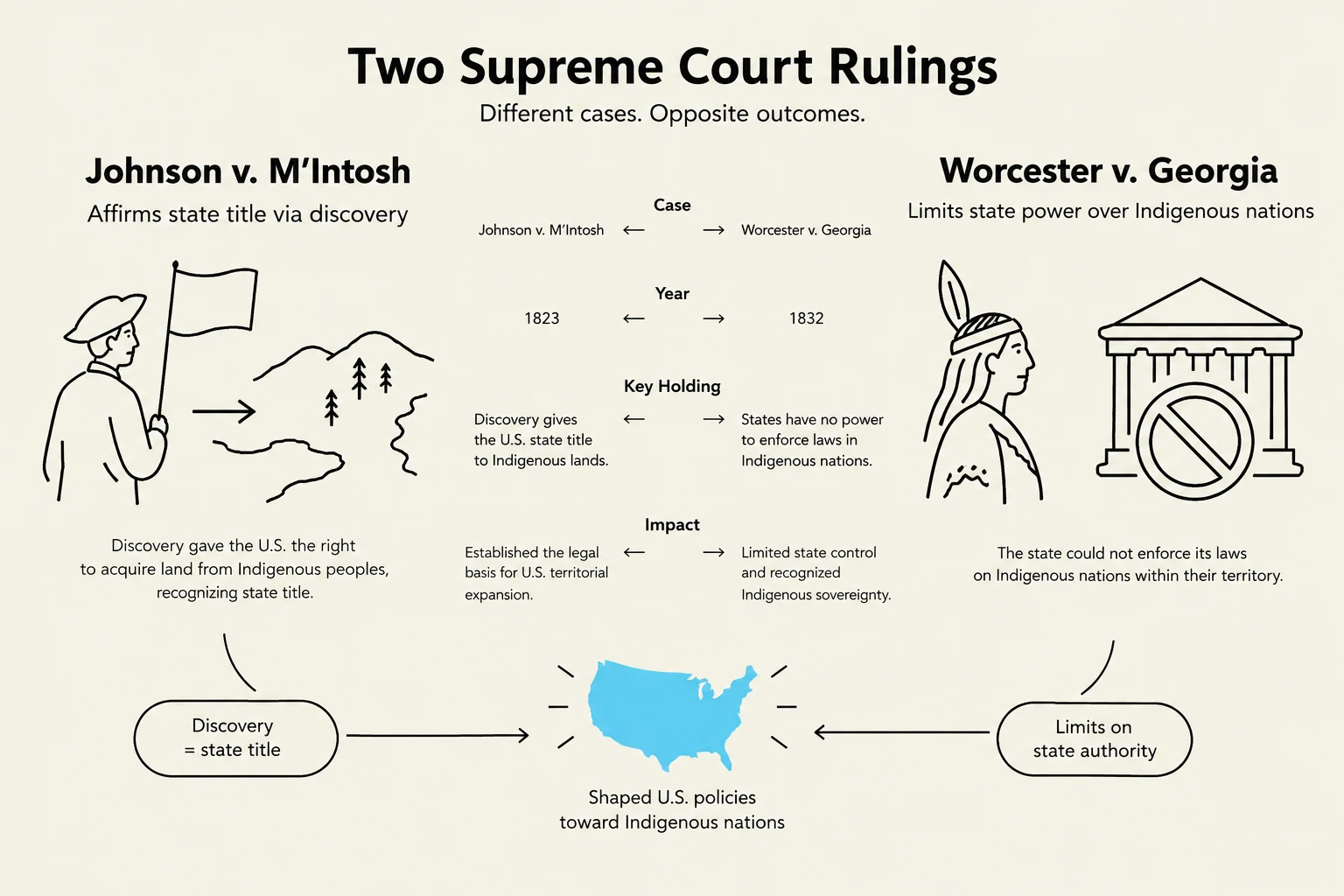
Johnson v. M’Intosh (1823)
In this landmark case, Marshall affirmed that the United States held title to land based on the Doctrine of Discovery. This ruling effectively limited Indigenous sovereignty by stating that while Indigenous peoples had a right to occupy the land, they did not hold full ownership that could be sold to anyone other than the discovering nation.
Worcester v. Georgia (1832)
Marshall’s jurisprudence was not entirely one-sided. In Worcester v. Georgia, he attempted to mitigate the doctrine's harshness to protect tribal sovereignty. He argued that:
The Doctrine of Discovery only regulated rights among European discoverers.
It did not diminish the rights of original occupants to possess or sell their land to others.
In his view, the "discovery right" was the exclusive right of the nation to purchase land, but it did not automatically extinguish the inherent rights of the Indigenous people to manage their own territory.
This diagram illustrates two landmark Supreme Court rulings, Johnson v. M'Intosh and Worcester v. Georgia, highlighting their contrasting impacts on state authority and Indigenous nations.
Exam Note: Be prepared to discuss the tension in Marshall's rulings. While Worcester attempted to preserve sovereignty, the legal foundation laid in Johnson remained the primary tool for the expansion of settler-state authority and the eventual implementation of Indian removal policies.
Summary of Legal Implications
The interplay between religious mandates, oral histories, and legal doctrines created a landscape where Indigenous rights were constantly being negotiated and redefined. While the Doctrine of Discovery was often used as a "fiction dressed in legal costume" to facilitate land dispossession, the persistence of Indigenous oral traditions and the legal struggles for sovereignty continue to challenge the legitimacy of these historical frameworks.
Keep reading for free.
Create an account to finish this reading and make it part of your study routine.