Improving Clinical Care Instructions: Bedpan Procedure Revisions
This document details revisions made in March 2018 to clinical training and healthcare documentation, specifically focusing on the "Assists with Use of Bedpan" skill protocol. It explains the shift from passive to active language for client coverage and the streamlining of equipment disposal steps to enhance clarity, p
In clinical training and healthcare documentation, the precision of language is just as important as the physical execution of a task. Small changes in how a procedure is written can significantly impact how a caregiver performs that task at the bedside. As of the March 2018 update, specific revisions were implemented regarding the "Assists with Use of Bedpan" skill protocol to improve clarity, promote proactive client dignity, and streamline operational workflows.
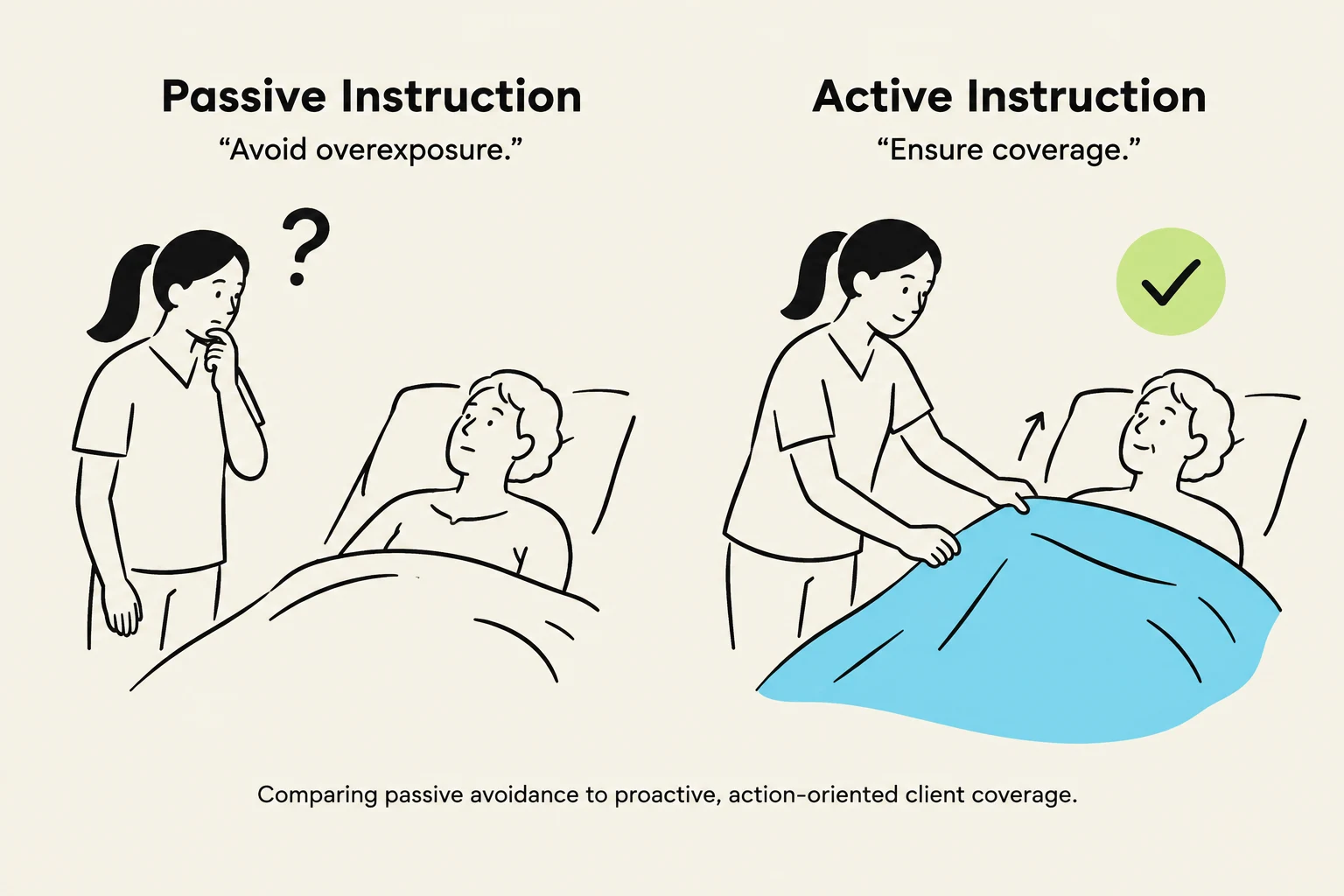
Comparing passive avoidance to proactive, action-oriented client coverage.
These revisions focus on two primary areas: the way we describe client coverage and the way we document the disposal of equipment in dirty supply areas. By moving away from vague, outcome-based descriptions and toward direct, action-oriented instructions, the updated notes provide a clearer roadmap for caregivers.
Enhancing Client Dignity through Proactive Coverage
One of the most significant changes involves the language used in Step 13 of the bedpan procedure. Previously, the instructional note for this step used the phrase "avoids overexposure of client".
While "avoiding overexposure" describes a goal, it is a passive way of instructing a caregiver. In a clinical setting, a passive instruction tells you what not to do, rather than what to do. This can lead to ambiguity; a student might wonder, "How much exposure is too much?" or "Am I doing enough to avoid it?"
The revised instruction replaces this with: "Ensures client is covered except when placing and removing bedpan".
Why This Change Matters
The shift from "avoiding a negative" to "ensuring a positive" is a fundamental principle of high-quality clinical instruction.
Direct Action: "Ensures" is a verb that requires a specific, measurable action. The caregiver must actively check that the client is covered.
Clarity of Scope: The new phrasing explicitly defines the exceptions—specifically, that coverage may be adjusted only during the actual placement or removal of the bedpan.
Focus on Dignity: By making "ensuring coverage" the standard, the protocol moves from a mindset of "preventing embarrassment" to a mindset of "actively maintaining dignity."
Clinical Tip: When performing tasks that require exposing a client's body, always use a bath blanket or sheet to cover all areas not essential to the procedure. This proactive approach is the gold standard for maintaining client privacy and comfort.
Streamlining Equipment Disposal and Workflow
The second set of revisions involves the omission of certain descriptive phrases in Step 15. These changes were designed to simplify the workflow and remove redundant language that does not add value to the core requirement of the task.
In the original documentation, Step 15 contained specific conditional phrases that have since been removed. Specifically, the following components were omitted:
The instruction "After rinsing bedpan".
The instruction "After placing bedpan in designated dirty supply area".
Understanding the Omissions
At first glance, removing instructions might seem counterintuitive. However, in the context of standardized skill checklists, these omissions serve to focus the caregiver on the action rather than the sequence of descriptions.
The primary goal of Step 15 is the bedpan placement within the dirty supply area. By removing the "After [X]" qualifiers, the documentation becomes more concise. The caregiver already knows the sequence of the procedure (emptying/rinsing occurs in Step 14, followed by placement in Step 15). Including these phrases in every step can create "clutter" in the instructional notes, making it harder to identify the essential requirements of the skill.
Summary of Procedural Changes
To help students prepare for skills assessments, the following table summarizes the transition from the old instructional style to the current March 2018 standard.
Skill 4 - Assists with Use of BedpanFigure 1: The updated skills assessment checklist showing the revised steps for bedpan assistance.
Feature
Old Instruction Style
New Instruction Style (Post-March 2018)
Purpose of Change
Client Coverage
"avoids overexposure of client"
"Ensures client is covered..."
Shift from passive avoidance to proactive action.
Step 15 Complexity
Included "After rinsing..." and "After placing..."
Simplified/Omitted redundant phrases
Streamlining workflow and reducing documentation clutter.
Practical Application: A Worked Example
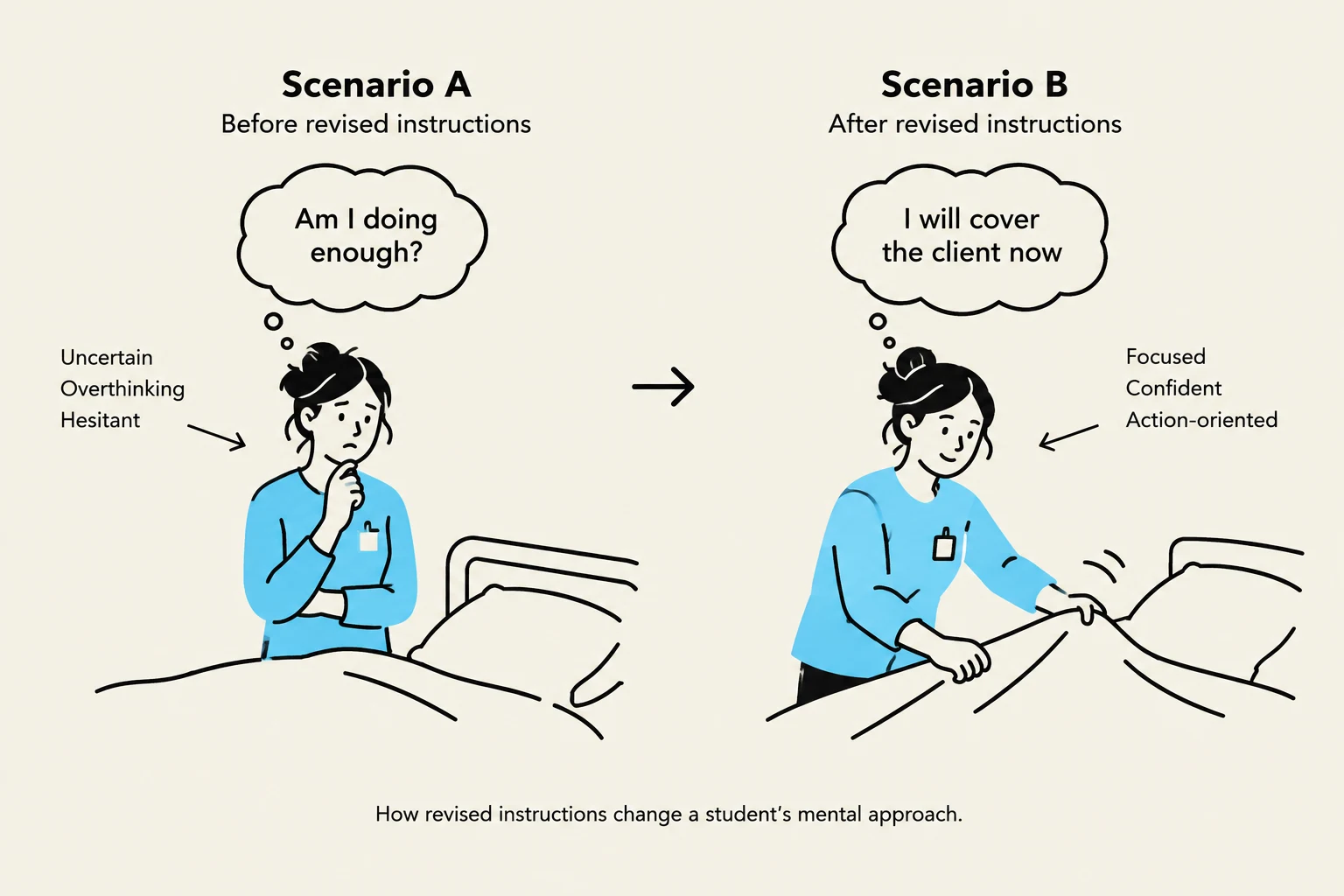
This illustration depicts how revised instructions can positively impact a student's mental approach, transforming uncertainty and hesitation into focus, confidence, and action-orientation.
Imagine you are a nursing student performing "Skill 4 - Assists with Use of Bedpan" during a practical exam.
Scenario A (Old Protocol):
You finish positioning the client. You look at your checklist, which says "avoids overexposure." You think to yourself, "I hope I'm not exposing too much of them." You are focused on not making a mistake.
Scenario B (Current Protocol):
You finish positioning the client. You look at your checklist, which says "Ensures client is covered." You immediately reach for the sheet to pull it up over the client's torso, leaving only the necessary area exposed for the bedpan. You are focused on performing a specific, positive action.
The Result:
Scenario B is safer, more professional, and easier to grade. The instructor can see a clear, completed action (the client is covered) rather than having to guess if you successfully "avoided" something.
Exam Tip: During skills testing, always verbalize your actions. Instead of just moving a sheet, say, "I am ensuring the client is covered to maintain their privacy." This demonstrates to your evaluator that you understand the intent behind the revised instructional notes.
Conclusion
The March 2018 revisions to the instructional notes for client care are more than just minor edits; they represent a shift toward professional standardization. By refining the language around client coverage and streamlining the steps for bedpan placement in the dirty supply area, the protocol ensures that caregivers are focused on direct, meaningful actions that prioritize both client dignity and operational efficiency.
Keep reading for free.
Create an account to finish this reading and make it part of your study routine.