Implicit Prices, Value of a Statistical Life, and Behavioral Economics
This article explains how economists value non-market goods using hedonic pricing, calculate the Value of a Statistical Life (VSL), and explore how behavioral economics challenges traditional models of rationality with concepts like prospect theory and cognitive biases.
In environmental economics, one of the most difficult challenges is assigning a monetary value to things that are not traded in a traditional market, such as clean air, water clarity, or a reduction in mortality risk. Because these "goods" often lack a price tag, economists use specialized methods to infer value from observed human behavior. This article explores how we derive these values through hedonic pricing, how we calculate the value of a statistical life, and how the psychological realities of human decision-making—behavioral economics—complicate our traditional models of rationality.
Measuring Environmental Value: Hedonic Pricing
When an environmental amenity (like a park) or a disamenity (like pollution) affects a market, its value is often "hidden" within the price of a related good. This is known as the hedonic pricing method. In real estate, for example, the price of a home is a function of its internal characteristics (bedrooms, square footage) and its external environmental quality.
The Implicit Price and Marginal WTP
The implicit price is the specific portion of a good's price that is attributed to a single environmental attribute. We can see this in a "two-lake model": if two identical lakes exist, but Lake A undergoes a water clarity improvement, the demand for homes near Lake A will increase. This excess demand drives up house prices until a new equilibrium is reached. The difference in price between the two sets of homes represents the implicit price of that improved clarity.
Mathematically, we express the price of a house P as a function of housing characteristics x and environmental quality q:
$P = P(x, q)$
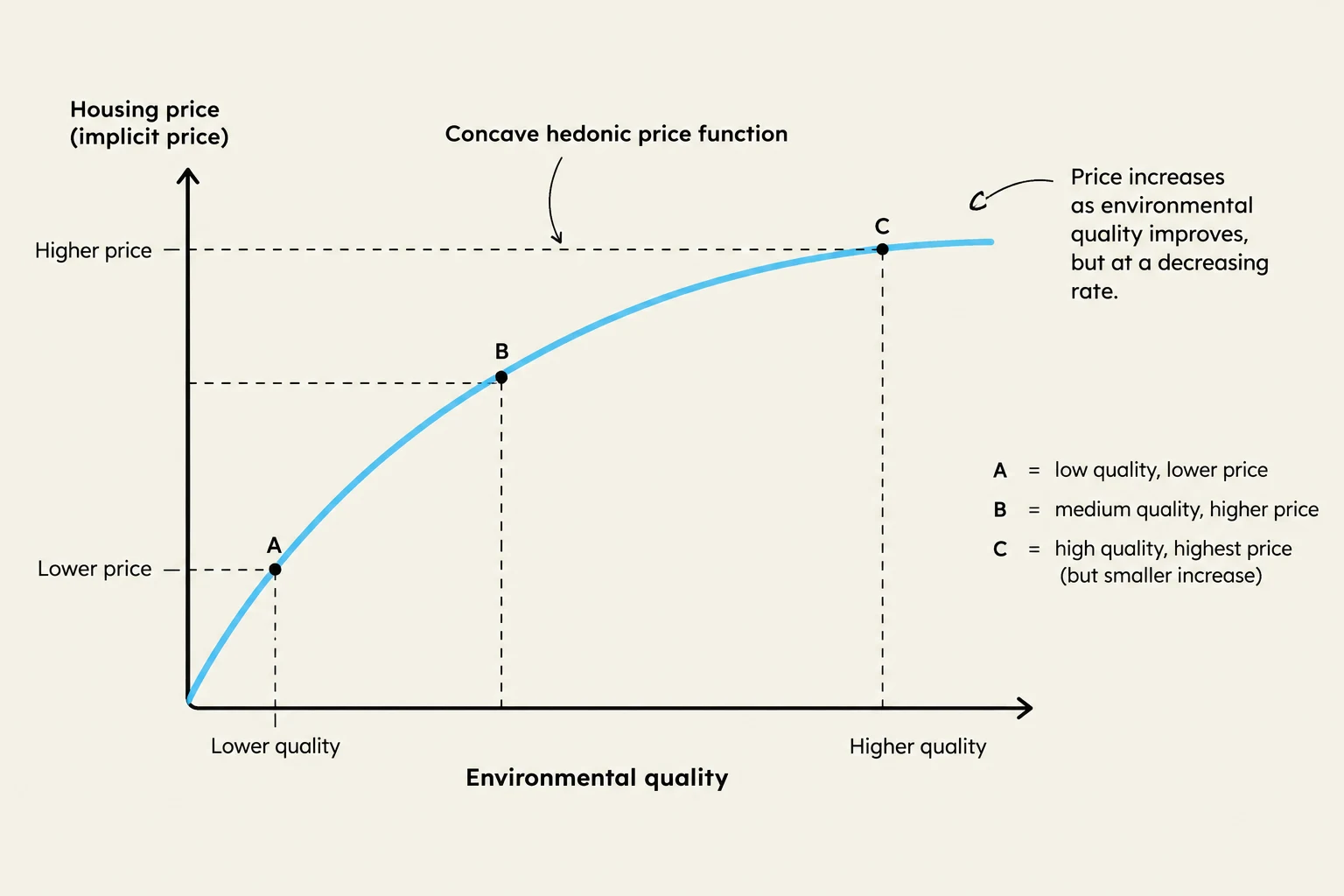
The implicit price is the marginal willingness to pay (WTP), which is the derivative of the price with respect to the environmental quality:
dqdP
A concave hedonic price function illustrates how housing prices increase with environmental quality, but at a diminishing rate. Points A, B, and C represent increasing levels of quality and price, with the price increase slowing down at higher quality levels.
Rosen’s Two-Stage Approach
To move from simple price observations to a full welfare analysis, economists use Rosen’s two-stage approach:
Stage One: Regress house prices on various characteristics to isolate the implicit prices (the marginal WTP) for each attribute.
Stage Two: Regress those derived implicit prices on household characteristics (like income) to recover the actual demand curve for the environmental good.
Real-World Applications: Superfund and Sea Level Rise
Empirical studies have used these methods to quantify environmental risks. Research on Superfund cleanups has shown that proximity to contaminated sites affects property values, with some studies finding significant price drops (up to 18%) for the most affected homes.
Similarly, studies on Sea Level Rise (SLR) demonstrate the capitalization of future risks. Homes exposed to even one foot of SLR may sell for 15% less than identical homes in safer areas. Interestingly, while home prices (capital values) drop significantly, rents may remain relatively unaffected because the impacts of SLR are long-term, and current rental values are discounted heavily.
Exam Tip: Remember that the hedonic price curve P(q) is typically concave (increasing at a decreasing rate). This means the implicit price dqdP is downward-sloping, representing a standard demand curve for the environmental attribute.
The Value of a Statistical Life (VSL)
When policymakers debate safety regulations, they must decide how much a reduction in mortality risk is worth. This is captured by the Value of a Statistical Life (VSL). It is crucial to understand that VSL does not represent the value of a specific individual life; rather, it is the aggregate willingness to pay (WTP) of a population for a small reduction in the probability of death.
For example, if 100,000 people are each willing to pay $100 to reduce their risk of dying by 1/100,000, the total WTP to save one "statistical life" is:
VSL=100,000×$100=$10,000,000
The Hedonic Wage Approach
One common way to estimate VSL is through the hedonic wage approach. This method looks at the labor market to see if workers demand higher wages to compensate for increased mortality risk (p) in certain jobs. If we model wages (w) as a function of risk:
w=f(worker characteristics, job characteristics, p)
The coefficient on the risk variable p tells us the wage premium required for a unit of risk. To find the VSL, we scale this premium by the relevant population or risk unit.
This metric is a cornerstone of benefit-cost analyses. For instance, the EPA uses a recommended VSL (approximately $7.4 million in 2006 dollars) to evaluate the social benefits of mortality-reducing environmental regulations.
Behavioral Economics: Beyond Rationality
Traditional economic models assume "perfect rationality," where individuals make optimal decisions based on all available information. Behavioral economics challenges this by introducing the concept of bounded rationality—the idea that humans have limited attention, memory, and processing capacity.
Prospect Theory and Loss Aversion
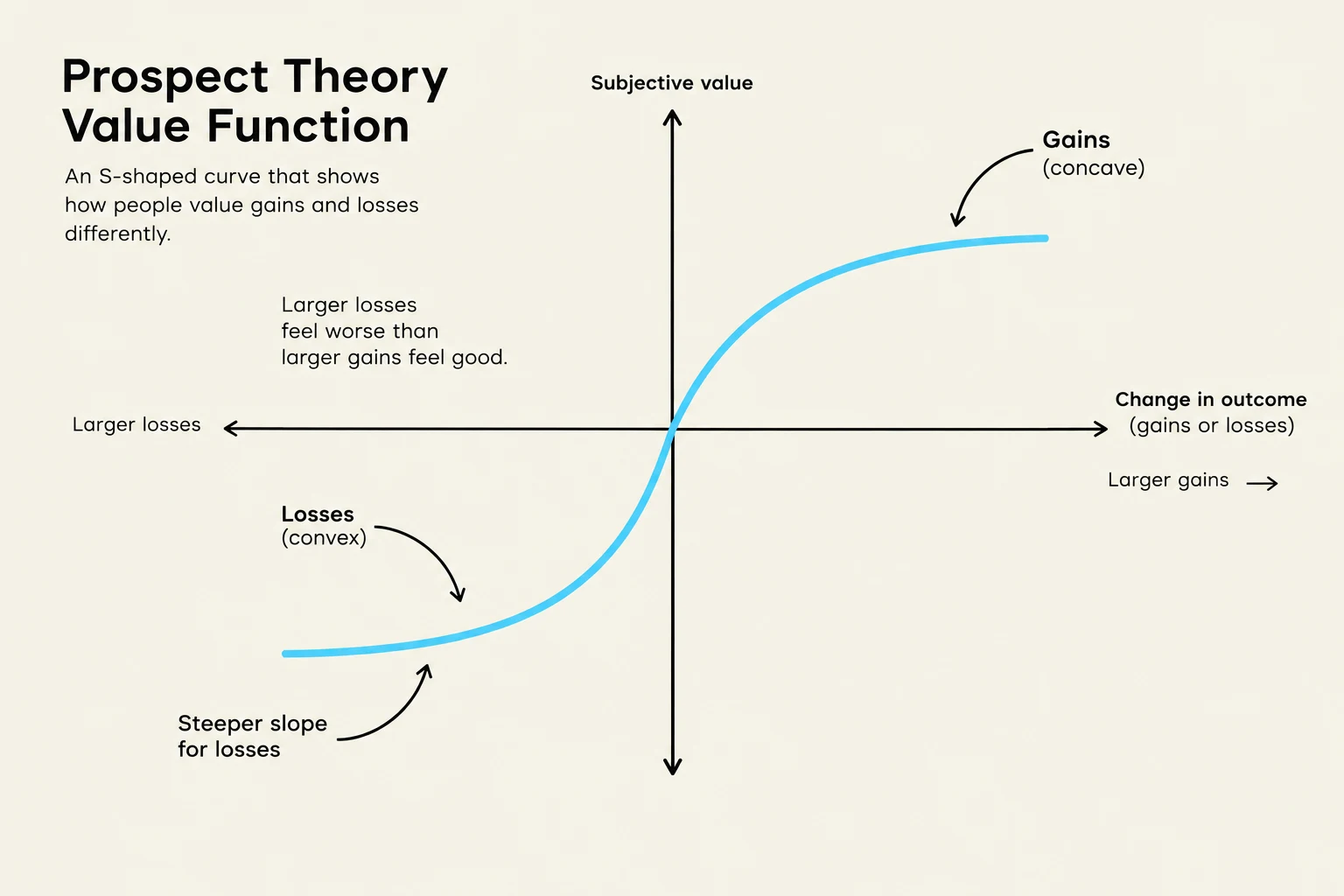
Developed by Kahneman and Tversky, Prospect Theory suggests that people do not evaluate outcomes in absolute terms, but rather relative to a reference point. This leads to two critical phenomena:
Loss Aversion: The psychological pain of a loss is felt much more intensely (often twice as much) than the pleasure of an equivalent gain.
Asymmetric Risk Preferences: People tend to be risk-averse when facing potential gains but become risk-seeking when trying to avoid certain losses.
Heuristics, Biases, and Framing
Because our cognitive resources are limited, we rely on heuristics—mental shortcuts—which can lead to systematic errors or biases:
Anchoring: Being overly influenced by an initial number or piece of information.
Availability: Judging the probability of an event based on how easily examples come to mind.
Representativeness: Judging the likelihood of something based on how much it resembles a stereotype.
Furthermore, framing effects demonstrate that how information is presented can fundamentally change decisions. For example, a policy described as "saving 200 lives" will elicit different support than one described as "allowing 400 people to die," even if the underlying statistical outcome is identical.
The Prospect Theory Value Function illustrates how individuals perceive gains and losses differently, with losses feeling more impactful than equivalent gains.
In the context of climate change, these behavioral traits can be detrimental. Bounded rationality may cause people to focus on "easy" individual actions (like recycling) while ignoring high-impact systemic interventions (like carbon pricing) because the latter are harder to process or feel more distant.
Keep reading for free.
Create an account to finish this reading and make it part of your study routine.