Ideological Collisions: A History of Modern Europe (1914-1991)
Examines the violent and transformative period in modern European history marked by collisions between Liberal Democracy, Fascism, and Communism, from WWI to the collapse of the Soviet Union.
The history of modern Europe is not a linear progression of stability, but rather a violent and transformative series of collisions between radical political ideologies. From the wreckage of the First World War to the sudden collapse of the Soviet Union, the continent was a laboratory for competing visions of how human society should be organized. This period was defined by the struggle between Liberal Democracy, Fascism, and Communism—three frameworks that sought to redefine the relationship between the individual, the state, and the concept of social class.
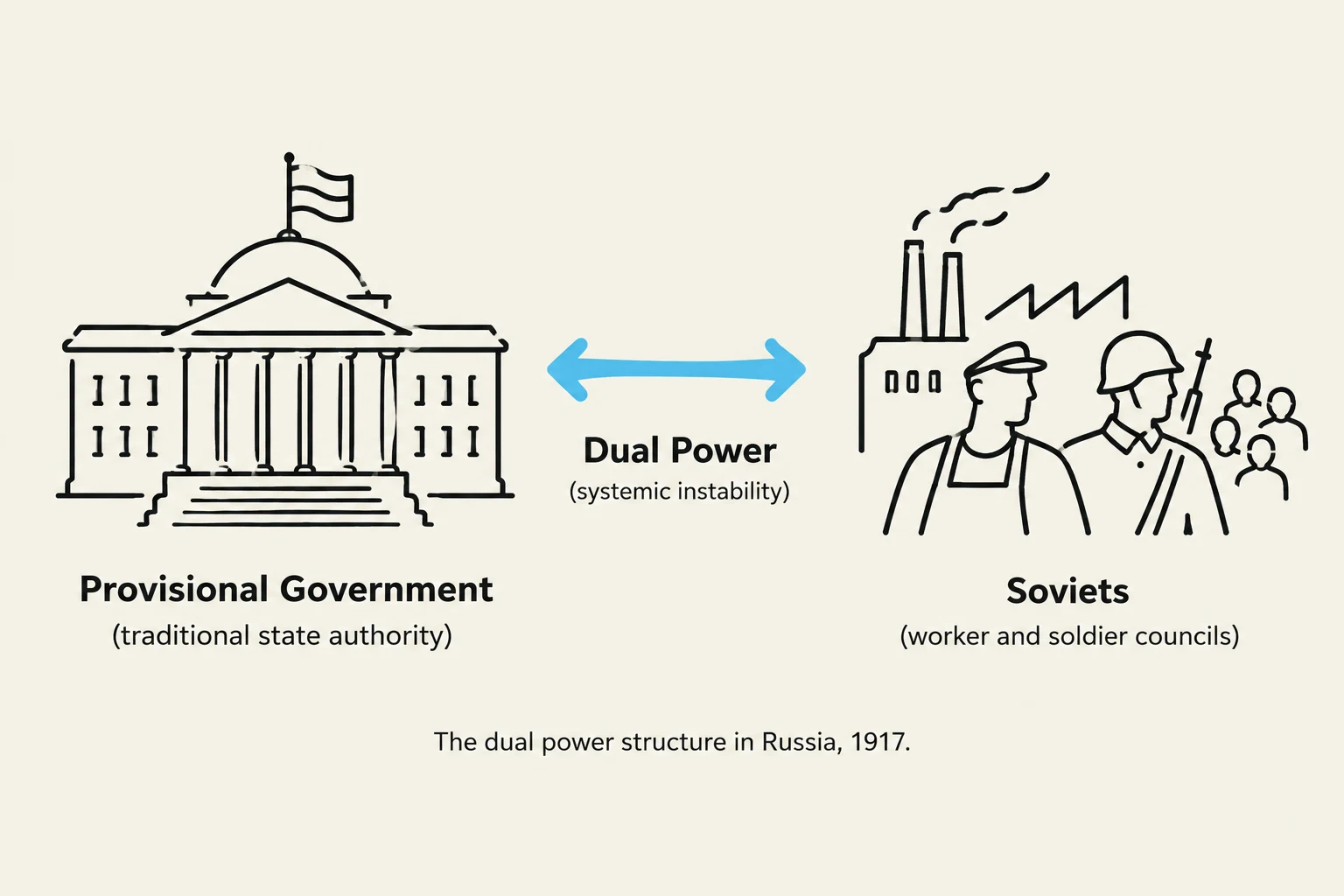
A diagram illustrating the dual power structure in Russia in 1917, contrasting the Provisional Government with the Soviets.
The Great War and the Collapse of Empires
The early 20th century was marked by the catastrophic impact of World War I (1914–1918). The conflict pitted the Allied Powers (including Tsarist Russia, France, and Great Britain) against the Central Powers (Germany, Austria-Hungary, and the Ottoman Empire). The war acted as a catalyst for total systemic change, leading to the simultaneous collapse of four major empires: the German, Russian, Austro-Hungarian, and Ottoman.
In Russia, the strain of the war triggered the Russian Revolution of 1917. Following the abdication of Tsar Nicholas II during the February Revolution, a period of "dual power" emerged between a provisional government and local worker/soldier councils known as Soviets. This instability allowed Vladimir Lenin and the Bolsheviks to seize power in October 1917, establishing the world's first socialist state.
The Rise of Totalitarianism and the Interwar Crisis
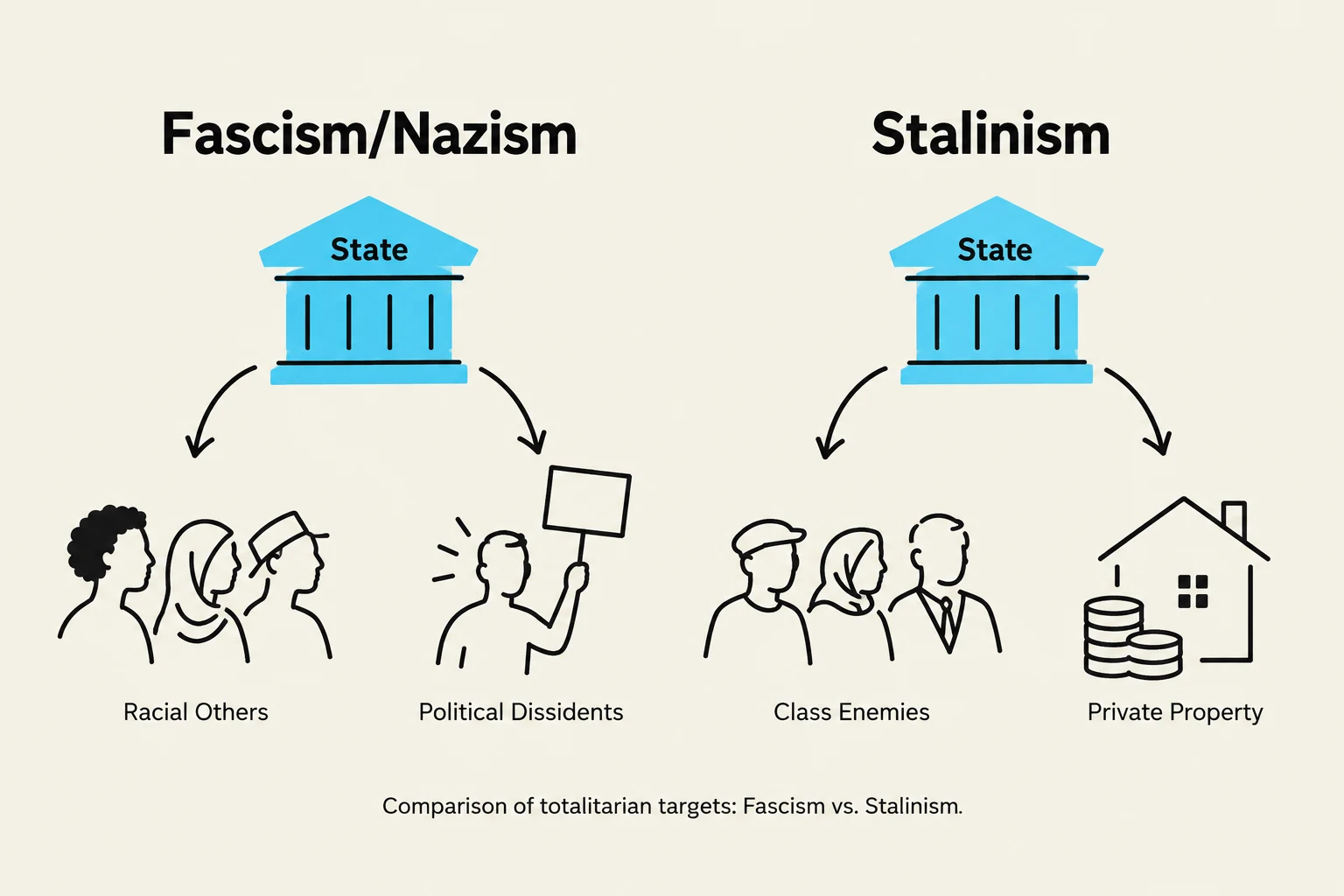
Comparison of totalitarian targets: Fascism vs. Stalinism.
The aftermath of WWI left Europe in a state of profound economic and psychological fragility. In Germany, the transition to the Weimar Republic was marred by the "Stab-in-the-Back" myth (Dolchstoßlegende), a false narrative propagated by conservative elites claiming the army had been betrayed by domestic traitors like Social Democrats and Jews. This resentment, coupled with the economic devastation of the Great Depression, provided fertile ground for radicalization.
As parliamentary democracies struggled, two forms of Totalitarianism rose to prominence:
Fascism: Pioneered by Benito Mussolini in Italy, this ideology emphasized a cult of leadership and the total subordination of the individual to the state.
Nazism: In Germany, Adolf Hitler utilized the promise of national rebirth and racial pride to dismantle democracy. The Nazi regime implemented the concept of Volksgemeinschaft—a racial people's community that demanded the surrender of all private and class identities to the state.
While both regimes utilized state terror and propaganda, they differed in their core objectives. Fascism sought national expansion and the suppression of class struggle while often preserving private industry under state supervision. In contrast, Stalinism in the Soviet Union sought a classless global order through the total abolition of private property and the implementation of a command economy. Under Joseph Stalin, this included forced collectivization, which led to catastrophic famines such as the Holodomor in Ukraine.
Exam Tip: Distinguishing Totalitarianism
When analyzing the difference between Nazi Fascism and Stalinist Communism, focus on the target of the state's violence. Fascism primarily targets "racial others" and political dissidents to achieve national/racial supremacy, whereas Stalinism targets "class enemies" to achieve a socio-economic restructuring.
The Cold War: A Continent Divided
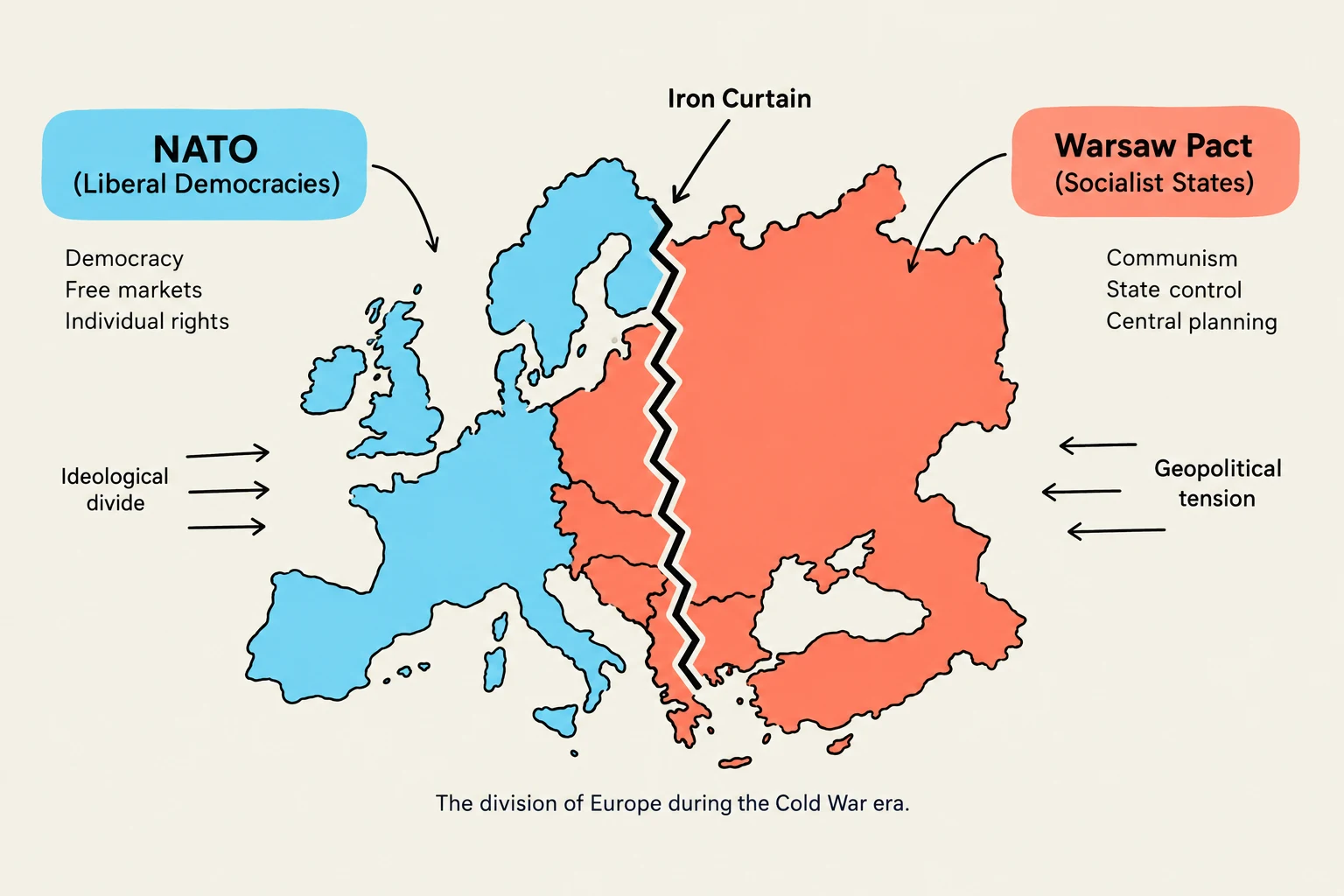
A map illustrating the division of Europe during the Cold War, with NATO (Liberal Democracies) on one side and the Warsaw Pact (Socialist States) on the other, separated by the Iron Curtain and marked by ideological divides and geopolitical tension.
The end of World War II did not bring peace, but rather a new form of systemic confrontation. Europe was bisected by the Iron Curtain, separating the Western liberal democracies from the Eastern socialist states.
The West: Aligned under NATO (1949), Western Europe focused on economic recovery through the Marshall Plan, which provided the "seed money" for reconstruction and served as a strategic tool for the containment of communism. This era also saw the beginnings of European integration, starting with the European Coal and Steel Community (ECSC) to prevent future conflict through economic interdependence.
The East: Aligned under the Warsaw Pact (1955), the Eastern Bloc operated under central planning. This system often suffered from structural scarcity and the rise of a "shadow market" where citizens traded stolen state goods. The Soviet Union also enforced the Brezhnev Doctrine, which asserted the right to intervene in any socialist state where the communist regime was threatened.
The Collapse of the Soviet Bloc
By the 1980s, the Soviet model faced terminal decline due to economic stagnation and an unsustainable arms race. The ascension of Mikhail Gorbachev in 1985 introduced two transformative policies: Perestroika (economic restructuring) and Glasnost (political openness). While intended to save the system, these reforms unintentionally eroded central control.
The year 1989 became the turning point for Europe. A wave of peaceful revolutions swept through the East, characterized by:
The Solidarity movement in Poland, which successfully challenged communist authority through trade unionism.
The Velvet Revolution in Czechoslovakia, where mass protests led to a peaceful transition of power.
The Fall of the Berlin Wall, which symbolized the physical and ideological collapse of the division between East and West.
The process culminated in the formal dissolution of the USSR in December 1991, marking the end of the bipolar geopolitical era and the reunification of much of the European continent.
Keep reading for free.
Create an account to finish this reading and make it part of your study routine.