


In the study of genetics, understanding how a change in a DNA sequence translates to a change in a protein is fundamental. To identify a mutation, scientists must compare a mutant sequence to a wild-type sequence—the "normal" or standard version of the gene found in nature. By analyzing the differences between a mutant polypeptide (the chain of amino acids) and the wild-type polypeptide, we can work backward to deduce the specific changes that occurred in the mRNA sequence and, ultimately, the original DNA.
The Mechanics of Mutation Identification
The process of identifying a mutation is a logical puzzle that follows a specific workflow:
- Deduce the Wild-Type mRNA: Using the known amino acid sequence of the wild-type protein and a genetic code table, determine the original mRNA codons.
- Locate the Change: Compare the mutant amino acid sequence to the wild-type. Find the exact position where the amino acids differ.
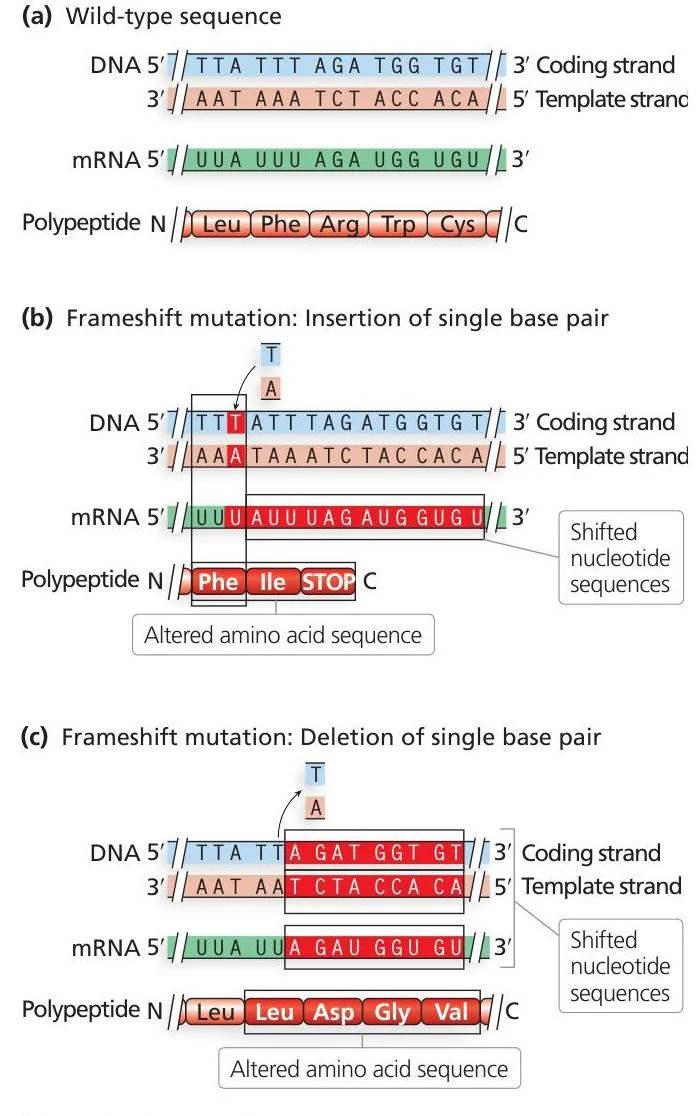
- Determine the Mutation Type: Analyze whether the change is a base-pair substitution (one nucleotide swapped for another) or an indel (an insertion or deletion of nucleotides).
It is vital to distinguish between a simple DNA replication error—a mispairing that might be caught and fixed by repair mechanisms—and a replicated error, where the mistake is not repaired and becomes a permanent part of the genome passed to future generations.
Point Mutations: Substitutions
A point mutation occurs when a single nucleotide is replaced by another. These are often categorized by their effect on the resulting protein.
Missense Mutations
A missense mutation is a substitution that results in a different amino acid being incorporated into the polypeptide. For example, if a codon for Asparagine (Asn, AAU/C) is changed to a codon for Lysine (Lys, AAA/G), the protein's function may be altered.
Keep reading for free.
Create an account to finish this reading and make it part of your study routine.
Continue reading freeAlready have an account? Log in
Updated