


In the modern business landscape, an organization is only as strong as its people. To ensure success, companies cannot simply hire people as they appear; they must engage in a systematic process that begins long before an interview takes place. This process is a continuous cycle of planning, sourcing, and evaluating talent to ensure that the right people are in the right roles at the right time.
Human Resource Planning (HRP)
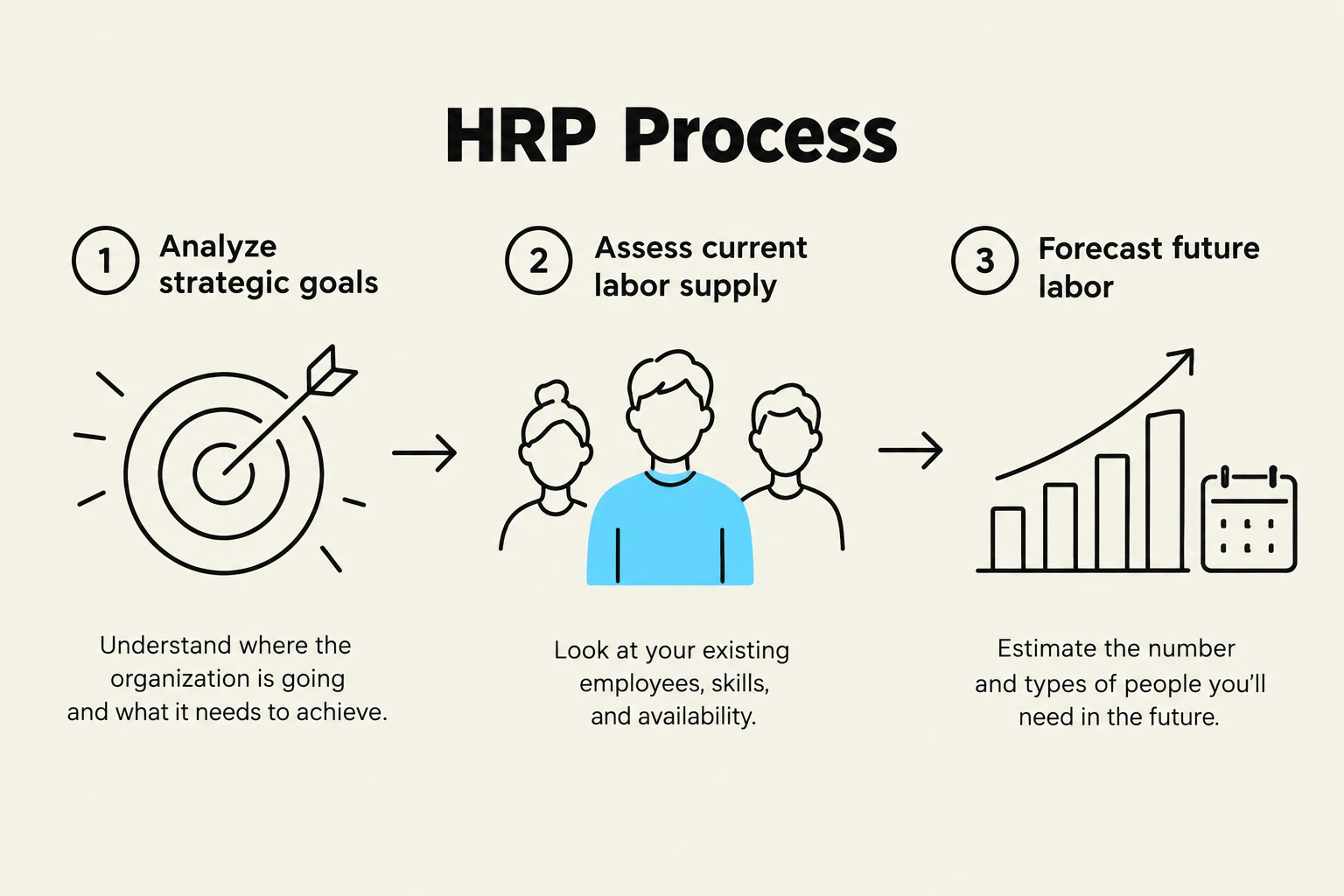
Human Resource Planning (HRP) is the strategic foundation of talent management. It is the process of ensuring an organization possesses the necessary number of employees with the required competencies, utilized effectively to achieve organizational objectives. Crucially, HRP is not an isolated HR task; it is directly linked to the organization’s broader strategic plan.
The core of HRP involves analyzing the relationship between labour demand (how many people and what skills the company needs) and labour supply (how many people are currently available or will be available in the future). This analysis helps organizations anticipate two primary outcomes:
- Oversupply of labour: Having more employees than necessary, which may lead to rising costs or layoffs.
- Shortage of labour: Having fewer employees than required to meet goals, which can lead to burnout and lost revenue.
Approaches to Effective Planning
To move from guesswork to precision, managers use several quantitative and qualitative tools:
- Trend Analysis: A quantitative method that looks at past employment levels to predict future needs.
- Management Forecasts: Qualitative predictions where managers use their professional knowledge and opinions to estimate future needs.
- Staffing Tables: Graphic representations that allow managers to visualize internal job positions and their current distributions.
- Markov Analysis: A mathematical approach used to track the patterns of employee movements (promotions, transfers, exits) within the organization over time.
- Skills Inventory: A comprehensive database containing detailed information regarding the current competencies and skills of the existing workforce.

Keep reading for free.
Create an account to finish this reading and make it part of your study routine.
Continue reading freeAlready have an account? Log in
Updated