The human body is a masterpiece of biological engineering, organized into levels of increasing complexity. At the highest level, the organism is composed of various organ systems that must work in harmony to maintain life. These systems do not operate in isolation; rather, they are interdependent, meaning the function of one system often relies on the input or output of another. To ensure these vital organs function safely, the body provides specialized spaces known as body cavities, which offer physical protection and structural organization.
The Eleven Organ Systems
Organ systems are groups of organs that collaborate to accomplish complex physiological tasks. While we often study them individually, they are constantly communicating to maintain homeostasis—the stable internal environment necessary for survival.
Support, Movement, and Protection
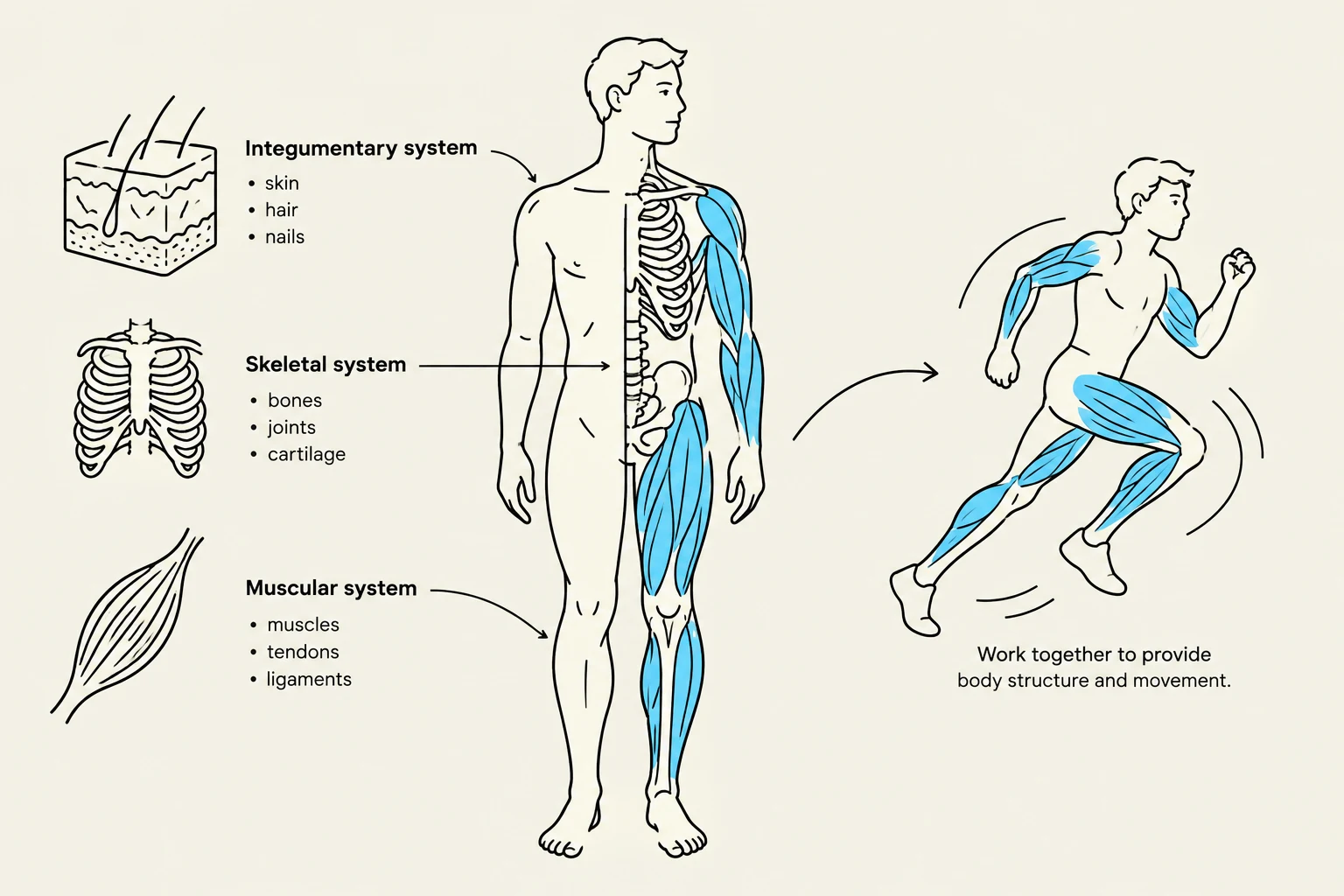
The body's physical structure is maintained by the interaction of the integumentary, skeletal, and muscular systems.
Integumentary System: This is the body's external covering. It serves as a barrier, contains glands, houses sensory receptors, and plays a crucial role in producing Vitamin D.
Skeletal System: This system provides the rigid framework that supports the body and protects internal organs. It also serves as an essential attachment point for muscles.
Muscular System: Working alongside the skeleton, the muscular system enables movement, helps maintain posture, and is a primary generator of body heat.
Diagram illustrating the integumentary, skeletal, and muscular systems of the human body, and how they work together for structure and movement.
Control and Regulation
To coordinate these physical movements and maintain internal balance, the body relies on the nervous and endocrine systems.
Nervous System: Acting as the body's rapid-response control center, this system detects and responds to both internal and external stimuli.
Endocrine System: While the nervous system uses electrical signals, the endocrine system uses chemical signals. It consists of glands that secrete hormones to regulate long-term processes such as metabolism, growth, and reproduction.
Transport, Defense, and Maintenance
The internal environment is constantly being monitored, cleaned, and replenished by the cardiovascular, lymphatic, respiratory, urinary, and digestive systems.
Cardiovascular System: This system acts as the body's transport network, pumping blood to deliver oxygen, nutrients, and hormones while removing carbon dioxide and metabolic waste.
Respiratory System: To support the cardiovascular system, the respiratory system supplies oxygen to the blood and facilitates the removal of carbon dioxide.
Lymphatic System: This system serves as a secondary circulatory route, collecting fluid from tissues and housing white blood cells to support immune function.
Digestive System: This system processes the fuel required for life by breaking down food into absorbable units for the bloodstream and eliminating solid waste.
Urinary System: To maintain the chemical balance of the blood, the urinary system regulates water, electrolytes, and acid-base levels.
Reproduction
Reproductive System: While not vital for the survival of the individual organism, this system is essential for the survival of the species through the generation of offspring.
Body Cavities: Protection and Organization
The organs of the body are not loosely floating; they are housed within specific spaces called body cavities. These cavities serve two main purposes: protecting the organs from injury and providing organized compartments for different organ systems.
Cavities are broadly categorized into two types: open cavities and closed cavities.
Open Cavities
Open cavities are those that communicate directly with the external environment. Examples include:
The oral cavity (mouth)
The nasal cavity
The digestive cavity
The orbital cavities (eyes)
The external ear
Closed Cavities
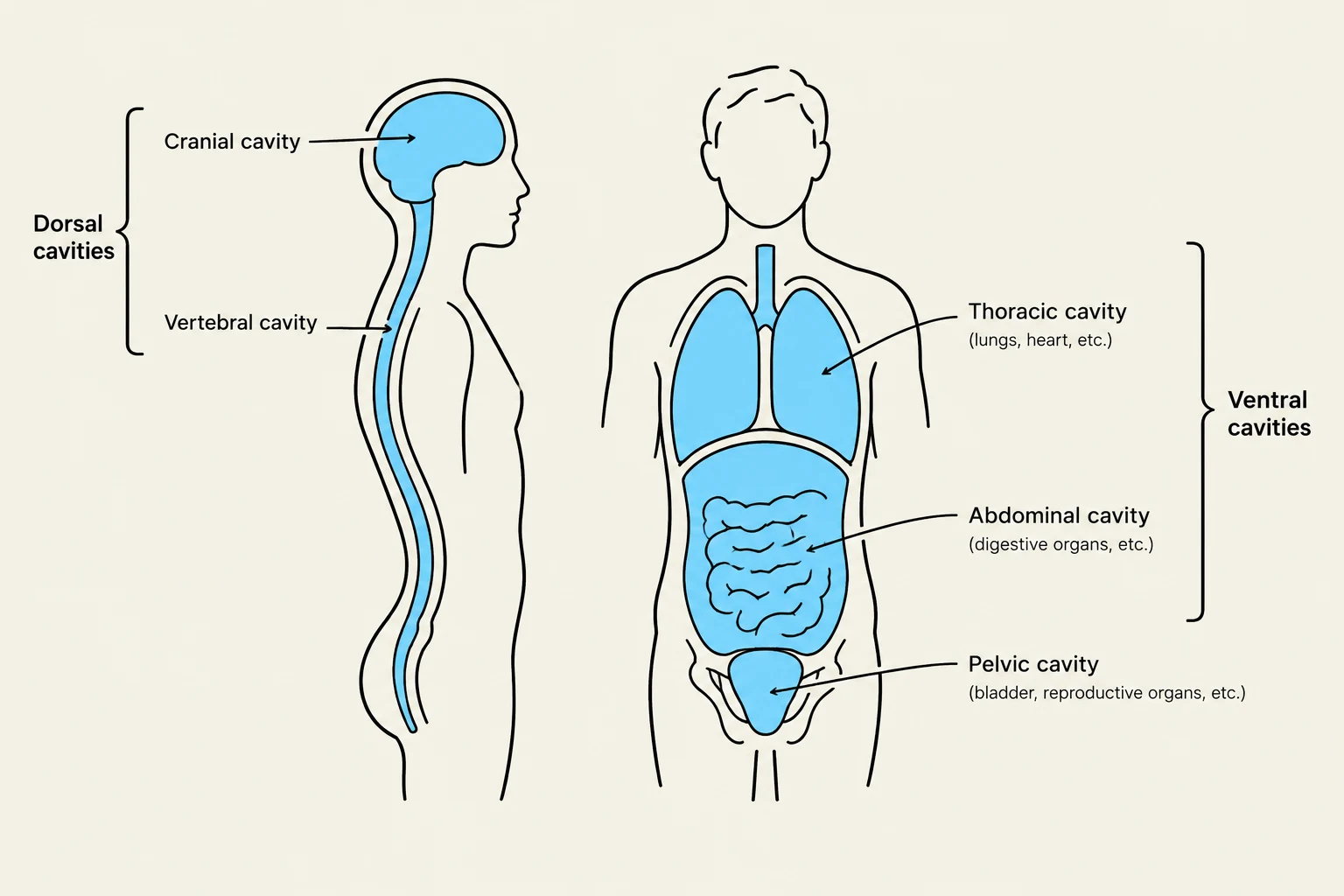
Closed cavities are internal compartments that are not open to the outside. These are divided into two major groups based on their location: the Dorsal Cavities and the Ventral Cavities.
1. Dorsal Cavities
Located at the posterior (back) of the body, the dorsal cavities protect the vital components of the central nervous system.
Cranial Cavity: Houses and protects the brain.
Vertebral Cavity: Protects the spinal cord (vertebral column).
Diagram illustrating the dorsal and ventral cavities of the human body, including the cranial, vertebral, thoracic, abdominal, and pelvic cavities.
2. Ventral Cavities
Located at the anterior (front) of the body, the ventral cavities are much larger and house the visceral organs (internal organs). This group is further subdivided into three main areas:
Thoracic Cavity: The upper portion of the ventral cavity, containing organs like the heart and lungs.
Abdominal Cavity: The middle portion, containing digestive organs.
Pelvic Cavity: The lower portion, containing reproductive and urinary organs.
Exam Tip: When identifying cavities, remember that "Dorsal" refers to the back (posterior) and "Ventral" refers to the front (anterior). If a question asks about the protection of the brain, look for the Cranial Cavity within the Dorsal group!
Summary Table: Cavity Overview
Cavity Group
Specific Cavity
Primary Contents/Protection
Dorsal
Cranial
Brain
Dorsal
Vertebral
Spinal Cord
Ventral
Thoracic
Heart, Lungs
Ventral
Abdominal
Digestive Organs
Ventral
Pelvic
Reproductive/Urinary Organs
Keep reading for free.
Create an account to finish this reading and make it part of your study routine.