Explore the fundamental laws of energy in biological systems, the role of ATP as the energy currency, and the body's mechanisms for ATP resynthesis through the phosphagen, anaerobic glycolysis, and aerobic metabolism systems.
To understand how the human body moves, breathes, and performs exercise, we must first understand the fundamental laws of energy. In biological systems, energy is defined as the ability to do work or cause change. According to the Law of Conservation of Energy, energy cannot be created or destroyed; it can only change from one form to another.
In the context of exercise physiology, we distinguish between energy (the total capacity to do work) and power (the rate at which that energy is used or delivered). While energy is measured in joules (J), power is measured in watts (W). For a cell to function, it must convert potential energy—energy stored in chemical bonds—into free energy, which is the energy liberated and available to do work.
The Energy Currency: ATP
The primary molecule used to drive cellular work is Adenosine Triphosphate (ATP). ATP consists of an adenine nucleotide, a ribose sugar, and three inorganic phosphate groups. When the body needs to perform a task, it breaks a high-energy phosphate bond through a process called hydrolysis:
ATP+H2O→ADP+Pi−7.3 kcal/mol
This reaction is exergonic, meaning it releases energy. However, there is a significant physiological problem: we do not store much ATP. The body stores only about 100g of ATP, which provides roughly 1.4 kcal—an amount far too small to meet even a fraction of our daily energy needs. To survive and perform exercise, the body must constantly engage in ATP resynthesis—the process of rebuilding ATP from Adenosine Diphosphate (ADP) and inorganic phosphate (Pi).
Exam Tip: If a question asks how the body compensates for the lack of stored ATP, remember the two-part answer: 1) We store large amounts of energy in other forms (Glycogen, Fat, Protein), and 2) We use various metabolic pathways to rapidly resynthesize ATP.
Energy Storage: The Fuel Reservoirs
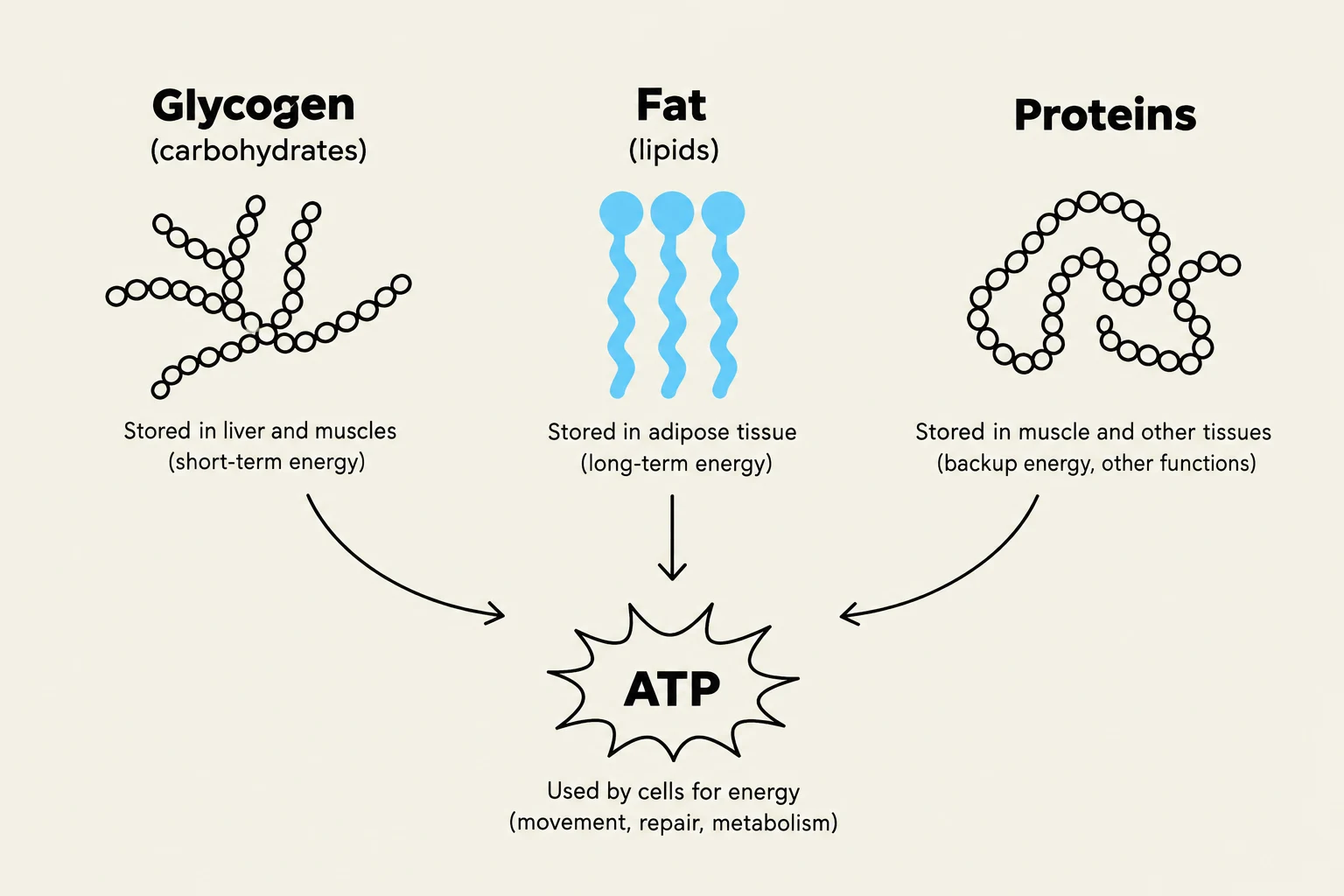
Since ATP cannot be stored in large quantities, the body relies on macronutrients to act as long-term reservoirs. These stores provide the "potential energy" that can be converted into "free energy" during metabolic processes.
Glycogen: Carbohydrates are stored primarily as glycogen in the muscles and liver. Glycogen is a critical fuel because it is the only substrate that can be used for anaerobic metabolism.
Fat: Triacylglycerols are stored within muscle fibers or circulate as lipoproteins. Fats are broken down through a process called β-oxidation to produce energy.
Proteins: While not a primary energy source, proteins can be used for fuel, particularly under extreme conditions.
This diagram illustrates how glycogen, fat, and proteins are stored in the body and used to produce ATP, the energy currency of cells.
The Phosphagen System (ATP-CP System)
When you engage in a maximal effort, such as a heavy sprint or a 1-repetition maximum lift, your body requires ATP almost instantaneously. The fastest way to resynthesize ATP is through the phosphagen system, also known as the ATP-CP system.
This system utilizes phosphocreatine (CP), a high-energy molecule that acts as an immediate energy reservoir. During high-intensity work, the enzyme creatine kinase facilitates the transfer of a phosphate group from CP to ADP, rapidly regenerating ATP:
ADP+CP→ATP+C
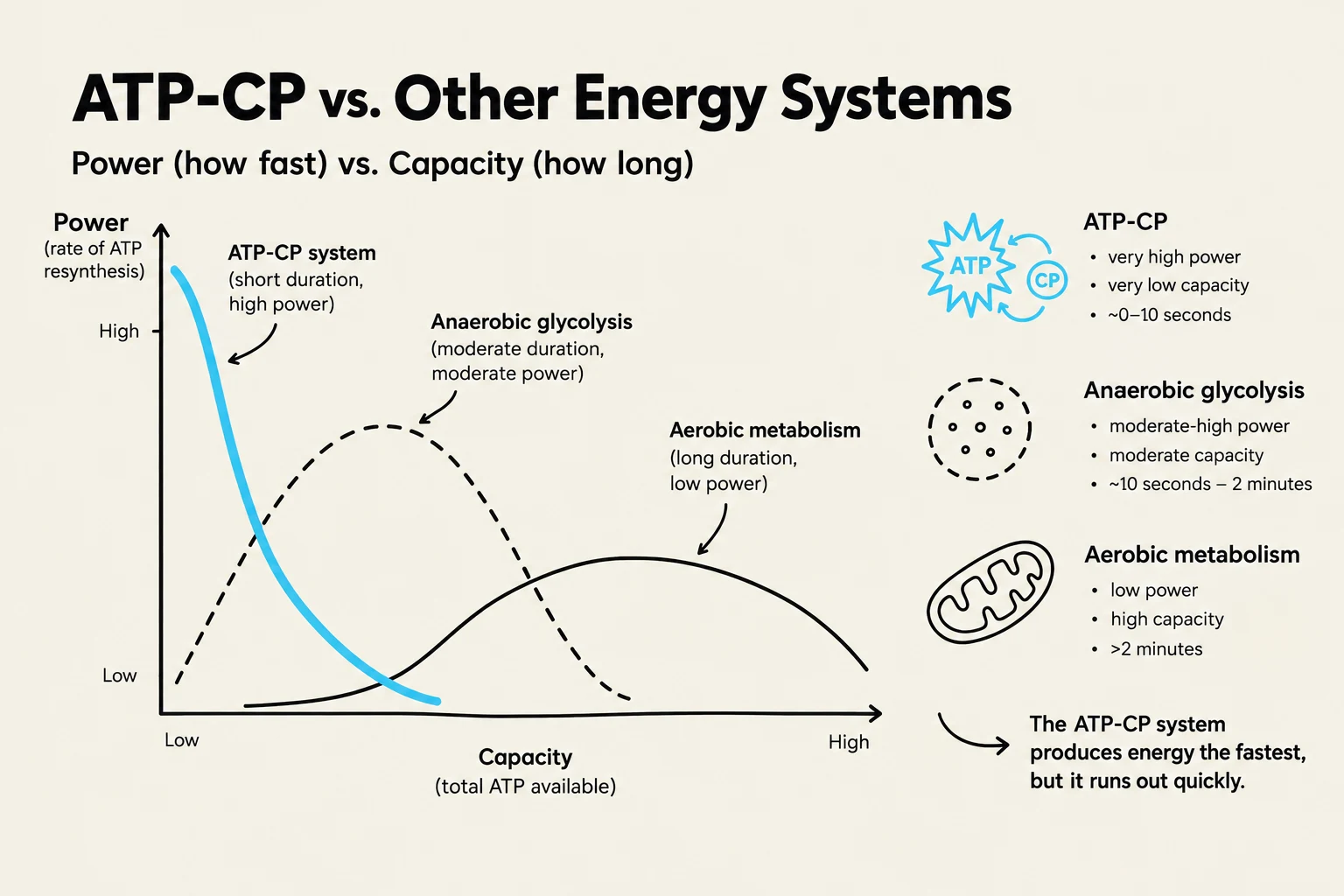
The ATP-CP system is characterized by its incredible speed but very limited duration. It provides the highest max power but has a low max capacity.
System
Max Power (kcal/min)
Max Capacity (kcal)
ATP-CP System
36
11.1
Anaerobic Glycolysis
16
15
This graph illustrates the relationship between power and capacity for three different energy systems in the human body: ATP-CP, anaerobic glycolysis, and aerobic metabolism. It shows how each system provides energy at different rates and for different durations.
Anaerobic Glycolysis and the Role of Lactate
As the phosphagen stores deplete, the body shifts toward anaerobic glycolysis. This pathway breaks down glucose/glycogen to produce ATP without the immediate need for oxygen.
During high-intensity activity, the energy demand exceeds the body's ability to supply oxygen to the mitochondria. When this happens, the respiratory chain cannot process all the NADH produced, and the system faces a shortage of NAD+. To solve this, the body uses an alternate pathway: pyruvate is converted into lactate. This conversion is vital because it frees up NAD+, allowing glycolysis to continue producing ATP in the absence of sufficient oxygen.
The lactate produced is not merely a waste product; it can be transported via the blood to the liver, where it undergoes the Cori cycle to be converted back into glucose or glycogen through gluconeogenesis.
Aerobic Metabolism: The Long-Term Solution
For light to moderate intensity activity, the body relies on aerobic metabolism, which is much more efficient at producing large amounts of ATP but is slower to respond to sudden changes in demand. This process involves three main stages:
Aerobic Glycolysis: Glucose is converted into pyruvate.
Krebs Cycle (Citric Acid Cycle): Pyruvate enters the mitochondria and is converted into Acetyl-CoA, which then enters the Krebs cycle. This cycle produces electron carriers like NADH and FADH2.
Electron Transport Chain (ETC): Located on the cristae of the mitochondrion, the ETC uses the electrons from NADH and FADH2 to drive the production of a large volume of ATP.
While the ATP-CP system provides a burst of 36 kcal/min, the aerobic system is the engine of endurance. For example, the complete oxidation of one glucose molecule yields approximately 32 ATP.
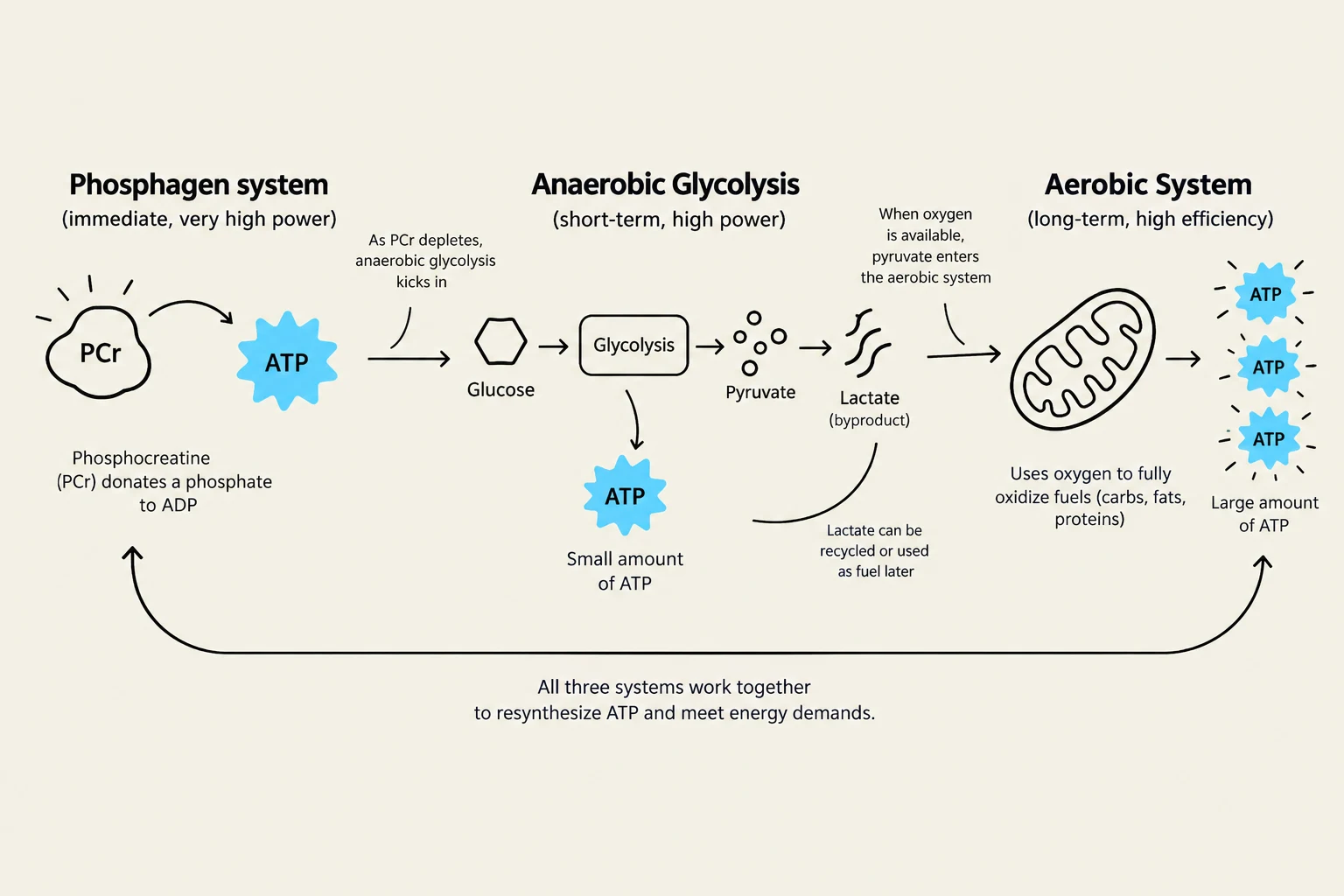
This diagram illustrates the three main energy systems in the human body: the phosphagen system, anaerobic glycolysis, and the aerobic system, detailing their roles in ATP production during different types of physical activity.
Key Takeaway: All macronutrients except carbohydrates require aerobic metabolism to generate ATP. This means that if you are performing strictly anaerobic work, carbohydrates are your only viable fuel source.
Keep reading for free.
Create an account to finish this reading and make it part of your study routine.