The human digestive system breaks down food into nutrients through mechanical and chemical processes, involving various organs like the stomach, small intestine, and large intestine, and accessory organs such as the pancreas and liver. It covers digestion, absorption, and elimination.
The human digestive system is a complex biological network designed to perform extracellular digestion—the process of breaking down food into constituent organic molecules within the lumen of the alimentary canal. This system allows the body to extract essential nutrients, such as monosaccharides, amino acids, and fatty acids, from food and transport them into the circulatory system for distribution to tissues. The entire process is regulated by the enteric nervous system, which manages rhythmic contractions known as peristalsis. While the enteric system can function independently, it is heavily influenced by the autonomic nervous system: the parasympathetic nervous system upregulates digestive activities (promoting secretion and motility), while the sympathetic nervous system downregulates them.
The Mechanics and Chemistry of Digestion
Digestion is categorized into two distinct but complementary processes: mechanical digestion and chemical digestion.
Mechanical Digestion: This involves the physical breakdown of large food particles into smaller ones without breaking chemical bonds. An example is mastication (chewing) in the oral cavity, which increases the surface-area-to-volume ratio of food, making it more accessible to enzymes.
Chemical Digestion: This is the enzymatic cleavage of chemical bonds, such as the peptide bonds in proteins or the glycosidic bonds in starches.
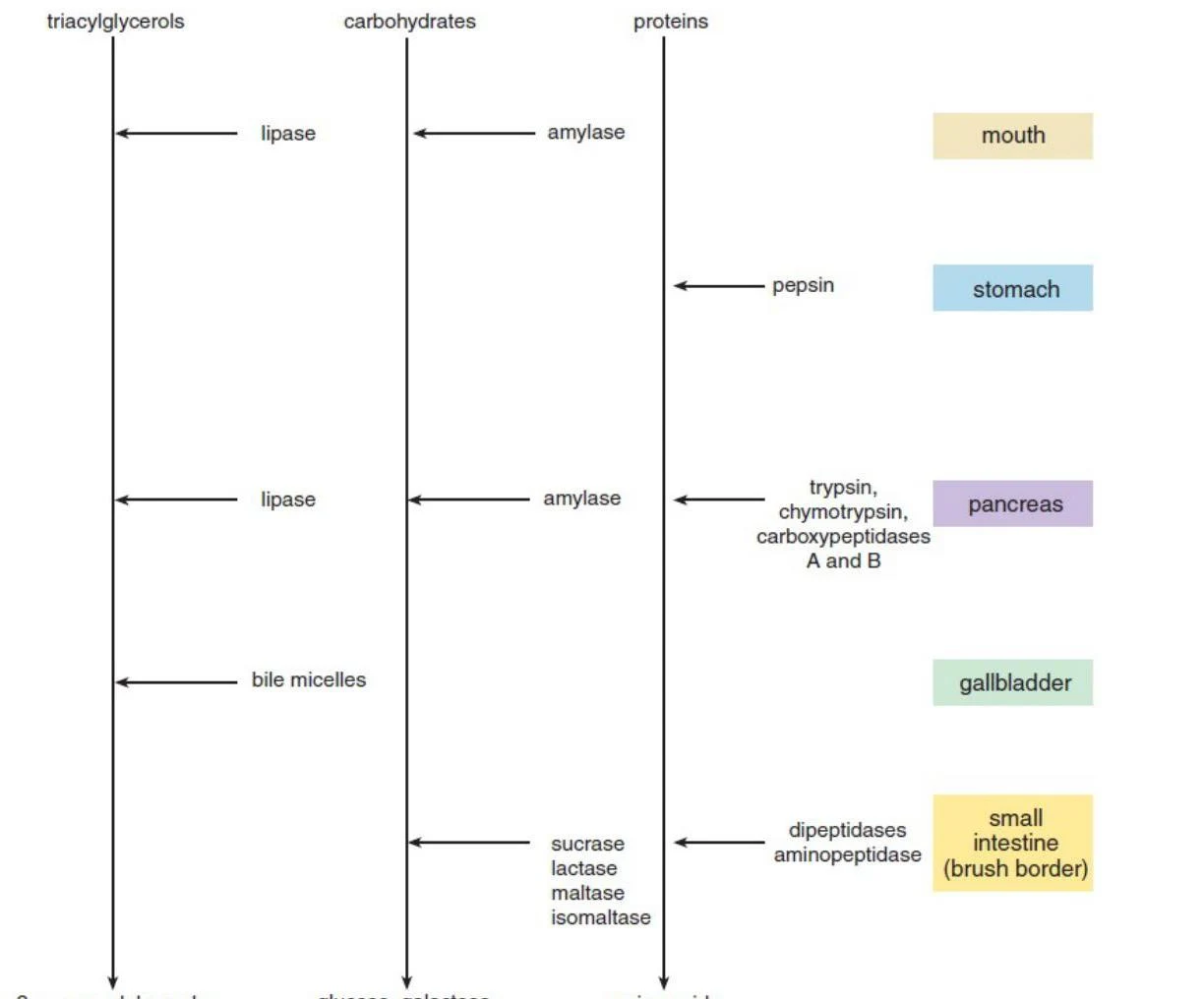
This diagram illustrates the digestion of triacylglycerols, carbohydrates, and proteins in different parts of the digestive system, including the mouth, stomach, pancreas, gallbladder, and small intestine.
The Anatomical Pathway: From Mouth to Stomach
The journey of food begins in the oral cavity, where mastication and the secretion of saliva initiate digestion. Saliva contains salivary amylase (which targets soluble starches) and lipase (which begins lipid hydrolysis). Once food is formed into a bolus, it passes through the pharynx and into the esophagus. The esophagus uses peristalsis to propel the bolus toward the stomach, eventually passing through the lower esophageal sphincter.
The stomach serves as a highly muscular reservoir that converts food into a semifluid mixture called chyme. The stomach's mucosa is protected by bicarbonate-rich mucus, but it maintains a highly acidic environment (pH ≈ 2) to denature proteins and kill microbes. Key secretory cells include:
Parietal cells: Secrete HCl and intrinsic factor (required for Vitamin B12 absorption).
Chief cells: Secrete pepsinogen, an inactive zymogen that is cleaved into the active protease pepsin by the acidic environment.
G-cells: Secrete the hormone gastrin, which stimulates HCl production and increases gastric motility.
The Small Intestine: The Hub of Digestion and Absorption
The small intestine is divided into three segments: the duodenum, the jejunum, and the ileum. While the duodenum is the primary site of chemical digestion, the jejunum and ileum are the primary sites of nutrient absorption.
Chemical Regulation in the Duodenum
When chyme enters the duodenum, several hormones and enzymes are deployed to finalize the breakdown of macromolecules:
Secretin: Stimulates the pancreas to release bicarbonate-rich juices to neutralize stomach acid and slows motility.
Cholecystokinin (CCK): Stimulates the release of bile from the gallbladder and pancreatic juices, and promotes satiety.
Brush-border enzymes: Located on the luminal surface of the intestinal cells, these include disaccharidases (like maltase, lactase, and sucrase) to break down sugars, and peptidases (like dipeptidases) to break down peptides.
The Role of Accessory Organs
The pancreas and liver are essential accessory organs that provide the necessary tools for digestion.
Pancreas: Produces pancreatic juices containing bicarbonate and enzymes such as pancreatic amylase, pancreatic lipase, and various proteases (e.g., trypsinogen).
Liver and Gallbladder: The liver synthesizes bile, which is stored and concentrated in the gallbladder. Bile contains bile salts that are critical for the mechanical digestion of fats. Bile salts emulsify large fat globules into smaller micelles, vastly increasing the surface area for pancreatic lipase to perform chemical digestion.
Absorption Mechanisms
Absorption occurs across the specialized surface of the small intestine, which is lined with villi and microvilli to maximize surface area. The method of absorption depends on the solubility of the nutrient:
Water-soluble nutrients: Monosaccharides, amino acids, water-soluble vitamins (B complex and C), and water are absorbed across the endothelial cells and enter the capillary bed.
Diagram illustrating the absorption of nutrients like glucose, galactose, fructose, amino acids, and peptides from the small intestine into the bloodstream, highlighting the role of sodium and ATPase in transport.
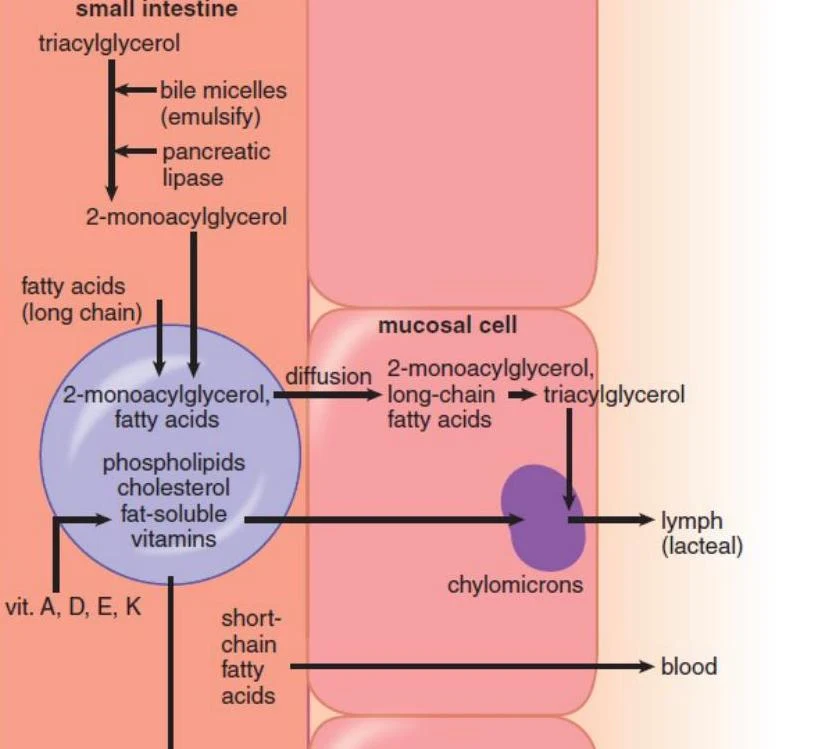
Fat-soluble nutrients: Fats, cholesterol, and fat-soluble vitamins (A, D, E, and K) are packaged into chylomicrons and enter the lacteals, which are part of the lymphatic system.
Diagram illustrating the absorption of fats in the small intestine, showing the breakdown of triacylglycerol by bile micelles and pancreatic lipase, and the subsequent transport of fatty acids and vitamins into mucosal cells and then into lymph or blood.
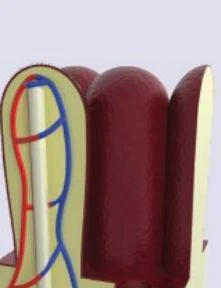
A diagram illustrating blood vessels within a structure.
The Large Intestine and Elimination
The final stage of the digestive process occurs in the large intestine, which consists of the cecum, the colon, and the rectum. Unlike the small intestine, the large intestine's primary role is the absorption of water and salts to concentrate undigested material into feces.
The cecum receives fluid from the small intestine and is the attachment site for the appendix. The colon (comprising ascending, transverse, descending, and sigmoid portions) absorbs the remaining water and electrolytes. Finally, the rectum stores feces until they are eliminated through the anus via the internal and external anal sphincters.
Exam Tip: Remember that while the large intestine is vital for water reabsorption, the small intestine actually absorbs a much larger total volume of water. Massive, watery diarrhea is often a sign of small intestine dysfunction or infection.
Summary Table: Key Digestive Secretions
Organ
Secretion
Primary Function
Stomach
HCl
Denatures proteins, activates pepsinogen
Stomach
Pepsinogen
Precursor to pepsin (protein digestion)
Pancreas
Bicarbonate
Neutralizes acidic chyme in duodenum
Liver
Bile Salts
Emulsifies fats (mechanical digestion)
Duodenum
Secretin
Stimulates pancreatic bicarbonate release
Keep reading for free.
Create an account to finish this reading and make it part of your study routine.